At Ground Zero, after the last living person was pulled out, the search dogs stopped eating.
So the police did something nobody had written down in any manual.
They climbed into the rubble, lay down, and pretended to be alive.
More than 300 dogs worked the World Trade Center site. They came from every corner of the country, on trucks and in cargo holds, with handlers who had been trained to do one thing. Find people who are still breathing under the ground.
That is what a search and rescue dog is built for. Not bodies. Life. They are trained on live human scent. When they find it, they bark, they dig, they light up, and the handler rewards them, and the whole thing means something.
The last living person recovered from Ground Zero was a woman named Genelle Guzman-McMillan. She had been buried for 27 hours. A dog found her.
She was the last.
After that, the dogs kept going out on twelve-hour shifts, across sixteen acres of smoldering steel, at temperatures that burned their paws, and they found nobody.
Nobody.
Day after day.
The handlers noticed it first. The dogs were changing. Their tails were down. They were not eating. They would come off the pile and lie flat and not look at anyone.
A veterinarian named Cindy Otto, who spent ten days there working night shifts to care for the animals, put it plainly. The dogs had been sent to find life, and every day they were finding the opposite.
It was breaking them.
An NYPD officer named Famiglietti described what happened next.
They pulled everybody off the rubble. Then they asked for volunteers.
The volunteers, police officers, went out into the debris and hid themselves. Under beams. In voids. Curled up in pockets of concrete. They were told to lie down like they were hurt. Then the handlers sent the dogs in.
Picture that.
A grown man with a badge, a man who had spent the last week pulling friends out of that same pile, lying down in it on purpose. Face down. Holding still. Waiting for a dog.
And the dog comes over the top of the wreckage, and catches the scent, and barks, and digs, and finds a person who is warm and moving and alive.
And the handler says good girl, good boy, and the whole team celebrates.
They called them mock finds.
They did it for the dogs.
They did it so the dogs would remember what they were for.
One of those dogs was a two-year-old golden retriever named Bretagne. She came from Texas with her handler, Denise Corliss. It was her first deployment. They worked ten days at Ground Zero. They found no survivors.
But firefighters would come off the pile, stone-faced, not speaking, and see the dog, and something would break open in them. They would kneel down. They would put their face in her fur.
One day a man walked up to Bretagne and started petting her. He told Corliss his best friend loved golden retrievers.
Corliss asked where his friend was.
The man pointed at the pile.
"He's in there somewhere."
He kept petting the dog.
Bretagne went on to work Hurricane Katrina and Rita. She retired at 10. She was the last known surviving search dog of 9/11.
On June 6, 2016, at age 16, she was carried into a veterinary office in Texas to be put to sleep.
Outside, a dozen firefighters from her fire department stood in a line in their dress uniforms, in the heat, and saluted as she went past.
They draped her in an American flag on the way out.
Three hundred dogs went into that pile looking for the living.
They found one.
And when they could not find any more, the men they worked beside laid down in the rubble and let themselves be found, so the dogs would not lose heart.
That is the whole story of Ground Zero, really.
Nobody could save the dead.
So they saved each other. 🇺🇸
🇺🇸 The Little Chapel That Stood
The day after the towers fell, a priest named Lyndon Harris walked down Broadway toward St. Paul’s Chapel. He had already decided it was gone. When he saw the spire, he wept.
He opened the door. Ash on the floor. The chandeliers still up. Not one window broken.
A sycamore in the northwest corner of the churchyard had caught debris, including a steel beam from the North Tower. The tree was damaged. The chapel was not.
Workers off the pile started using the porch to sit down and wash. On September 15 the Seamen’s Church Institute showed up with food and lit a grill on the sidewalk.
After that the doors stayed open. For nine months.
Cots in the pews. Eighty asleep at a time, helmets for pillows. Boots and belts marked the wood. Podiatrists set up in George Washington’s pew, the one he used after the inauguration in 1789. Massage tables in the aisle. Musicians played seven hundred times for whoever happened to be in the room.
Half a million meals were served before they closed the doors. Socks, boots, eye drops, cigarettes. Schoolchildren’s letters on the walls. The iron fence outside vanished under photographs, unit patches, teddy bears, and names.
They shut the relief operation down in early June 2002. They still ring the Bell of Hope every September 11.
St. Paul’s went up in 1766. It lived through the fire that burned Trinity in 1776. Oldest public building still in use in the city.
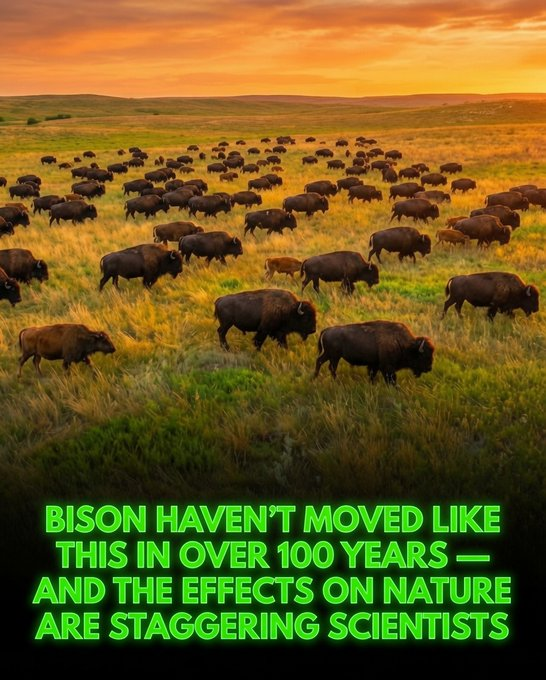
Bison are leading one of the most remarkable ecological comebacks in North American history.
For more than a century, the great herds of the American bison were fragmented, broken into isolated groups by roads, fences, and human development across the Great Plains and Yellowstone region.
Now, in a powerful wildlife success story, those artificial barriers are being overcome. On their own, bison are instinctively reuniting and reopening ancient migration corridors that had been lost for over 100 years.
This isn’t just movement: it’s a profound return to ancestral memory. Large, unified herds are once again flowing across the landscape as they did in centuries past.
As they travel, these iconic animals act as masterful ecosystem engineers. Their powerful hooves aerate compacted soil, their selective grazing encourages the growth of diverse native plants, and their dust wallows create seasonal watering holes that benefit countless other species. In doing so, they spread nutrients and help restore the health of the grasslands.
By simply allowing bison to roam freely across their historic ranges, nature is showing us that wild ecosystems recover best when their original architects are given the freedom to lead.
[Texas A&M University. After 120 Years of Conservation, Yellowstone Bison Are Now a Single Breeding Population. Journal of Heredity]
In May 1970, the senior class of Little Cypress-Mauriceville High School in Orange, Texas, booked a young, local three-piece band called ZZ Top to play their high school prom. Posing on stage with their gear for the school yearbook—which humorously printed their name as Zee Zee Top—a clean-shaven Billy Gibbons, Frank Beard, and Dusty Hill were just beginning their journey as That Little Ol' Band from Texas. Rest in Peace Frank Beard.
🎸 What is your favorite ZZ Top song?👇️
In 1945 the USS Indianapolis secretly delivered the parts for the atomic bomb that would hit Hiroshima.
Days later, mission done, a Japanese submarine put two torpedoes into her. She sank in 12 minutes.
Nearly 900 men made it off the ship alive and into the open ocean. Then it got worse.
No one knew they were missing. Three separate Navy stations picked up the distress signals and every one of them ignored it. One officer thought it was a Japanese trap. Another had ordered not to be disturbed.
So the men floated. For almost five days. No food, no fresh water, burning by day and freezing at night. Some drank seawater and went insane. And the whole time, the sharks were circling and feeding. It is considered the worst shark attack in human history.
When rescue finally came by accident, only 316 of the nearly 1,200 crew were still alive.
The Navy needed someone to blame for the disaster. They chose Captain Charles McVay, one of the men who survived it. He became the only U.S. captain in the entire war to be court-martialed for losing his ship to the enemy.
At his trial the Navy did something almost unheard of. They brought in the Japanese commander who sank the ship to testify against him. Instead, the enemy captain told the court that zigzagging would have made no difference and that McVay did nothing wrong.
They convicted him anyway.
For years afterward McVay got hate mail from the families of the dead. Some sent letters every Christmas telling him he murdered their sons. In 1968 he walked onto his front lawn and shot himself, holding a toy sailor he had kept since he was a boy.
Case closed. For fifty years.
Then in 1996 an 11-year-old named Hunter Scott watched Jaws with his dad and got hooked on the 30 second speech about the Indianapolis. He made it his sixth grade history project.
He tracked down and interviewed nearly 150 survivors. He dug through more than 800 documents. And buried in there he found what the Navy had left out, including that they knew enemy subs were operating right on the ship's route and never warned McVay.
A kid's school project turned into a national story. It reached Congress. In 2000 lawmakers passed a resolution clearing McVay's name and President Clinton signed it. The Navy officially cleared his record in 2001.
The captain the Navy spent decades blaming was finally exonerated by a sixth grader.
Hunter Scott grew up and became a naval flight officer.
You do not need to echo the talking heads. You do not need to have a hot take.
Show us instead the small, mundane, beautiful moments of your fading June. The now-waning light, the fireflies, the flowers.
All infinitely superior to The Current Thing ™.
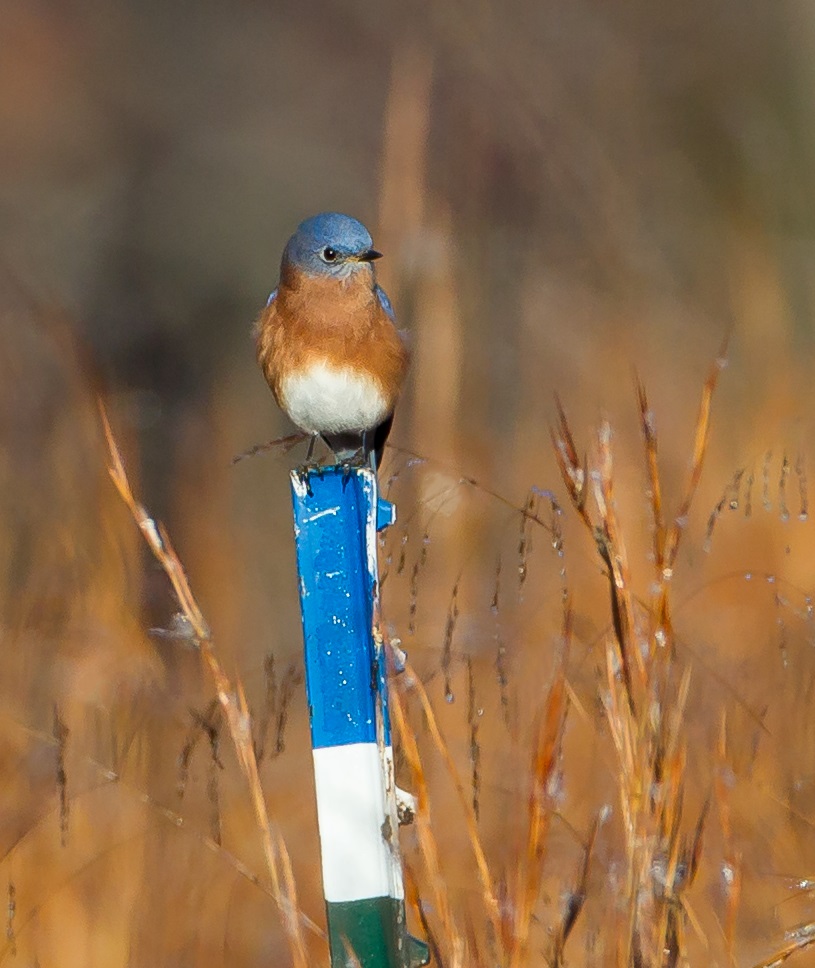
Frank Newell spent 38 years in the military. When he came home to his family farm in North Carolina, the bluebirds were gone.
When Frank was young, the fence posts around the pastures in Warrenton were wood, and Eastern bluebirds nested in them by the hundreds. When he came home decades later, the posts had been replaced with metal. The bluebirds had nowhere to nest and were disappearing.
Bluebirds can't excavate their own nest cavities. They depend on old woodpecker holes and natural rot in dead wood, both of which vanish when a landscape gets tidied up. So Frank started building them nest boxes by hand, 25 a week, with donated lumber and a Sears table saw that lasted him 33 years.
The word spread, volunteers joined, and businesses donated wood. The Eastern Bluebird Rescue Group, which Frank founded in 1996, has now built and distributed more than 500,000 bluebird houses, sold at or below cost. Warren County is now believed to hold the largest concentration of Eastern bluebirds in the United States.
Frank Newell has since passed away, but the group he started is still going, run by his daughter and son-in-law and a few dozen volunteers.
Every year, I share this video of French caretakers who take sand from Omaha Beach in Normandy, and scrub them into the letters to give them the gold coloring.
They do this for all 9,386 US soldiers who died.
France also gave us this land as American soil. #MemorialDayWeekend
Watch this sweet beagle experience love for the very first time 🐶❤️
For their entire lives, they only knew cages inside Ridglan Farms breeding facility.
Little by little, with patience and love, they start to relax ❤️
Please donate to our mission: https://t.co/PtKmboFiDx
Elon Musk just defended America better than every politician in Washington combined.
Musk: “After World War 2, the US could have basically taken over the world and any country. Like we got nukes, nobody else got nukes. We don’t even have to lose soldiers. Which country do you want?”
One nation on earth held a weapon nobody else had.
Total dominance. Zero competition. No risk of retaliation.
Every empire in history that held that kind of advantage used it.
Rome. The Mongols. The British. The Ottomans.
They conquered until they collapsed.
America had a bigger advantage than all of them combined.
And it rebuilt the countries it just defeated.
Musk: “The United States actually helped rebuild countries. So it helped rebuild Europe, it helped rebuild Japan. This is very unusual behavior, almost unprecedented.”
Almost unprecedented?
It had never happened before. Not once in 5,000 years of recorded history.
The Marshall Plan wasn’t foreign aid.
It was the most radical act of restraint any superpower ever committed.
America turned its enemies into allies. Turned rubble into economies. Turned surrender into partnership.
Germany went from ashes to the economic engine of Europe in a generation.
Japan went from unconditional surrender to the third largest economy on earth.
Three years after the war, America was flying food into Berlin.
A city in the heart of the nation that just tried to destroy it.
That’s not policy.
That’s a civilization deciding what it is at the exact moment it has the power to be anything.
You’re being told a story right now.
That America is the villain of history.
You hear it everywhere. Media. Universities. Social platforms.
Musk: “There’s always like, well America’s done bad things. Well of course America’s done bad things, but one needs to look at the whole track record.”
Every nation on earth has dark chapters. Every single one.
The difference is what a country does when nobody can stop it.
And when nobody could stop America, it fed its enemies and rebuilt their cities.
Musk: “The history of China suggests that China is not acquisitive. Meaning they’re not going to go out and invade a whole bunch of countries.”
Probably right.
China has historically built walls, not fleets.
But the real question isn’t about borders anymore.
We’re approaching a moment that mirrors 1945 in ways nobody has fully processed yet.
AI is going to give a handful of people a power advantage that makes nuclear monopoly look quaint.
If someone is going to hold that kind of power, who do you want it to be?
The country that conquered when it could? Or the one that rebuilt when it didn’t have to?
Every alliance. Every trade route. Every economy.
Billions lifted out of poverty.
All of it traces back to one act of restraint that had never been done before.
And carries no guarantee of being repeated.
The most powerful thing America ever did wasn’t building the bomb.
It was what it didn’t do after.
Imagine describing the modern food system to a farmer in 1955.
"So you've stopped eating butter?"
Mostly. We were told it was killing us.
"And the cream off the top of the milk?"
We pour that down the sink. Then we buy powdered vitamins to replace what it contained.
"You eat the chicken without the skin and the egg without the yolk?"
Yes.
"You cook your food in oil pressed from a flower with hexane in a refinery?"
Yes.
"You've swapped wool for polyester and leather for plastic?"
Yes.
"You eat bread made by a machine, from grain you've never seen, in a factory five counties away?"
Yes.
"And you're sicker than we are?"
Considerably. Diabetic by 40. Medicated by 50.
"And you blame the cow?"
Yes.
The 1955 farmer goes back to his work and says nothing more.
He is glad he was born when he was. He pities the children of the children of his children.
He has every reason to.
Myth: "I only wear vegan fabrics. Better for the animals, better for the planet."
Let's check in on Doris's annual contribution.
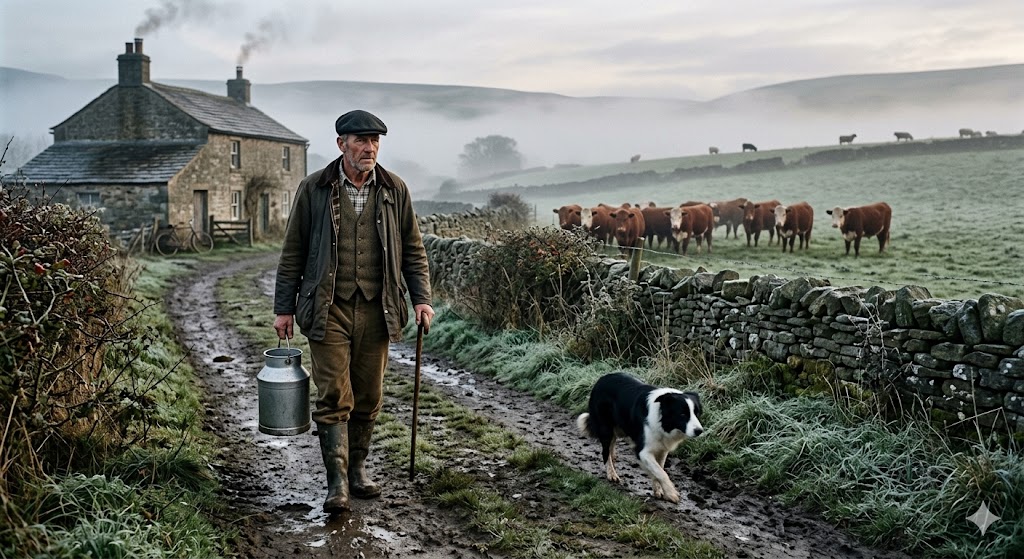
Once a year, in late spring, Doris is sheared. The procedure takes approximately three minutes. Doris does not enjoy it. Doris does not, by any visible measure, suffer from it. Doris is, immediately afterwards, a noticeably more comfortable animal in the British summer.
The fleece weighs approximately 3 kilograms. It is sold to the British Wool Marketing Board for, depending on the year, between £0.40 and £2.50 per kilogram. The shearing costs more than the wool fetches. Brian is shearing Doris at a loss.
The wool is then:
- Naturally flame-retardant
- Naturally antibacterial
- Moisture-wicking
- Biodegradable
- Renewable, annually
- Carbon-storing while in use
The replacement, in performance fabrics:
- Polyester
- Polyamide
- Acrylic
- Polypropylene
- All petroleum-derived
- All shedding microplastics on every wash
- All requiring fossil fuel inputs to produce
- All non-biodegradable, with a typical landfill lifespan of 200-500 years
A single wash of a polyester fleece can release up to 700,000 microplastic fibres into the water system. These fibres are now in: every tested water source on earth, every tested human placenta, every tested rainfall sample, the deep ocean, the Arctic ice, and the lungs of marine mammals.
A single wash of a wool jumper releases: nothing. The wool, when eventually disposed of, returns to soil within a few years.
The fabric being marketed as the "ethical" alternative to wool is plastic.
The plastic is "ethical" because nobody has been asked to slaughter the polymer.
The polymer also has not been asked.
Doris, by being a sheep on a fell, is producing the most thoroughly sustainable performance fabric humans have ever made.
Brian is selling it at a loss.
The fashion industry, meanwhile, is selling petroleum at a profit and calling it ethical.
Reject plastic. Wear wool.
Doris is, this morning, growing next year's batch.