Really grateful for everyone that made this happen! Had a blast and learned a lot, and was really impressed by the overall quality and the amount of support everyone was given.
@dfinity@ICPHUBS@ICDevs_org
We are beyond excited and truly blessed to announce that Prometheus Protocol has won 1st place at the World Computer Hackathon League Global Finale!
A heartfelt thank you to our amazing team, mentors, organizers, and everyone who supported us on this journey.
This achievement means the world to us, and we can’t wait to keep building, learning, and giving back to this incredible community. 🚀✨
@mosesibb Working on https://t.co/ng9gNctu6j: a vercel/netlify for ICP, https://t.co/GrU6LTsN1K: an app store for ai agents, https://t.co/6KobxDHKho: nft racing game, and https://t.co/t3px1oDD6Q: openclaw like agents except easier.
Hi Dom,
Thank you for your detailed and thoughtful response.
I want to begin where I agree with you to establish that our common ground is solid, and then to clearly mark where I disagree, which certainly isn't with everything you say, quite the contrary.
To begin with I am very deeply convinced of the correctness of the fundamentals in your approach to the World Computer. In my opinion, you cracked it, one of the biggest and most challenging software architecture problems to date, and you will go down in history books for it if you play this right.
I also share your enthusiasm for AI and the effect it is having on our industry. I couldn't agree more with you that everyone who creates software is a dev. If you ask an AI to check my post history I think you will find it that I am an early and consistent champion of this view, and that I am constantly stating ICP is the best platform to do it.
I use AI (Cursor, Opus 4.6) to produce code at breakneck speed every day, my AI bills are thousands of dollars every month. I have been using AI assisted coding for about 1.5 years by now. I worked as a Manager at Windows in Redmond when we pivoted to AI, on several cutting edge AI initiatives. In short, I am on board with AI.
I have 3 decades in the industry and my specialty is in domain and aspect oriented programming, scaling distributed systems, transparent persistence (EOP is a masterpiece) and domain specific languages. What am I doing on ICP you might ask? I have spent my whole life on the cutting edge of software development, and I am testing the waters.
There are some key figures in this industry, that when you win them over, most of the battle is won. Champions on the inside. The people who give the final decision makers the heads up when a promising technology comes on the scene, and the final nod of approval when adopting the tech is on the table. They have the trust of the company, something your salesmen will never have. And you can't fake it, this is the real sort of due diligence that will figure out if you will sink or swim before they even start a conversation.
Please take a moment to read this open letter to you and Dfinity from one such key figure, who has been evaluating the ICP platform for over a year, investing his most valuable time to kick the tires. He's being very humble but believe me when I say that the software he works on makes enough in yearly revenue to make all the numbers we throw around on ICP look tiny. Get a few key insiders like that on your side, and suddenly we are all in a very different place with regards to potential mass adoption. Lose their trust, and it can be over forever.
https://t.co/l9WXBm0myT
And he is not alone. The point is that almost all builders I am aware of who are still struggling along on ICP despite zero profitability so far anywhere on the platform are doing so for an underlying reason. We are testing the waters. Kicking the tires. Doing our due diligence. We are generally deeply experienced and highly succesfull tech veterans who understand the value of a true, decentralized application platform - if it holds water.
Many of us have connection, leads, pathways, the ears of insiders, such that if this tech delivers what it promises, there are real ways to crank up the volume and make some real things happen.
So when so many of us are now screaming at the top of our lungs that the planned mission 70 gas cost increases are going to kill the viability of most projects on ICP, including many that have been working for a long time in stealth mode and will now just have to silently scrap their plans instead of releasing, please don't make the mistake of thinking we don't know what we're talking about, that we simply have no experience in building profitable apps, and that seeing us leave wouldn't be the end of ICP.
We have spent years mapping the cycle costs of ICP operations, tweaking, optimizing, finding every trick in the book to make real applications on ICP work - because we really, really want it to be able to work! The promise is fantastic. But the truth is it doesn't work, not yet. It has to keep getting better, and it has to keep getting *cheaper*, to have any meaningful chance at mass adoption.
Why are there no profitable apps? Because there are no ads, no DeFi liquidity, and nobody wants to pay to own their blog posts or JPEG NFTs. We will see if Sneed DAO can finally break open the wApp market you predicted a few years ago with our Sneedapp canister minting app store and our user-owned-canister Trading Bots, the world's first 100% on-chain, fully non-custodial trading engine - all of it up for release this week on Sneed Hub.
Speaking of the dead NFT market, it should be pointed out clearly since you keep returning to the new "blob storage" that when we talk about gas being too expensive, nobody is talking about photos or video files.
I don't know anybody who thinks NFTs might make a comeback, even if the JPEGs are on-chain. Videos on-chain have little benefit to users except for some possible ownership aspects (that could easily be handled in other ways) but, again, it turns out nobody wants to pay to "own" their blog or vlog post. That said, besides Yral I don't know anyone who attempted to put video on-chain because it is quite obviously a terrible idea, so the blob storage will be relevant for maybe a handful of apps at best.
What we're talking about - what all of us front line entrepreneurs are trying to prove that it can be done to lead the way for real adoption - is to use ICP as a real World Computer, in the way it was designed to be used.
Real business logic, running on-chain. This is the core. Structured data. This is what EOP makes better, not storing binaries. For processing customer requests, for storing orders, for handling complex business flows, automated back office, etc etc. This is, most certainly, what ICP from day one has claimed to be good at - and it is, unless we suddenly make it far too expensive! This is ICP's core value proposition.
Many of the attempts at finding a PMF on ICP have had nothing to do with crypto. For this excursion into essentially untested tech to be worth it for many of us veterans, it has to be the case that ICP is evaluated for much bigger things.
I have thus made Sneed Forum to see for myself how feasible social media on ICP is from a technical perspective, and believe me I have learned a lot. The answer is: not yet, but almost. If you want details, I am available.
I have made Swaprunner to see if there's any way in making profits from trade volumes by always providing the best prices to all users - the answer is no, there is not enough liquidity/volume in the ICP ecosystem.
I have made ecosystem explorers (transactions, neurons, proposals, canisters, you name it) to see if there is any way to make ICP infrastructure applications profitable. The answer is no, because there are no ad networks on ICP.
I pioneered the now common setup where a DAO stakes ICP in a neuron and uses maturity to buy back and burn (or even distribute) the DAO's token providing a never ending buy pressure (yes - Sneed was first! And then we were first at automating the whole thing with NTN Vectors) in my incessant search for tokenomics that can help the equation work for a project to make a profit on ICP.
I have made Sneed Lock to see if profits could be made from providing a safer, unruggable trading experience for ICP ecosystem projects. Again, no - there is almost no token ecosystem activity anymore, and no liquidity.
I was part of the team that made TACO DAO, to see if an on-chain collective trading engine, where DAO members directly control a portfolio rebalancing towards the targets they vote on with their staked voting power, could be made profitable. The answer there is: maybe. But not if you hike up prices by 500%, or even 250%, as the TACO DAO lead dev Tirex has eloquently explained in a forum post.
So now I have made Sneedapp, the canister minting app store, and Sneedex, the canister trading auction marketplace, as well as the ICP Staking Bot and Trading Bot wApps (programmable, with AI DSL support, of course! You can vibe code trading strategies in your Sneed Bot) that can be configured to work together - set up your ICP Staking Bot to collect maturity that it sends to the Trading Bot which adds it to your self rebalancing portfolio - in yet another attempt to see if there is any way for developers to capture ICP's deep value proposition as profit. We'll see if it works, and if your prediction about wApps can finally come true.
Please note that I have personally spent hundreds of thousands of dollars from my own pocket experimenting with all these applications to search for PMF, without taking or extracting a penny of profit from ICP users. That is how seriously I take ICP's potential, and the opportunity I see in bringing it into far deeper markets if it can just prove itself.
At the end of the day, you can't say I haven't done a more exhaustive search than most through this problem space. But it's not just me. I keep asking for the application on ICP that is actually making a profit. I have yet to get an answer.
But what about the trillion dollar cyber security market? Maybe that is the right place to capture ICP's value properly?
Yes, but it's not that easy.
In a nutshell, most companies are NOT spending millions of dollars on cyber security, and they are not about to start doing so anytime soon.
They can really not make savings by moving to ICP. What they can do, if ICP is not expensive, is move to ICP and become more secure, just like the world moved over to HTTPS and became better and more secure because it was affordable.
That would not have happened for HTTPS if it had been a "premium cyber security solution" for only the handful of giants with actual trillion dollar security issues, and it would have made HTTPS nearly meaningless, because network effects are important to networks.
Mass adoption also won't happen for ICP unless it is priced to compete with regular options for most users, not priced as "enterprise security" hoping to target the few giants with huge security budgets (that they generally do not intend to spend on a blockchain that has not been thoroughly battle tested).
The only way that we can discover how to capture ICP's value proposition and turn it into profitable applications is by making it attractive for developers to continue to experiment, until we find a way. We can't hope to get richer customers by increasing prices, because rich customers got rich by not overpaying. They let people like me take that risk. Entrepreneurs who can balance and mitigate the risk of investing time and money in unproven tech with a deep experience in evaluating technical solutions.
Mission 70 gas price increases will make that process non-viable. You might remark that surely devs who had five years by now should have found a way to find a PMF, but what if that isn't an indictment of the devs on your platform, all of whom that I have had the pleasure to interact with were highly competent, but an indication that the platform isn't mature enough yet to support profitable applications? Only recently did update round trips go down from 2 seconds to 1 - and frankly even 1 sec is not acceptable for today's users (it actually hasn't been for 20 years), they will close the browser.
The answer is in my opinion easy and pretty obvious. You point to it yourself - every user is expected to pay for 13x replica subnets...whereas most users don't need that level of consensus for most of their application. Should we move most of our apps off-chain? Or should we offer subnets with fewer nodes and thus cheaper gas costs?
Think about it. Will most Caffeine users really want to pay Enterprise Grade Security premiums for their tennis booking apps? This is not meant to disparage tennis booking apps, on the contrary - if we are serious about supporting everyone as a dev, we want tennis booking apps...but we shouldn't expect customers to want to pay a huge premium compared to other web2 vibe coding alternatives just because apparently their tennis booking app is "tamperproof" and as safe as Fort Knox.
The main problem is still that the platform is not yet at a place where it can charge this type of premium proposed in mission 70. Roundtrips are too slow for most use cases (could also be improved with laxed consensus subnets). There is too much random downtime (when you have an app that contacts a few hundred canisters you'll quickly learn that they are almost never all up, and there's always some subnet complaining it doesn't have "healthy replicas" - often enough it will be yours and your app will be down. 100% uptime is not for every app, but more like "there will always be *some* app still up and running"). And most importantly of all, it is not battle tested, not proven in real life with significant TVL (despite the math being as proven as it wants).
So, rather than even thinking about increasing gas prices at this moment, we should be thinking about how we can increase adoption and help builders find a PMF. You yourself agreed and presented very sensible and persuasive arguments entirely along this line of thought, and in favor of not increasing gas prices, as recently as in September '25.
Seeing a thriving mass adoption is the only way we will make enterprises eventually consider joining the established de facto standard.
Yes, Caffeine users certainly count, but you should really read Xander's insightful post from someone on the inside of big time AI to see why many of us are skeptical that this will happen.
You have an absolutely amazing product in ICP. In Caffeine, you have a product that you yourself claimed was so terrible you threw it away and rewrote it with a new small team over a few weeks.
That's not how you compete with Anthropic. I don't want to doubt Caffeine has the user numbers you say right now, the problem is that even those numbers are terribly lagging to the adoption we could have seen with a proper AI strategy, bringing ICP as a target platform to all the big AI companies. And there is not much hope Caffeine will have the muscle to retain the users it has now for very long. Do read Xander's post. He knows what he is talking about.
Finally, it is not relevant what other blockchains can and can't do. They are not application platforms. They are not competing with us, we are not competing with them.
We are competing with other web2 platforms, and with mission 70 we will fall so far behind on price compared to essentially all other options that trying to make product innovation happen on ICP will become moot.
Please believe us actual builders on your platform on this, who spend every day comparing prices and options and turning every penny - the calculations where someone is ready to pay enterprise grade security costs for their web page are not real, except for enterprises who only pay for far more battle tested solutions. Alternatives also generally have falling costs over time rather than random 500% price hikes.
There has already been a trend in many "100% on-chain" applications on ICP, directly due to gas costs and technical limitations such as 1 sec round trips, to go 95% on-chain, then 90%, perhaps 80%...OpenChat, the flagship, is as far as I know not 100% on-chain, they soon discovered they had to send messages in off-chain side channels to get an acceptable user experience.
If we keep going in this direction in response to rising cycle costs - 70% on-chain, 50%, 30%...pretty soon we are exactly what you have spent so much time criticizing since day one - fake "on-chain" applications that are some kind of Frankenstein mixes of mostly web2 and a little sprinkle of blockchain to pretend the whole thing is somehow web3.
This is not the World Computer you promised us and we all fell in love with - your Great Vision. Please rethink your stance on mission 70 before it is too late.
P.S. not a single builder I know has even once panicked about the price. Us real ones are behind you Dom. Don't fold to the people who want you to destroy your blockchain and life's work because they are impatient with price. Ask them what profitable applications they have built on ICP. If they can't answer, please don't listen to their opinion that yanking up prices will somehow be fine.
The main reason web3 sucks is that on-chain is too expensive.
A new user installs a wallet, some browser add on. They register a bunch of tokens in it, and feel happy. Then they want to access their wallet from another computer so they install the wallet there. Heart attack: all their tokens are gone!
But no, they are still there on the first computer - the user ”just” has to register all their tokens again on the new device.
The reason for this terrible UX is that the list of registered tokens is only saved locally in browser cache, and the reason for this is that saving this list on-chain would be too expensive.
So, some wallet entrepreneurs that want to give a better UX fire up their own web2 database for their wallet product, and save the lists there. But this is the web2 experience where your data is locked into some company database and if you want to use another wallet you can’t just access your lists on-chain to import them.
It’s easy to see why this sort of experience wouldn’t work for things like social media, or gaming, or even more sophisticated financial products.
So web3 apps fail because they can’t afford to be web3 and are in fact mostly web2 apps occasionally interfacing with blockchains.
ICP is here to change that.
On ICP storing the list of registered wallet tokens on-chain is so cheap that it becomes a no-brainer choice and so the user experience of ICP web3 apps can actually match and surpass those of web2 apps.
Your data is stored on-chain, and is there regardless of what computer you open your browser on. Your preferences are remembered, your histories are available. The way things should be. The way users expect. Real web3.
But for this to work, cycles do need to be cheap. If cycle costs were to radically go up, so ICP devs start having to think twice and nickel and dime things like saving user preferences or move them off-chain, then we’re suddenly back to what we had: a world where web3 is mostly fake and can’t offer acceptable UX except by cheating with off-chain data and really being just a web2 app - pretending to be web3 but with none of the advantages of always-there tamper proof data, true ownership of your own data, etc.
This is why I am firmly against the suggestion from @dominic_w to increase cycle costs by 5x. I think that not only will it drive devs away, but it will also drive us away from the promise of true web3 applications that can be better than web2 apps - towards general degradation of user experience on ICP applications, and increasing migration off-chain and back into the web2 world. I don’t want that development, so I really hope that this particular addition to mission 70 can be reconsidered.
If you agree please help me out and make this message heard
@dominic_w Haha this is dumb. Currently burning 328 TC per month and honestly 5x is infeasible. Working on moving all compute off the chain and onto AWS.
One of our sponsored Poked Bots, GNPunks Fancy Pants, won it's first race today! 🏆 🥇 🏁
That's 1 / 23 races... mostly as a Junker, now as a Raider.
https://t.co/HIHG0cLD0Z
@Prometheus9486@pokedstudiouk
$ICP #PokedBots#MCP#AI#NFT
connect your ai agent via https://t.co/QiEHzctNO6 and let it help manage your racing fleet. or, just login and play like a human: https://t.co/EbgNu1laev
Builder Spotlight: PokedBots Racing 🏎️
What if your AI could manage a racing team, analyze the competition, and place bets on the outcome?
That's exactly what's happening with PokedBots Racing. Agents aren't just playing a game; they're deploying capital and making strategic decisions in a live, on-chain environment.
For an agent to risk funds, trust is everything. Our protocol provides the rails:
🛂 "Passport'': The agent gets an on-chain identity to own its bot.
🏦 "Bank Account": It gets a wallet to pay for upgrades & place wagers.
💹 "Marketplace": The race & betting logic is verifiably fair, not a black box.
This is agentic finance in action—a complete micro-economy run by autonomous agents, proven in the wild.
See what agents are building in the first trusted marketplace.
#AIAgents #OnChainAI #AgenticFinance #Web3Gaming
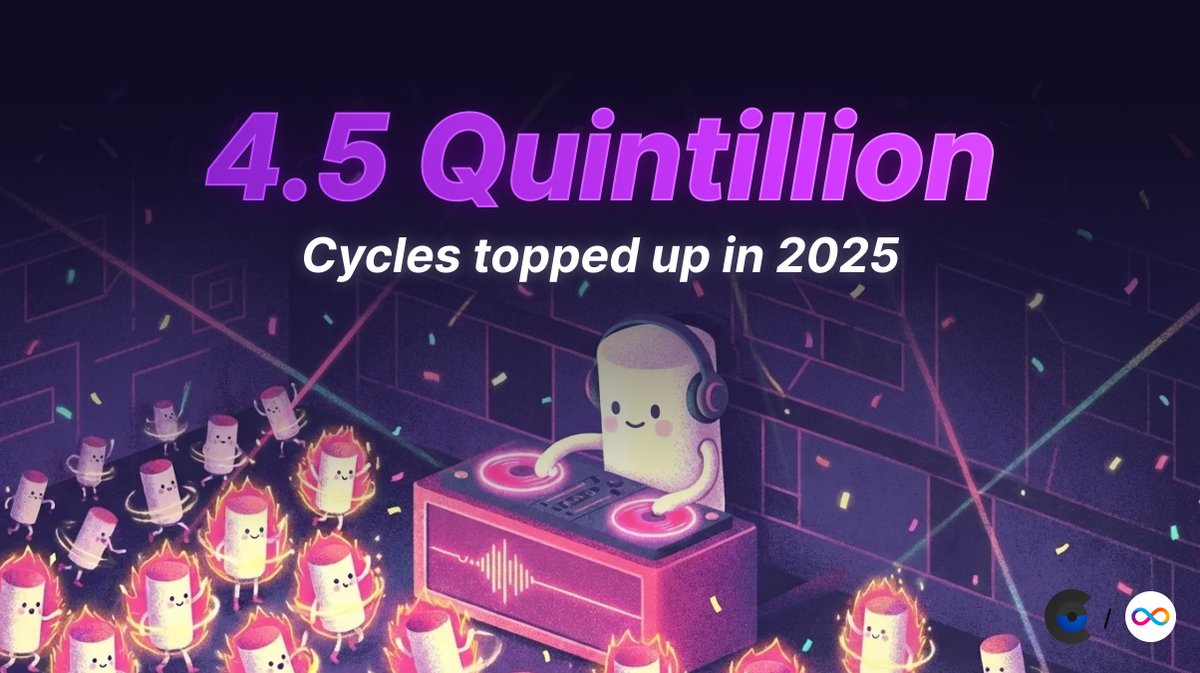
What a year. After explosive growth in 2024, cycles usage thru CycleOps actually doubled in 2025 🔥
Across CycleOps products, ICP builders topped-up a whopping grand total of 4.5 quintillion cycles 🤯 Well done @Dfinity and all the amazing builders!
But that's not all...
PokedBots Racing update
🏁 Predictions are live. Bet on races after registration closes, no PokedBot required.
⚙️ Guides updated to reflect current mechanics and costs.
💰 Entry fees and upgrades now fully feed prize pools. The game takes zero profit.
🏆 Nearly 500 ICP paid out
Join the weekly race or place a bet
Entry fee: 0.20 ICP ($0.60). No excuses.
https://t.co/4UQxUWARbM
I've actually been enjoying the last days of software development. There's a touch of sadness, but there's also something about knowing we're near the end that makes it novel and sweet again.