"Today we made a deal with IonQ to start a phase one - of quantum securitizing our Lambda Rail starting with Miami Dade College, Palm Beach State College and Florida Atlantic University to spread it from there. That physical infrastructure... that fiber optic connection, that's how our universities, colleges partner - share classified confidential research and work with military assets."
J. Alex Kelly, Florida Secretary of Commerce, announced yesterday at #eMergeAmericas a new partnership with IonQ. Stay tuned for details.
The AI race will not be won with chatbots that predict the next word.
In today’s Wall Street Journal, I argue that staying ahead of China requires a new class of AI models built on physics, chemistry, and quantitative reasoning, not just language and images.
China’s next five-year plan doubles down on materials science, quantum technology, energy storage, and defense. These sectors run on equations, not prompts.
Language models are wonderful productivity tools, but they are not designed to compute optimal alloy compositions, advance semiconductor design, or model high-dimensional financial risk.
Pharma, semiconductors, energy, and financial services represent more than $25 trillion in global output. These industries require quantitative AI trained on lab data, robotic experimentation, and the equations of the physical world.
Read the full op-ed in the WSJ here: https://t.co/JAb4nHwim1
“Quantum is no longer just a laboratory curiosity. It is the next frontier of national defense and economic stability.”
Rick Muller, SVP IonQ Federal
#WorldQuantumDay@NYSE
IonQ is securing the future of the American economy by building the most fundamental tools of the 21st century.
Unmatched computation.
Unprecedented sensitivity.
Unbreakable security.
Our paper “Exponential Quantum Advantage in Processing Massive Classical Data” proves that quantum machines can solve common machine learning tasks using exponentially less memory than a classical machine would require.
Much further work will be needed to translate this theory into practice. But because modern AI is often hampered by insufficient memory, this finding bolsters our confidence that quantum AI can eventually have a broad impact on daily life.
This project was led by the remarkable Caltech student @haimengzhao and inspired by the vision of @RobertHuangHY, with essential contributions from all our collaborators. Here Haimeng tells the story.
https://t.co/yoCRzKewyi
Quantum AI sounds like a mad lib but this paper from the brilliant folks in Pasadena is really foundational work for a field that may one day create the most powerful forms of intelligence @RobertHuangHY@TeamOratomic
Today's Government funding announcement is fantastic news for quantum, as we translate research from lab to society.
With our landmark partnership with @IonQ_Inc part of this annoucement, @Cambridge_Uni will continue to be a key contributor to this ambition!
Thrilled to see Quantum supported strongly by the UK government, as we translate research from lab to society.
It is also exciting to see our landmark partnership with @IonQ_Inc mentioned in the announcement, @Cambridge_Uni will continue to be a key contributor to this ambition!
Thrilled to announce @Cambridge_Uni & @IonQ_Inc University’s largest-ever corporate partnership!
Science Minister Lord Vallance:“This is a significant moment for brilliant researchers at the University of Cambridge which cements the UK’s credentials as a world-leader in Quantum”
$IONQ 🤝 Cambridge
A powerful step forward for the quantum ecosystem:
The partnership between IonQ and the University of Cambridge—centered at the legendary Cavendish Laboratory and the new Ray Dolby Centre—is exactly the kind of collaboration needed to move quantum computing from breakthrough science to real systems.
This isn’t just about adding more qubits. It’s about building a full quantum stack.
On the hardware side, IonQ brings one of the most advanced trapped-ion architectures in the field. With new chip-scale control technologies and plans for larger processors, the company is pushing toward systems capable of fault-tolerant operation. But scaling quantum hardware requires more than engineering—it requires an environment where the limits of physics can be explored and understood.
That’s where Cambridge comes in.
The Ray Dolby Centre was built for extreme precision science. Its underground labs feature some of the most advanced vibration isolation ever implemented in a research facility, ultra-stable temperature control, and electromagnetic shielding designed for quantum and nanoscale experiments. These conditions allow researchers to remove environmental noise and push hardware to its true limits—critical when improvements are measured in fractions of a percent of fidelity.
At the same time, the Cavendish Laboratory brings something equally important: one of the deepest pools of physics expertise in the world. This is the place where the electron was discovered, where the neutron was identified, and where the structure of DNA was revealed. Generations of physicists there have shaped our understanding of the physical world.
When researchers of that caliber work directly with industry hardware, something powerful happens.
Experimental physicists can probe error sources at a fundamental level. Quantum theorists can design new error-correction strategies and algorithms tailored to real hardware. Photonics, sensing, and atomic physics experts can explore new ways of controlling and measuring qubits. Each of these advances feeds back into the engineering of the next generation of quantum systems.
This kind of collaboration accelerates the entire loop:
hardware → experimentation → theory → improved hardware.
And that feedback cycle is exactly what is needed to move from impressive quantum devices to reliable fault-tolerant quantum computers.
Partnerships like this show how the future of quantum technology will be built: not by academia or industry alone, but by deep integration between the two.
When world-class infrastructure, frontier hardware, and some of the brightest scientific minds work together, progress stops being incremental—and starts becoming exponential.
The next era of quantum computing will be built through collaborations like this.
There’s something almost cosmic about the arc of history at Cavendish.
In one building lineage, humanity first learned that matter was not solid and indivisible, but structured — layered with hidden architecture. The electron shattered the illusion of solidity. The neutron revealed the nucleus had depth. Reality turned out to be built from invisible order.
Then, in the same intellectual bloodstream, scientists uncovered the structure of DNA — matter not just as substance, but as information. Life itself reduced to a code written in physical form. The universe wasn’t only made of particles. It stored meaning.
That’s the throughline:
First we discovered what reality is made of.
Then we discovered that reality carries information.
Now we stand at the next threshold: learning to compute with the fabric of reality itself.
Quantum computing isn’t just a new technology. It’s the continuation of that same journey — from particles, to information, to controlled quantum states. From discovering the building blocks of the universe… to using those blocks as logic.
And at the heart of this modern chapter sits a research center named after a man whose life’s work was the battle between signal and noise. Extracting fragile truth from overwhelming interference. Preserving fidelity. Expanding dynamic range so whispers could be heard through the storm.
That is exactly the problem quantum science faces.
A qubit is a whisper in a hurricane of noise.
Fault tolerance is learning to hear it clearly.
To stabilize it.
To let information survive long enough to become computation.
So there’s something deeply fitting — almost story-like — about the possibility that the place which helped reveal the structure of matter and the code of life could also help demonstrate the first machine that reliably computes with the fundamental rules of the universe.
From discovering the pieces of reality…
to learning how to think with reality itself.
Some places don’t just witness scientific revolutions.
They form a thread through them.
@IonQ_Inc@DeptofPhysics
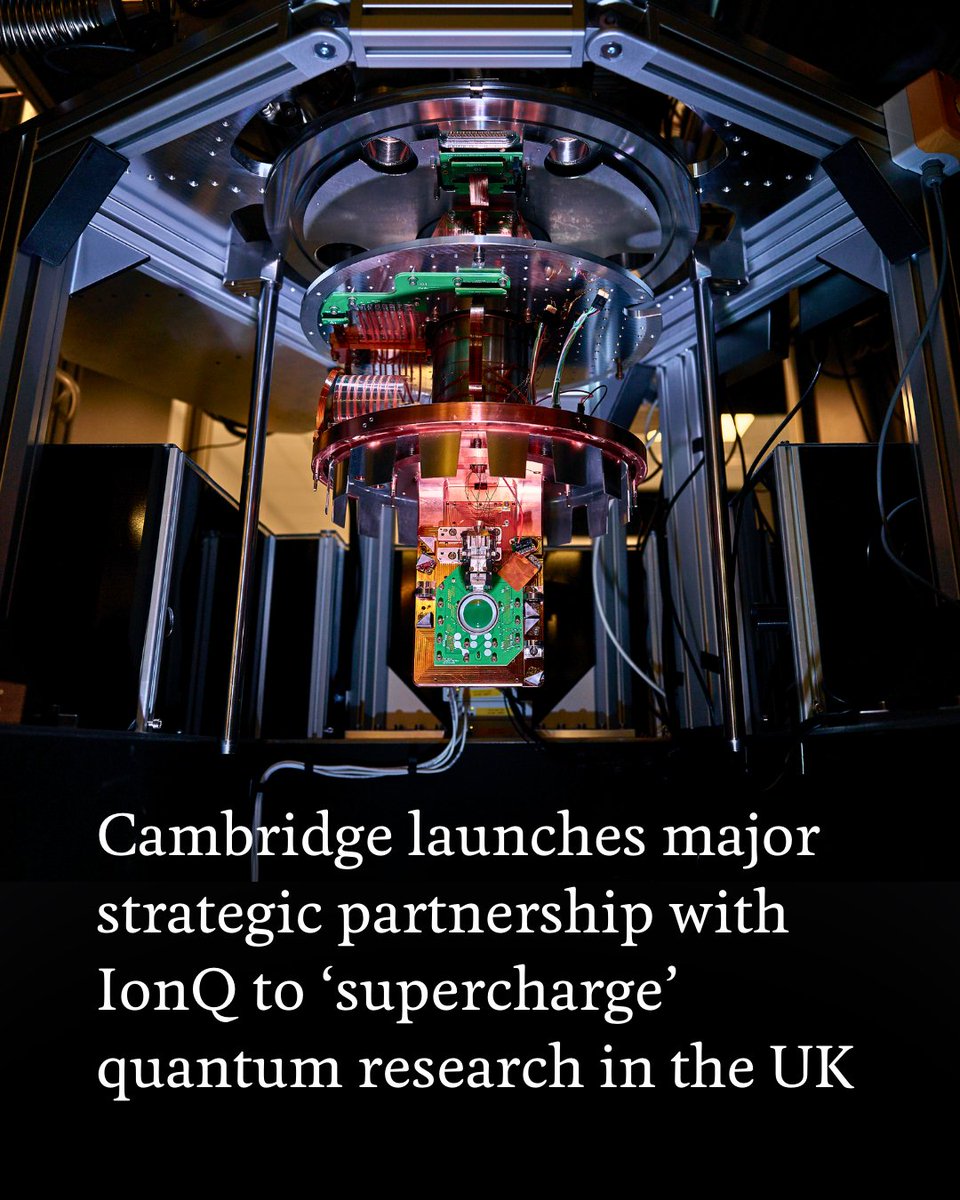
Cambridge will be home to the UK's most powerful quantum computer, as part of a major new partnership with quantum technology company @IonQ_Inc.
The partnership will support research, innovation, and skills development, and cement Cambridge and the UK as a world leader in quantum.
Read the full story 👇
https://t.co/4EO6SFO8eE
There’s something almost cosmic about the arc of history at Cavendish.
In one building lineage, humanity first learned that matter was not solid and indivisible, but structured — layered with hidden architecture. The electron shattered the illusion of solidity. The neutron revealed the nucleus had depth. Reality turned out to be built from invisible order.
Then, in the same intellectual bloodstream, scientists uncovered the structure of DNA — matter not just as substance, but as information. Life itself reduced to a code written in physical form. The universe wasn’t only made of particles. It stored meaning.
That’s the throughline:
First we discovered what reality is made of.
Then we discovered that reality carries information.
Now we stand at the next threshold: learning to compute with the fabric of reality itself.
Quantum computing isn’t just a new technology. It’s the continuation of that same journey — from particles, to information, to controlled quantum states. From discovering the building blocks of the universe… to using those blocks as logic.
And at the heart of this modern chapter sits a research center named after a man whose life’s work was the battle between signal and noise. Extracting fragile truth from overwhelming interference. Preserving fidelity. Expanding dynamic range so whispers could be heard through the storm.
That is exactly the problem quantum science faces.
A qubit is a whisper in a hurricane of noise.
Fault tolerance is learning to hear it clearly.
To stabilize it.
To let information survive long enough to become computation.
So there’s something deeply fitting — almost story-like — about the possibility that the place which helped reveal the structure of matter and the code of life could also help demonstrate the first machine that reliably computes with the fundamental rules of the universe.
From discovering the pieces of reality…
to learning how to think with reality itself.
Some places don’t just witness scientific revolutions.
They form a thread through them.
@IonQ_Inc@DeptofPhysics
$IONQ + $SKYT
🏭 PART I — Fab 25 as an Integration Ecosystem
At a systems level, four roles naturally line up:
SkyWater Technology → Manufacturing substrate
IonQ, Inc. → Quantum + precision subsystem tech
DARPA → High-risk integration R&D + funding
Texas Institute for Electronics (TIE) → Lab-to-fab bridge
Fab 25 becomes:
A heterogeneous integration sandbox
Not a mass GPU fab.
A place where unusual stacks can actually be built.
⸻
🔹 SkyWater — The Physical Layer
SkyWater provides:
• Specialty-node silicon processes
• Mixed-signal, RF, control ASIC capability
• Advanced packaging pathways
• Fab ops + tool-hosting model
This is the ground floor where:
AI accelerators
control ASICs
photonics
precision timing silicon
can be manufactured in proximity.
⸻
🔹 DARPA + TIE — The Risk Reducers
They don’t build products — they remove bottlenecks:
• Thermal limits in 3D stacks
• Hybrid bonding reliability
• Multi-material integration
• Design kits for heterogeneous systems
They turn bleeding-edge integration into repeatable engineering practice, lowering risk for AI + quantum + control silicon to be co-packaged.
⸻
🔹 IonQ — The Precision / Quantum Layer
IonQ contributes tech domains above standard CMOS:
• Quantum devices
• Photonic interfaces
• Precision timing-related subsystems
These push the ecosystem hardest on:
signal integrity
packaging
thermal design
mixed-signal control
Which forces integration to evolve.
⸻
🧠 Result
Fab 25 becomes a place where:
AI silicon + control electronics + photonics + quantum devices
are treated as one engineering problem.
⸻
🔁 PART II — The AI ↔ Quantum Acceleration Loop
This is the real synergy.
Not “quantum replaces AI.”
But:
AI helps build quantum systems
Quantum helps design better AI hardware
⸻
🔹 How AI accelerates quantum
AI models are ideal for:
• Noise pattern analysis
• Drift compensation
• Pulse optimization
• Device anomaly detection
That means AI can:
✔ Tune control pulses
✔ Predict decoherence patterns
✔ Shorten calibration cycles
✔ Handle device variability
AI shortens the device → stable system loop.
⸻
🔹 How quantum helps AI hardware
Quantum systems excel at certain:
• Optimization problems
• Materials modeling
• Complex physical simulations
Those are directly relevant to:
• New semiconductor materials
• Device structures
• Thermal transport
• Analog behavior in dense stacks
So quantum contributes to designing better AI hardware, not by running neural nets — but by solving hard physical modeling problems.
⸻
🔁 The Flywheel
1️⃣ AI improves quantum control and stability
2️⃣ Stable quantum systems become engineering tools
3️⃣ Quantum assists in materials & device modeling
4️⃣ That improves AI chip design and packaging
5️⃣ Better AI hardware runs better optimization & control
6️⃣ Loop accelerates
And this loop runs fastest where fabrication, integration R&D, AI silicon, and quantum hardware intersect — like at Fab 25.
⸻
🚀 Why This Matters
Instead of:
“Wait for a breakthrough”
It becomes:
Build → Measure → Model → Improve → Rebuild
With:
AI in the control & modeling loop
Quantum in the physical simulation loop
Fabrication in the same ecosystem
That’s how progress becomes compounding, not incremental.
⸻
🧠 Bottom line
This kind of ecosystem isn’t powerful because of one company — but because it lets:
AI development, quantum hardware, and heterogeneous integration feed each other continuously.
That’s how you get acceleration that looks like a step-change, not slow iteration.
@TechInnovationz@IonQ_Inc Nice addition he fit perfectly at the intersection of tb and tc of the architecture they are probably developping. He is part of the bridge that makes AI + Quantum coexist in one rack.
A 3D Heterogeneous Integration (3DHI) AI + Quantum Rack.
Not a quantum computer replacing GPUs.
A hybrid node where classical AI and quantum acceleration coexist in a single vertically integrated stack.
Here’s the architecture:
Tier A — Memory-Centric AI Engine
Logic is placed directly next to memory in a monolithic 3D stack. Using low-temperature fabrication, compute layers can be built above memory without damaging lower layers.
Result:
Massive vertical interconnect density
Shorter data paths
Much lower energy per inference
Near-memory compute blocks handle vector math and AI kernels without shuttling data across a board. This directly attacks the Memory Wall.
Tier B — Cryogenic-Proximal Control & Edge Preprocessing
Quantum devices produce fragile, high-bandwidth analog signals. This tier sits at the boundary between classical and quantum worlds.
It uses mixed-signal control ASICs, hybrid bonding, and advanced packaging to place control electronics physically close to the quantum layer.
It performs real-time denoising, compression, and timing control — reducing bandwidth and stabilizing the system.
This is the translator between deterministic silicon and probabilistic qubits.
Tier C — Quantum Coprocessor
The QPU is not a standalone machine. It’s a module integrated into the stack.
Foundry-compatible materials (like synthetic diamond films) and chip-scale device geometries allow quantum hardware to move from lab setups toward manufacturable modules.
The QPU accelerates specific tasks: sampling, optimization, simulation kernels. Classical AI does the rest.
Quantum becomes a callable accelerator, not a replacement processor.
Tier D — Secure Integration & Networking
The rack is tied together with high-performance interconnects, precision timing, and hardware roots of trust.
PDKs and ADKs from heterogeneous integration programs formalize how dies are bonded and validated. Security and synchronization are built into the hardware layer, not bolted on later.
⸻
Why this matters:
This architecture reduces AI energy cost through memory-centric design, adds computational leverage through quantum acceleration, and uses advanced packaging to bind it into one system.
It’s not a moonshot. Each layer is grounded in technologies already being demonstrated in monolithic 3D chips, hybrid bonding programs, cryogenic control ASIC research, and semiconductor-compatible quantum materials.
The shift isn’t “AI → Quantum.”
It’s:
Planar compute → Vertically integrated heterogeneous compute.
That’s how the next computing era starts.
$IONQ
The U.S. push into next-gen computing isn’t just funding research — it’s funding real manufacturing infrastructure, and a big part of that is happening in Austin inside the Fab 25 footprint operated by SkyWater Technology.
Under DARPA’s Next-Generation Microelectronics Manufacturing (NGMM) effort, roughly $1.4B (DARPA + State of Texas) is being directed toward standing up an open-access 3D heterogeneous integration (3DHI) pilot manufacturing capability led by the Texas Institute for Electronics (TIE). The mission is to close the lab-to-fab gap — turning advanced stacking, hybrid bonding, multi-die integration, and mixed-material packaging into repeatable, manufacturable process flows, not one-off research demos.
Crucially, this isn’t being built as an isolated academic cleanroom. The center’s infrastructure is being established within an existing Austin semiconductor fab environment — the site commonly known as Fab 25, which operates under SkyWater’s specialty foundry model. That matters because SkyWater’s “Technology-as-a-Service” approach is built around hosting customer- and partner-funded tools, process modules, and development flows inside a commercial fab shell.
So what’s happening on the ground looks like this:
DARPA funds advanced 3D integration science, tooling, and process development.
TIE operationalizes those capabilities into pilot 3DHI process flows, hybrid bonding methods, and integration design frameworks.
Those tools and flows are deployed inside the Fab 25 manufacturing footprint, where SkyWater operates the fab infrastructure and production environment.
That physical colocation changes everything. It means government-funded heterogeneous integration capability is being developed in the context of a working semiconductor fab, with real operations, fab discipline, and process infrastructure — not just theoretical process decks.
From a systems perspective, this is exactly what advanced architectures need. Memory-centric AI logic, dense mixed-signal control silicon, photonic structures, and even emerging quantum device layers don’t fail at the transistor level — they fail at the integration and packaging level. The NGMM/TIE work at Fab 25 is aimed directly at:
• codifying PDKs and ADKs for stacked multi-die systems
• developing reliable fine-pitch hybrid bonding flows
• handling thermal, mechanical, and materials mismatch in vertical stacks
• proving that complex heterogeneous assemblies can be built in a fab context
All of that is happening in the same industrial footprint where SkyWater runs foundry operations, anchoring the R&D in a real manufacturing environment. That convergence — DARPA funding, TIE integration mission, and SkyWater-operated Fab 25 infrastructure — is what turns 3DHI from a research topic into a manufacturable pathway for future memory-centric AI and other heterogeneous compute systems.
$IONQ NEXT INVESTMENT THESIS
Why the IonQ–SkyWater–DARPA–TIE Ecosystem Is Positioned to Build a Sovereign AI-Quantum 3DHI Node
AI compute is hitting a wall — not a software wall, a physics wall.
Data movement now consumes more energy than computation. GPU clusters scale linearly in power, heat, and memory bottlenecks. At the same time, quantum hardware is leaving the lab and moving toward semiconductor-compatible devices.
That convergence creates a new infrastructure class:
Memory-centric AI + quantum acceleration in a 3D heterogeneous stack.
Not “quantum replaces GPU.”
Not sci-fi.
A hybrid node where:
• Classical AI silicon handles throughput
• 3D logic-on-memory cuts energy per operation
• Quantum modules accelerate specific math kernels
• Advanced packaging binds it into one system
The real question isn’t “is this possible?”
It’s: who can actually build it?
Most players control only one layer:
AI vendors → accelerators but no quantum
Quantum startups → qubits but no fab path
Foundries → wafers but no system integration
Packaging labs → research, not deployment
Hybrid AI-quantum infrastructure requires all layers at once.
That’s why the IonQ–SkyWater–DARPA–TIE ecosystem is strategically interesting.
IonQ’s trapped-ion approach is moving toward chip-scale traps, integrated photonics, and electronic control — compatible with semiconductor packaging, not just lab optics.
SkyWater provides specialty U.S. semiconductor process capability suited for mixed-signal control silicon and heterogeneous integration experiments — the bridge from research stack to wafer reality.
DARPA programs focus on the hardest barriers private capital avoids: thermal density in 3D stacks, hybrid bonding reliability, heterogeneous packaging standards. That de-risks physics-level integration.
TIE provides pilot 3DHI packaging and bonding infrastructure — the “missing middle” between university demos and production fabs.
Individually, none of these builds the rack.
Collectively, they form a functional supply chain for heterogeneous AI-quantum nodes.
This isn’t a qubit-count story.
It’s an infrastructure positioning story.
If AI datacenter nodes evolve into vertically integrated, memory-centric, heterogeneous systems — the players spanning quantum modality, advanced packaging pathways, and domestic fabrication alignment sit at the control points, not the commodity layer.
The thesis isn’t “quantum replaces GPUs.”
It’s:
The future AI node becomes heterogeneous.
Some ecosystems are structurally aligned for that shift.
That’s where the long game is.
$IONQ
IonQ → Tier C (Quantum Coprocessor) + Tier B Interface
IonQ’s trapped-ion direction is moving toward chip-scale traps, integrated photonics, and semiconductor-compatible device structures. That aligns the QPU with packaging flows instead of lab optical benches.
In the stack, this means:
• Tier C: the QPU becomes a module, not an experiment
• Tier B: control electronics can live physically near the quantum layer
IonQ represents the quantum modality that can be packaged, which is essential for hybrid integration.
⸻
SkyWater → Tier A (Memory-Centric AI Substrate) + Tier B (Control ASIC Fabrication)
Hybrid stacks fail without a fabrication path for heterogeneous silicon.
A specialty U.S. foundry like SkyWater provides:
• Process flexibility for mixed-signal and non-standard materials
• A path to prototype logic-on-memory silicon (Tier A)
• Fabrication for control ASICs that sit near cryogenic boundaries (Tier B)
This is the bridge from research devices to real wafers.
⸻
Seed Innovations → Tier B (System Stabilization) + Tier D (Operational Control Plane)
Dense 3D stacks create new problems: vertical thermal gradients, timing drift, and workload-driven heat spikes.
AI-driven systems software addresses:
• Workload scheduling across heterogeneous hardware
• Thermal modeling in stacked dies
• Secure deployment frameworks
Seed-style orchestration becomes the control plane that keeps Tier A, B, and C stable under real workloads.
⸻
Oxford Ionics → Tier C (Semiconductor-Compatible QPU Engineering)
Moving trapped-ion devices from lab optics to chip-compatible geometries requires deep device engineering.
This contributes:
• Lithographically defined trap structures
• Reduced dependence on bulky laser systems
• Designs that align with semiconductor packaging constraints
Oxford-style IP helps make Tier C a manufacturable device layer.
⸻
Vector Atomic → Cross-Tier Timing Layer
Hybrid AI-quantum stacks need tight synchronization across:
• Memory-centric AI engines
• Control ASICs
• Photonic interconnects
• Quantum operations
Atomic clock technology provides stable timing references independent of external networks. This supports deterministic behavior across all tiers.
⸻
ID Quantique → Tier D (Hardware Security Foundation)
Security in heterogeneous stacks must sit below software.
Quantum random number generation provides:
• Hardware entropy sources
• Roots of trust for encryption
• Protection for distributed, high-value compute nodes
This anchors the secure integration layer.
⸻
Lightsynq → Bridge Between Tier B and Tier C
The biggest systems problem is connecting digital AI hardware to fragile quantum states.
Photonic interconnect + quantum memory technologies provide:
• Low-energy optical links instead of noisy electrical routing
• Isolation of qubits from switching noise
• State buffering between AI timing and QPU timing
Without this layer, the AI and quantum parts sit next to each other but don’t behave as one system.
⸻
Capella Space → Tier A Workload Validation
Memory-centric AI architecture must be validated under extreme data loads. High-throughput SAR-style data streams stress:
• Memory bandwidth
• Scheduling across heterogeneous hardware
• Real-time processing
This proves the architecture under realistic conditions.
⸻
This ecosystem doesn’t represent one product.
It represents aligned capabilities across all layers of a future heterogeneous compute node:
Tier A — Memory-centric AI silicon
Tier B — Cryo-proximal control & stabilization
Tier C — Quantum coprocessor
Tier D — Secure, synchronized infrastructure
The thesis isn’t “quantum replaces GPUs.”
It’s:
AI infrastructure becomes vertically integrated and heterogeneous.
Some ecosystems are structurally aligned to build that class of system.
That’s the long game.
A 3D Heterogeneous Integration (3DHI) AI + Quantum Rack.
Not a quantum computer replacing GPUs.
A hybrid node where classical AI and quantum acceleration coexist in a single vertically integrated stack.
Here’s the architecture:
Tier A — Memory-Centric AI Engine
Logic is placed directly next to memory in a monolithic 3D stack. Using low-temperature fabrication, compute layers can be built above memory without damaging lower layers.
Result:
Massive vertical interconnect density
Shorter data paths
Much lower energy per inference
Near-memory compute blocks handle vector math and AI kernels without shuttling data across a board. This directly attacks the Memory Wall.
Tier B — Cryogenic-Proximal Control & Edge Preprocessing
Quantum devices produce fragile, high-bandwidth analog signals. This tier sits at the boundary between classical and quantum worlds.
It uses mixed-signal control ASICs, hybrid bonding, and advanced packaging to place control electronics physically close to the quantum layer.
It performs real-time denoising, compression, and timing control — reducing bandwidth and stabilizing the system.
This is the translator between deterministic silicon and probabilistic qubits.
Tier C — Quantum Coprocessor
The QPU is not a standalone machine. It’s a module integrated into the stack.
Foundry-compatible materials (like synthetic diamond films) and chip-scale device geometries allow quantum hardware to move from lab setups toward manufacturable modules.
The QPU accelerates specific tasks: sampling, optimization, simulation kernels. Classical AI does the rest.
Quantum becomes a callable accelerator, not a replacement processor.
Tier D — Secure Integration & Networking
The rack is tied together with high-performance interconnects, precision timing, and hardware roots of trust.
PDKs and ADKs from heterogeneous integration programs formalize how dies are bonded and validated. Security and synchronization are built into the hardware layer, not bolted on later.
⸻
Why this matters:
This architecture reduces AI energy cost through memory-centric design, adds computational leverage through quantum acceleration, and uses advanced packaging to bind it into one system.
It’s not a moonshot. Each layer is grounded in technologies already being demonstrated in monolithic 3D chips, hybrid bonding programs, cryogenic control ASIC research, and semiconductor-compatible quantum materials.
The shift isn’t “AI → Quantum.”
It’s:
Planar compute → Vertically integrated heterogeneous compute.
That’s how the next computing era starts.