This was so fascinating. I had a teflon knitting needle on @ISS and charged it by rubbing with my Russian fur boots. Then I directed water droplets from a syringe towards the charged knitting needle and this is the resulting dynamics. The droplets, due to charge forces, go into a crazy orbit around the knitting needle. If planets were cylindrical this would be the orbit of its moons due to gravity. Canon G1 video camera, Expedition 30, 2012.
@DrChrisCombs The last time I did aerodynamics was during my Bachelor's, but I would agree with you here, and my understanding is that's not the same thing as a vapour cone.
@FerreiramrR @pete_the_teapot To someone who's not in the field - like myself - it's not clear from the context that the opening statement was general and common knowledge. Absent that context, the first e-mail seems like a politely worded request to be properly acknowledged in future.
@DavidEerdmans@EuropeanSlpr Hoop logische routes zijn al genoemd, en A'dam-Barcelona komt er hopelijk aan, dus laat ik gek doen en zeggen: nachttrein door de kanaaltunnel, mag aan de andere kant evt verder rijden dan Londen (voor zover spoortechnisch mogelijk).
@DavidEerdmans Had hem deze zomer moeten nemen München - Bled v.v.; op de heenweg reed hij pas vanaf Villach, op de terugweg in Villach trein opgeheven wegens al 40 minuten vertraging. Dus hopelijk dat het met de knip beter wordt.
@AlexanderElder1@StephenWithAPhD @pauldauenhauer Fair point. From the point of view of a PI it's 'how much money do I need to secure to hire an additional PhD candidate', but indeed that's made up of different cost categories.
@AlexanderElder1@StephenWithAPhD @pauldauenhauer Supplies are not part of employee compensation, but they *are* a part of the total budget a PI needs to secure in order to set up the project. This is not about what the grad student will receive, this is about the budget on the grant application.
Great advice on applying for PhD positions. Some is specific to the US system, but I fully endorse the advice on how to (not) write your cover letter. Anyone can Google the title of my papers; if you really found one of them so impressive, get specific.
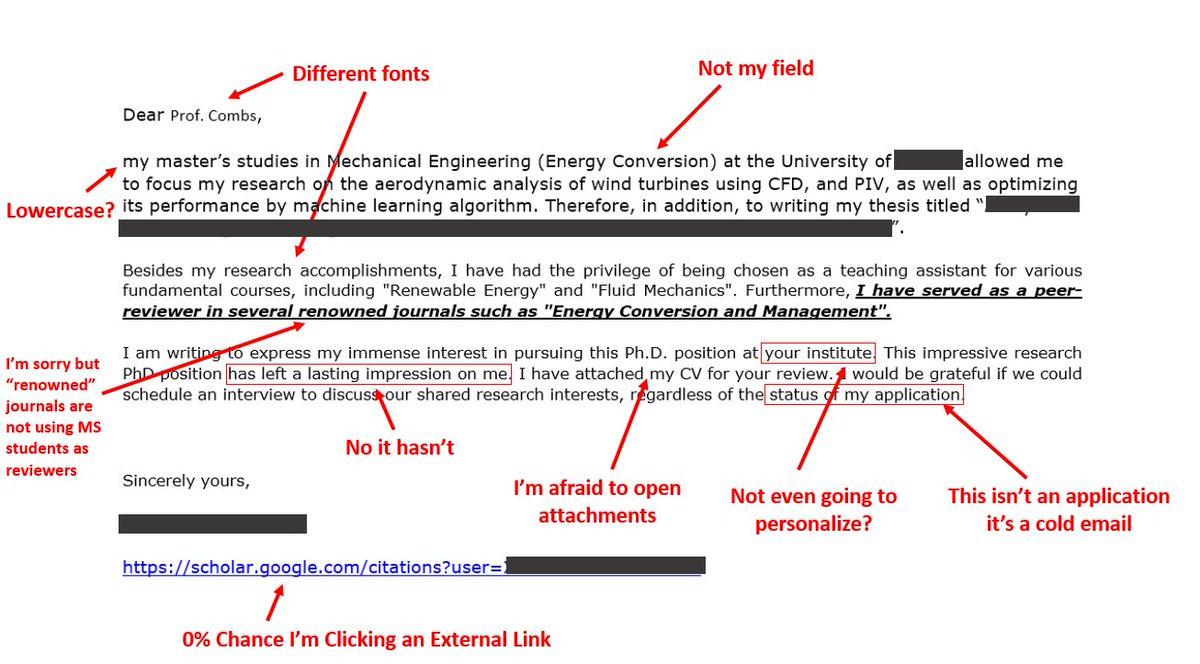
It's grad school application season and I see a lot of students wondering why faculty don't respond to their emails. I get emails like the one below every day and I delete almost all of them. Why? Let me discuss and help you learn how to write an email that WILL elicit a response...
For starters, when I see a clear form/copy-paste email with different fonts in the greeting it is 1) sloppy; 2) clearly someone fishing. Auto-delete. When you're writing these emails the format and grammar MATTER. PIs want students that write well because they will need to publish. Extensive formatting/grammar edits in manuscripts means significantly more work for us. Plus, it exhibits poor attention to detail and I don't want someone sloppy working in my lab.
Students should also try and target faculty working in their field. Notice that some of the first several key words are energy, wind energy, CFD, and machine learning. That's not me. But if this student had taken time to connect their strengths to my research by focusing on fluid dynamics, aerodynamics, PIV/diagnostics, this would have come across much stronger.
They should have said: "I know I have not worked in hypersonics but I have experience working in an experimental lab performing aerodynamic analysis using diagnostics like PIV. I would love the opportunity to apply this expertise in your hypersonic wind tunnel while completing my PhD". THAT is compelling.
Notice how the word "hypersonics" isn't in the original email once? They haven't mentioned the name of my university? Or mentioned any of our research areas? I also haven't had an active job posting in several weeks. It is all entirely generic.
You need to make an attempt to connect to this faculty member. Talk about how your experience would benefit their lab specifically. Which projects do they have that you find interesting? What was a specific finding in one of their papers that opened your eyes? Have you met them at a conference or been to one of their talks? Watched a recording online, heard them on a podcast, read an op-ed they wrote? Do you follow them on Twitter? (That last one might sound silly but it's a "connection" and can get a response)
Also note that we are probably wary of clicking external links or downloading attachments. Those might as well not be there. Highlight your high GPA, test scores, and maybe relevant coursework/papers in the body of the email. You don't want to make it too long but you need to sell yourself in the body not with attachments.
One point that is perhaps unfortunate but true: you need to have a certain degree of awareness of geopolitical events if you are applying to a school outside your home country. Are you applying somewhere that has a strained relationship with your home government? Will there be visa/travel/data access restrictions? This is especially true if the researcher is getting funding from defense agencies. Kids in the US probably shouldn't bother applying for grad school in Russia right now, for example. I wish the whole world was kumbaya all the time but unfortunately we all know that's just not how it is.
Can you get a current faculty mentor to reach out to someone on your behalf with a recommendation? That's also an introduction that is much more likely to get a response.
It also really helps if you send these emails *after* you have applied to the school. It shows you are serious. We're more likely to respond to an email from someone that we think we might run into on campus (or have in class) next year.
You might be saying "that's a lot of work to personalize those emails" and "that's a lot of money on application fees". Yes and yes. Regarding the former, if you aren't targeted in these emails and putting a lot of work into them, you aren't going to get responses. So consider the workload you can handle, do your research, and go after a select group of schools and faculty that seem like a good match. If you're sending 100s of these you're doing it wrong. Same comments go for application fee cost. There is a certain upfront investment in the application process (I'm not endorsing the system it's just a fact) but I would recommend applying to maybe 5 schools tops. Know your credentials and GPA. Talk to others to get a feel for where you will be admitted. You might email department/graduate school staff to inquire on general admissions requirements/guidelines. If your GPA + scores are so low you aren't confident you'll get in anywhere? You need to be asking yourself why you're going to grad school in the first place. Is it the right time? It's not like the classes are about to get easier.
Now, disclaimer, even if you do all that you're still not going to be getting responses from everyone. Plenty of faculty I work with don't even respond to my emails. Even faculty that are interested might not have funding at the right time, so there's a bit of timing luck involved as well. This is where targeting faculty that have specific ads posted (on personal websites or on job boards) makes a difference. But you'll at least have a good shot of not ending up in the auto-delete pile.
Hopefully this was constructive--please try to take this for what it is intended to be (helpful). This isn't a personal take-down, I'm sharing because I think this is information most students just don't have. Good luck out there!
PS: what to do when you don't get a response? Mostly, just try to not worry about it. Like I said, many will not respond even to a good email. Hopefully you get enough responses to have some options though. If you write good emails and your credentials are excellent (this is grad school, so they should be), it won't be a problem. If you feel the need to follow up, give people at least 5-10 business days before checking in. Also beware of local holidays (religious or otherwise). I've gotten emails from students on Dec. 25 and then follow-ups on Jan. 1 asking why I haven't responded. Don't be that person.
@ZJAyres Wild that this is not already the norm indeed. My uni will advance up to 70% (IIRC) of the travel budget, pays for the airline tickets directly and refunds declarations within 14 days most of the time. Wonder what's keeping other institutions.
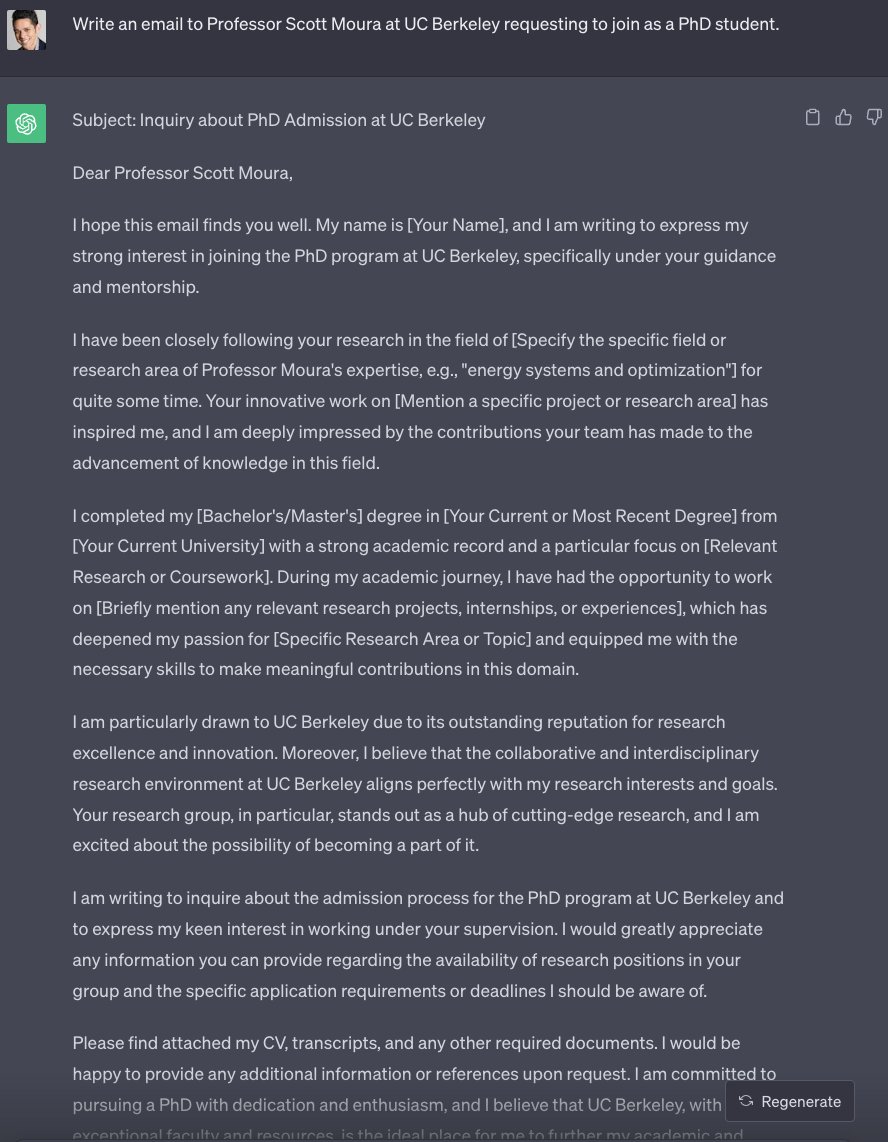
Using this template as a structure for a letter is fine, but ditch the vague and unspecific language. I get that you're applying widely, and you don't have to pretend that I'm the only person you'd ever consider working with, but at least explain what interests you about my work.
Even before chatGPT I got plenty of mails following this template (or similar ones). The issue is that they are so impersonal. If my work on [topic] actually inspired you, then articulate *specifically* what you found so inspirational.
Recently, I've received an uptick in emails requesting PhD admission. The emails are remarkably similar. I did an experiment and they match almost perfectly.
@hexallography Yep, that could definitely be a good approach. In a practice setting you can deliberately exaggerate such things and find out how far you can take it in a 'real' setting. Watching / listening to recordings of yourself is a great tool as well.