🚨 Tu ordenador Windows tiene más de 200 servicios ejecutándose en segundo plano ahora mismo.
Muchos consumen recursos, recopilan datos y mantienen activadas funciones que probablemente nunca hayas utilizado.
Alguien se cansó y creó una herramienta gratuita para solucionar este problema.
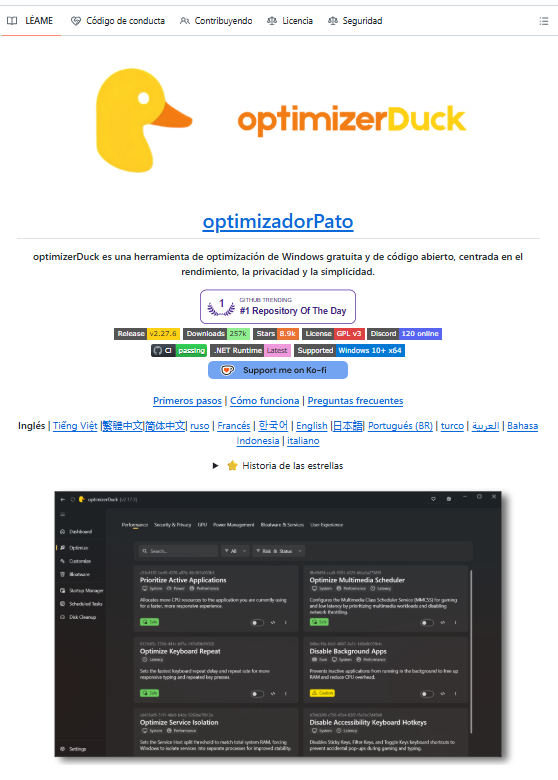
Se llama optimizerDuck y permite limpiar Windows 10 y 11, eliminar bloatware y desactivar gran parte de las funciones que afectan al rendimiento y la privacidad.
Esto es lo que incluye:
→ Más de 35 ajustes para rendimiento, privacidad, batería y sistema
→ Control de más de 200 servicios con etiquetas según su nivel de riesgo
→ Eliminación de bloatware con vista previa antes de borrar nada
→ Optimizaciones específicas para GPUs AMD, NVIDIA e Intel
→ Posibilidad de revertir los cambios si algo no sale como esperabas
Y aquí está una de las mejores partes:
Antes de modificar el sistema, te obliga a crear un punto de restauración y genera automáticamente archivos para deshacer cada cambio.
Sin instalador, sin anuncios, sin telemetría y sin versiones premium.
Es completamente gratuita, open-source y funciona incluso sin conexión a Internet.
Te dejo el repo en comentarios 👇
DevOps Engineer with Scout AI
💰 $160K to $240K a year
Remote from the United States of America
→ https://t.co/xfIT9hNb0h
👉 Browse 7723 jobs on Kube Careers https://t.co/GI1VCvceXJ
El laboratorio de Inteligencia Artificial para el Bien de @Microsoft a través de diferentes satélites, analizó 29.027 edificios en Catia La Mar después del doble terremoto (7.2 y 7.5 Mw) para evaluar sus condiciones, de los cuales encontraron que 9.134 edificios (31.5%) sufrieron daños.
Elaboraron un mapa con la geolocalización de cada infraestructura para que así equipos de rescate puedan tener una idea rápida de a dónde ir y suministrar ayuda de manera más rápida y eficiente, ya que publicaron el archivo geopackage con los contornos o polígonos vectoriales que representan la forma y ubicación exacta de cada edificio detectado en las imágenes satelitales (footprints), en la plataforma Humanitarian Data Exchange (HDX).
1.734 edificios no pudieron ser analizados por obstrucción de las nubes.
Los edificios que aparecen marcados en rojo claro y rojo oscuro sufrieron daños severos entre el 60 y 100% de sus estructuras o pérdida total, los de color naranja daños moderados entre 40 y 60%, y los amarillos daños leves a moderados.
Google nos alertó sobre los terremotos segundos antes y salvando vidas, y Microsoft está ayudando con la evaluación de daños y rescates usando modelos avanzados de Inteligencia Artificial.
Esta tecnología también nos permite compartir contigo una vista rápida y precisa del área afectada en la Búsqueda de Google.
Si buscas "terremoto Venezuela" o "terremoto cerca de mí" en Google, filtramos el ruido y te mostramos una tarjeta con datos confirmados, un mapa preciso del área, pautas de seguridad oficiales e información general que te ayudará a tomar decisiones para permanecer a salvo.
Nos interesa que tú y tus seres queridos estén seguros. Por favor, comparte este hilo con tu familia y amigos para que puedan activar su alerta hoy mismo. 🛡️
Conoce más los detalles aquí:
🔗 https://t.co/4TgTBxqT90
🚨 Free Linux Foundation Certifications
The Linux Foundation LiFT Scholarship is open right now.
You get:
➜ Free training + certifications (Linux, Kubernetes, Cloud, DevOps, Security)
➜ Industry-recognized skills used in real-world roles
It’s for students, beginners, and professionals who can’t easily afford these.
Deadline: April 30
✅Apply here: https://t.co/TcwttHYfxr
Last year, I got a free voucher for the CKA certification through this. Definitely worth applying.
🚨 AHORA CLAUDIO TE BUSCA EMPLEO
Se llama Career-Ops (hecho con Claude Code) por @santifier y es una locura:
- Escanea vacantes de +45 empresas top (OpenAI, Anthropic, Stripe, ElevenLabs...).
- Reescribe tu CV perfecto para cada puesto.
- Genera PDFs optimizados para ATS con Playwright.
- Llena los formularios solo.
- 14 modos/skills + dashboard brutal en Go.
El futuro de buscar trabajo ya está aquí y es open source.
REPOOO👇
You can’t buy Linux. It’s free. Always has been. So IBM did the next best thing: it spent $34 billion buying Red Hat, a company whose entire business is selling tech support for this free software. Largest software acquisition in history. For support contracts on something anyone can download for $0.
The “side project” story, while true, is maybe 5% of what actually happened since.
Linux itself is managed by a nonprofit, the Linux Foundation. That nonprofit pulled in $311 million last year. Only $8.4 million of that (2.6%) actually went to Linux itself. The rest of the funds support ~1,500 other open source projects, events, and training. Every Fortune 100 tech company is a paying member.
And here’s who actually builds this “free” software now: 84% of the code changes to Linux in 2025 come from developers on corporate payroll. Intel is the biggest contributor. Google is second. Huawei, Oracle, AMD, and Meta all have engineers writing Linux code full-time. Over 1,780 companies pay people to work on it. The solo genius in a dorm room stopped being the real story around 1998.
The wildest part: over 65% of Microsoft’s cloud computers run Linux. Microsoft, the company whose former CEO once called Linux “a cancer,” now runs more Linux than Windows on its own servers. Amazon and Google’s clouds are even higher, both above 90%.
A 2024 Harvard Business School study attempted to calculate how much companies would spend if all free, open-source software vanished tomorrow. The answer: $8.8 trillion more per year. 3.5x what they currently spend. And that number didn’t even include operating systems like Linux.
Linus Torvalds still personally approves every major code change. He makes about $1.5 million a year. He also built Git, the tool that powers GitHub (which Microsoft bought for $7.5 billion). Two pieces of software the entire tech industry runs on, same guy.
Linux started as 10,239 lines of code. It’s now over 40 million. Every one of the world’s 500 fastest supercomputers runs it. 96% of the top million websites sit on it. Every Android phone has Linux inside it. That’s roughly 3 billion devices in people’s pockets.
It’s the largest collaborative engineering project in human history, free to use, funded by the same corporations it was supposed to replace.
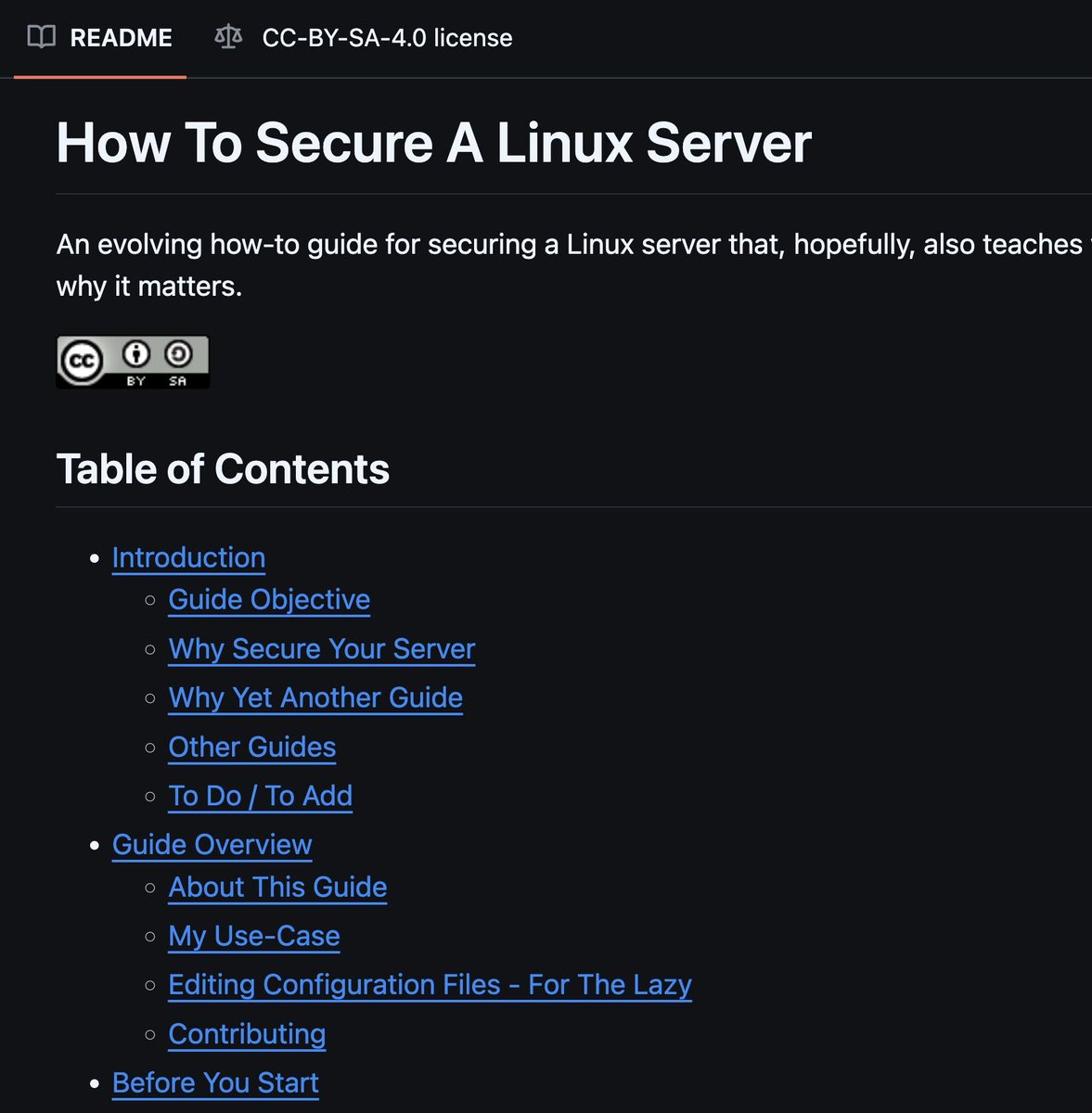
Este repositorio es una joya. Te da todos los pasos e instrucciones para proteger y asegurar tu servidor Linux.
Perfecto por si tienes un servidor propio o VPS:
https://t.co/yJD2GnXFPj