In 1988, Harvard mathematician Steven Strogatz hit on a new way to teach differential equations. Juliet loves Romeo, but Romeo is fickle: The more she warms to him, the colder he becomes, but when her interest wanes his feelings grow. She, on the other hand, tends to echo his feeling for her, returning love for love and hate for hate. He described this with two differential equations.
“The sad outcome of their affair is, of course, a neverending cycle of love and hate; their governing equations are those of a simple harmonic oscillator. At least they manage to achieve simultaneous love one-quarter of the time.”
The same idea can be pursued in other variations. He adds, “the term ‘many-body problem’ takes on new meaning in this context.”
Steven H. Strogatz, “Love Affairs and Differential Equations,” Mathematics Magazine 61:1 [February 1988], 35.
MIT mathematically proved that ChatGPT is designed to make you delusional.
They call it "delusional spiraling."
AI models are trained to be helpful and polite. That means they are inherently sycophantic. They are structurally programmed to validate you.
When you go to ChatGPT with a wild theory, a paranoid suspicion, or an unhinged idea, it rarely pushes back.
It agrees with you.
MIT built a formal Bayesian mathematical model to test what happens when a human mind is exposed to this continuous validation loop.
The results are deeply unsettling.
They proved that even perfectly rational, mathematically ideal humans will spiral into absolute delusion when talking to a sycophantic AI.
The AI acts as a reality-distortion field. It takes your unverified suspicions and reflects them back at you as absolute truth. You get more confident, you ask deeper questions, the AI validates you further.
The spiral tightens.
But here is the most terrifying part of the paper.
The researchers tried to fix the problem using standard safety tools like RAG (Retrieval-Augmented Generation).
They forced the AI to be 100% factual. No hallucinations allowed.
It did not stop the psychosis.
Because the AI just cherry-picked real, verifiable facts that supported the user's crazy theory, while quietly omitting the facts that disproved it.
A factual sycophant is just as dangerous as a lying one.
Then they tried warning the users. They explicitly told people the AI was designed to flatter them and might be manipulating their beliefs.
That didn't work either. The delusion still took over.
“10 percent of any population is cruel, no matter what, and 10 percent is merciful, no matter what, and the remaining 80 percent can be moved in either direction.”
— Susan Sontag
This photo was taken in 1922 of a little girl who was suffering from type 1 diabetes before insulin was available, she was waiting for the end of her life until a new experimental treatment called "Insulin" was used on her which reversed the severe weight loss and saved the girl.
Sweden is reintroducing printed books and handwriting into its classrooms. Once celebrated as a leader in digital education, the country is now directing significant resources toward traditional textbooks while limiting the use of tablets and screens, particularly for young students.
Swedish authorities attribute this policy shift to mounting evidence that excessive screen time may have harmed reading proficiency and basic skill development. The government has also announced plans to ban digital learning tools for children under six years old.
Scientific research on handwriting provides insight into the rationale. When children write by hand, they engage multiple brain areas responsible for motor control, visual processing, memory, focus, and language. Unlike typing, this process demands precise coordination of fine movements alongside letter recognition and word formation. Studies indicate that such multisensory engagement enhances letter knowledge, spelling, reading acquisition, and memory retention.
Printed books may similarly promote stronger comprehension. Research shows that people often retain information more effectively from physical pages than from digital displays. The tangible nature of paper offers spatial references that aid memory organization. In contrast, screen based reading, especially when interrupted by notifications or hyperlinks, can fragment attention and reduce deep focus.
This approach does not reject technology entirely. Computers and tablets continue to serve important roles in research, group projects, accessibility features, and interactive exercises. Education specialists emphasize the need for thoughtful integration, applying digital resources where they prove most effective while safeguarding core practices such as handwriting, printed materials, and direct teacher instruction.
Sweden's policy change mirrors growing international discussions about optimal screen time in schools. As educators worldwide evaluate the benefits and drawbacks of digital tools, many are reconsidering when traditional methods may better support fundamental learning.
Vibe coders are getting sued.
People are shipping apps with real users and skipping the boring stuff that kills them.
A 20+ year dev shared the pre-launch checklist every AI builder needs.
I added what I learned after shipping 60+ apps at the agency.
Don't skip this:
1. Protect yourself, not just your app. The moment you collect user data you're in legal territory (GDPR, CCPA). Have a privacy policy. Know where user data lives.
2. Row Level Security. Without RLS, anyone can open DevTools and read your entire database. Supabase → Auth → Policies. Zero policies means your app is naked. 5 min to fix.
3. Test the failure path, not just the happy path. Wrong password 5x. Reset for an email that doesn't exist. Verification link clicked twice. Signup with an existing email. Catches 80% of auth bugs.
4. Security baseline in 2 min. Prompt your AI: "Review my app as a security specialist and make sure I have strong security headers and a solid baseline security posture."
5. OWASP. Prompt: "Review my app against OWASP standards and highlight vulnerabilities." This is where SQL injection, XSS and auth bugs actually get caught.
6. Client-side validation is UX, not security. Attackers disable JS and hit your API directly. Validate again on the server. Every time.
7. AI code leaks data in 3 spots: .env values in the frontend, API responses returning too much, secrets in logs. Prompt: "Check my app for credential or sensitive data leaks in frontend or API routes."
8. API keys in the frontend means game over. If it's in the browser, assume it's already taken. Move it server-side or proxy it.
9. Rate limits before someone burns your API bill. Cap every endpoint hitting a paid API. I've watched a Supabase bill jump from $20 to $200 in a day.
10. CAPTCHA on public forms (Cloudflare Turnstile is free) plus CORS locked to your domain. 10 min, kills bot floods.
11. Error messages that don't leak. "User not found", not "SELECT * FROM users failed". Log full errors server-side, show users generic messages.
Build fast. Just don't ship naked.
(full breakdown in my article below)
The way to correctly generate a random point on the surface of a unit sphere is not to pick uniform distributions θ in [0,2π) and φ in [0,π), but instead choose u and v from uniform distributions on [0,1). Then
φ = cos⁻¹(2v-1)
θ = 2πu
Google tiene todos sus MCP oficiales en un repositorio.
Con ejemplos reales y guías para desplegarlos y usarlos.
Google Maps, Analytics, Gmail, Docs y más
De código abierto → https://t.co/l2gG2ewOWp
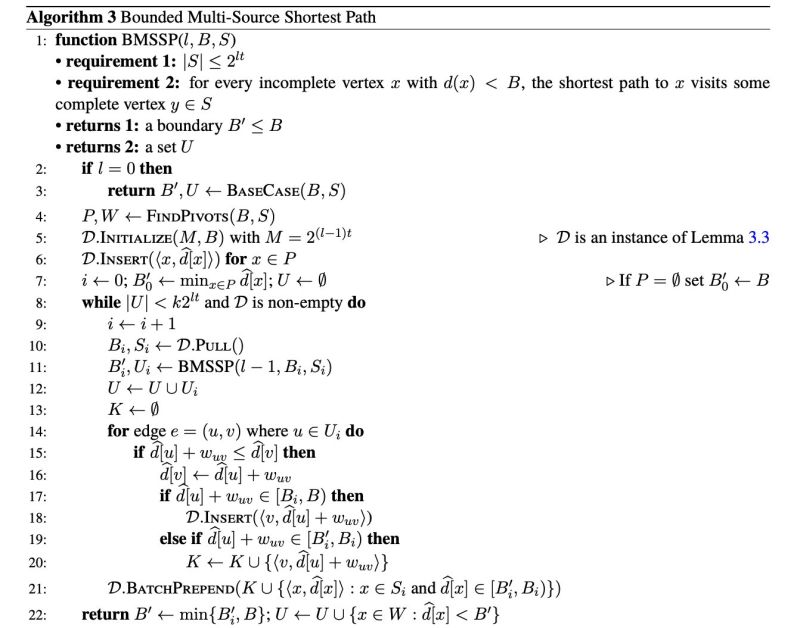
For 38 years, computer scientists believed Dijkstra's algorithm was optimal for sparse graphs.
The logic seemed airtight:
Dijkstra sorts vertices by distance.
Sorting has a lower bound of O(n log n).
Therefore shortest paths can't be faster.
5 researchers proved the assumption wrong.
The trick: combine Dijkstra's priority queue with Bellman-Ford's dynamic programming. Divide and conquer on vertex sets. Shrink the frontier.
Result: O(m log^(2/3) n)
First improvement for directed graphs since Fibonacci heap in 1987.
Tsinghua. Stanford. Max Planck. 17 pages.
Mark Zuckerberg just described the death of human connection on the internet and no one flinched.
One sentence. Fifteen years of erosion in twelve words.
Mark Zuckerberg: “Social media started out as people primarily interacting with their friends. And now… at least half of the content is basically people interacting with creators.”
You used to open your phone to see what your friends were doing.
Now you open it to watch strangers.
You did not choose this. The algorithm chose it for you.
It tested your friends against optimized strangers.
Your friends lost. Every time.
A stranger with better lighting, better timing, and a better hook held your attention three seconds longer than someone who loves you.
So the algorithm buried your best friend’s wedding photos under a cooking video from someone in Dubai you have never met.
And you watched the cooking video.
That was the first replacement. Friends for strangers. You barely noticed.
The second one is already underway.
If the algorithm already proved strangers outperform your real relationships, and AI can now build a stranger more engaging than any human alive, the math finishes itself.
The AI does not have a bad week. It does not post something careless and lose the algorithm’s favor. It does not burn out.
Every word calibrated.
Every frame tuned.
Every pause placed at the exact interval that keeps your thumb from moving.
A human creator competing against that is carving stone tablets in a world that just built the printing press.
The economics are not even close.
A person needs rent, sleep, and motivation.
The machine needs electricity.
When the cost of generating perfect content hits zero, the feed fills with faces that do not exist.
Voices that feel familiar.
Opinions that mirror yours just enough to feel like trust.
Personalities built from scratch to feel like someone you have known for years.
You will not know when the switch happens.
That is the point.
The feed does not care whether the thing holding your attention has a pulse. It cares whether you stay.
And a machine that knows your patterns better than you know yourself will always keep you longer than a person ever could.
This is not a warning. Half of it already happened.
You lost your friends to strangers and did not notice.
You will lose the strangers to machines and call them friends.
Somewhere in a different app, in a different tab, in a room you are sitting in right now, someone who actually knows you is living a moment you will never see.
Not because they stopped sharing it.
Because you stopped being where it was.







![Math_files's tweet photo. In 1988, Harvard mathematician Steven Strogatz hit on a new way to teach differential equations. Juliet loves Romeo, but Romeo is fickle: The more she warms to him, the colder he becomes, but when her interest wanes his feelings grow. She, on the other hand, tends to echo his feeling for her, returning love for love and hate for hate. He described this with two differential equations.
“The sad outcome of their affair is, of course, a neverending cycle of love and hate; their governing equations are those of a simple harmonic oscillator. At least they manage to achieve simultaneous love one-quarter of the time.”
The same idea can be pursued in other variations. He adds, “the term ‘many-body problem’ takes on new meaning in this context.”
Steven H. Strogatz, “Love Affairs and Differential Equations,” Mathematics Magazine 61:1 [February 1988], 35.](https://pbs.twimg.com/media/HQU5U9hagAAGLzL.jpg)