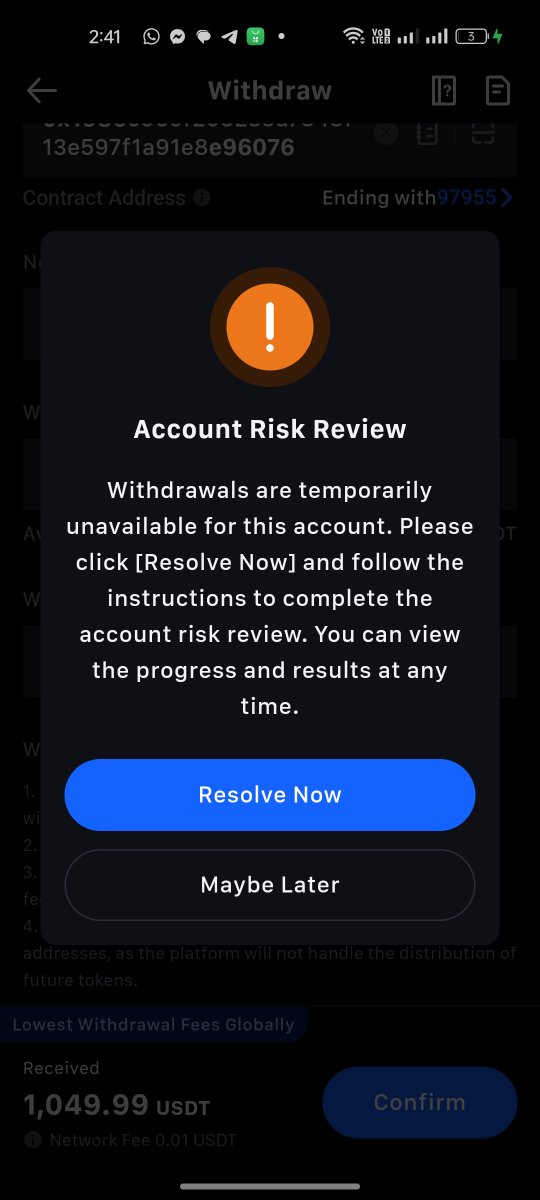
@JannatullFerdo1 @MEXC_Official @cecilia_hsueh Please clarify what this process involves. Also, ensure that her funds are released immediately. Thank you.
@MEXC_Official @cecilia_hsueh
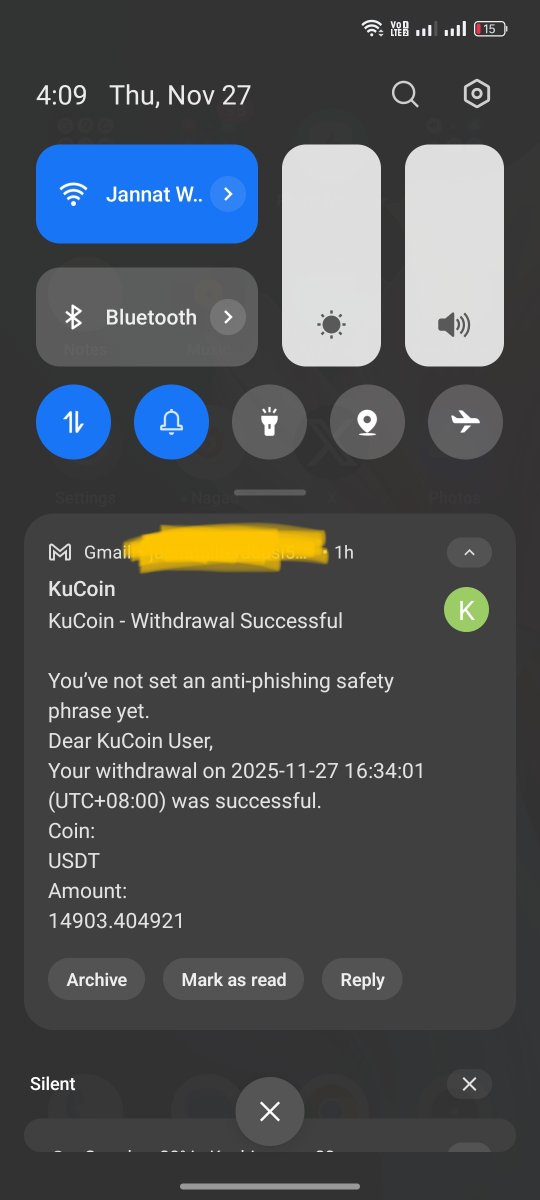
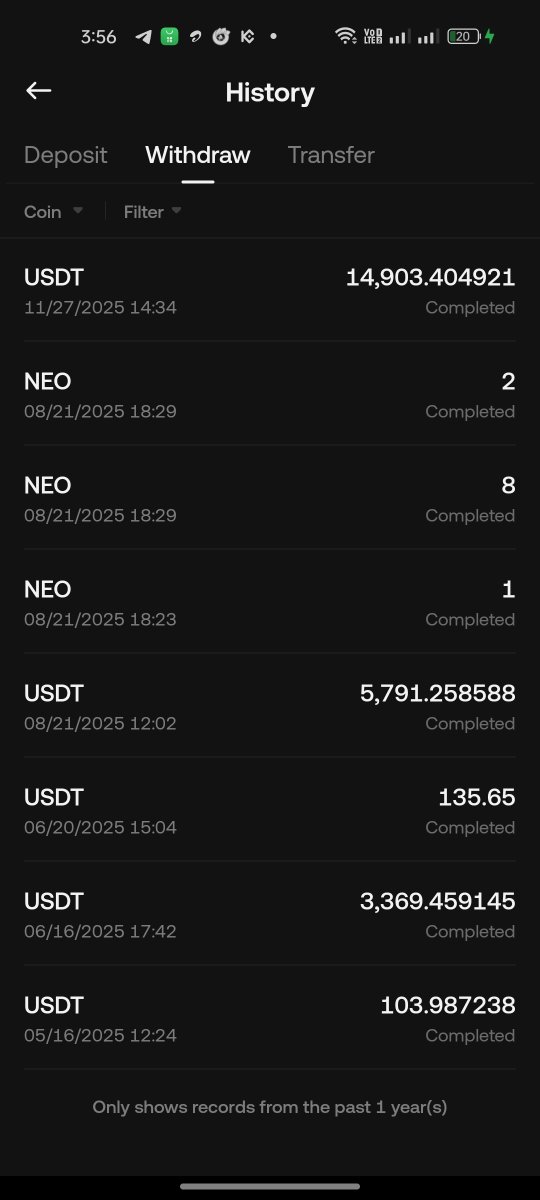
Today I withdraw 14900$+ from KuCoin to MEXC Exchange. As soon as the withdrawal was completed and the deposit reached MEXC, My MEXC account got restricted. This is my Hard Earned money. I want my funds Back
@MEXC_Official
@cecilia_hsueh
you: hate farmers
we: appreciate farmers as people all around the world trying to earn in the new global economy who deserve our respect and help growing the skills they need to meaningfully contribute
I expect Monad to be a failure
Huge VC raise followed by years wasted in their little bubble of arrogant mfers in nyc doing absolutely nothing
Now they’re all busy congratulating themselves over some random card reveal
Pathetic
No one will give a fuck about Monad in 45 days
When ppl claim this I always wonder how they think it happens, or have unrealistic expectations on how much $1bn actually is.
I joined crypto with $200. If I held my initial bitcoin since then and never traded, I would have ~$300k.
If, instead, from that moment I sold the top and bought the bottom of every crypto cycle on Bitcoin, and never paid any taxes, I would have ~$6m USD.
If I put my entire net worth into the Ethereum ICO and never touched it, today I would have ~$150m pre-tax.
While it was definitely possible to have made >$1bn with the opportunities in the market, these versions of reality would also require me to make no mistakes, and have no need to spend $ in real life, or take excessive risk via leverage.
In reality, I grew up in a working class family. I didn’t have a trust fund and I had to pay off my student loan myself. I had a job at Tescos while at high school. After university, I needed to pay rent and fund cost of living and eventually buy a place to live.
I worked at startups for relatively little $ salary, and while a couple have done okay, they still are illiquid and worth nothing until some exit.
Perhaps if I erase a couple of dumb mistakes and drawdowns, or if I had a lil more grind, then my answer would be different today. But it is easy to say this with perfect hindsight vision. It’s easy to see where you could have optimised better, and decisions you made look dumb when the past makes things so obvious.
The truth is I have always optimised for enjoying my life and not going to 0. I never felt like I had a safety net, so it was never possible for me to do anything in any other way. I would probably have less money if I had tried to add more risk or chased $ harder, because being all-in with your entire livelihood is a mental battle and I feel I only win that battle when the stakes are lower.
In writing this, maybe I do understand why CT folks believe this, because modern CT sees crypto as a late-stage lottery ticket farm, where the optimal strategy is to 5x leverage up your portfolio in a hope of catching a good 20% move and then leaving. Or, literally going all-in on the next coin they heard Ansem is buying. So perhaps to them, looking back at the charts, of course that’s what successful folks did.
In reality, I use leverage close to never (and typically to reduce risk rather than add risk — have used it to add risk maybe 3 times in the last 5 years, and maybe 15 times ever). I never go all-in on anything, have only ever done that on BTC and ETH before in the last decade. When I buy other things, I limit risk to tiny amounts, because I treat it as a 0 until proven otherwise (so, always <1% liquid portfolio). Liquid portfolio is also a smaller % of overall portfolio to future-proof against my own fuckups.
Obviously I made a lot of money, I have been here 12 years! CT doesn’t want to hear about “getting rich in a decade” though. I am happy with where I am and have never really cared or optimised for maximising $ earnings, but instead having a nice life that lets me enjoy the game we play together.
Spotlight on how Binance listings actually work.
Here are benefits we are pleased to provide to the project team:
1️⃣ Binance does not make money from the listing process. All project token allocations go 100% to users through marketing campaigns, including Alpha Airdrops, Launchpool, Hodler Airdrops, trading events, Earn APR campaigns, and more.
👉 Our business model is simple: small trading fees, not listing revenue.
2️⃣To protect users, Binance requires a refundable security deposit from projects. It acts as a safeguard against short term exploitation and ensures the project team stays committed post listing. Once a project meets its commitments, the full deposit is returned.
👉 User protection remains at the core of everything we do.
3️⃣If you’re in the early stages of your project, Binance Alpha is the best go-to-market path. No listing fees, just visibility, education, and growth. Alpha connects real users with promising projects through airdrops, Booster Programs, Pre-TGEs, and TGEs, building transparency and trust ahead of exchange listings.
👉 As of Oct 2025, 217 projects have joined Alpha, 103 listed on Futures and 36 on Spot after proving growth and meeting standards.
Join us! If you’d like to learn more about our listing process and apply to have your project listed.
Further details on Binance Listing and Requirements 👇
https://t.co/9ppRe39UUN
Unpopular opinion post:
On Listing "Fees" (saw this a few times recently)
1. If you are a project complaining about listing airdrops or "fees" (to users),
Don't pay it.
If your project is strong, exchanges will race to list your coin.
If you have to beg an exchange to list, then... You need to ask yourself why, and who is providing value to whom.
2. If you complain about a competitor exchange's listing fees, then by all means, make your own listing fees 0, and be happy.
In fact, why not set all your fees to 0? including trading fees?
In a decentralized world, businesses are free to have their own business models. No one is forcing you to adopt a certain model.
Focus on treating your users well. Don't focus on your competitors.
3. If you are a bag holder of a coin, complain to the project. Not the exchange. Or use a DEX.
4. PancakeSwap doesn't have listing fees, and has very good volumes.
Further on this topic, exchanges adopt different listing models.
1. List everything on every blockchain. Most tokens are scams. Of the real "hard working" projects, most fail. Only a few projects will succeed.
2. Selectively list and make listing fee a revenue source. It's fine business model if you can attractive enough projects to list. Many small exchanges use this model, as they don't have enough trading fee revenue.
3. Selectively list. Ask for Airdrops to users. Security deposits, to make scams and failed projects more expensive to pull off. Protect users.
These models are not black and white, and many exchanges adopt a combination of them between spot listing, futures listing, alpha listing, web3 wallet buys, etc.
Work on your project, not other people. 🙏
Let me share a little story on the largest ever single payment from @Binance, the $6m in 2017!
I hope this will help you better understand the #Binance culture.
Binance launched on July 14, 2017, having successfully raised $15m in its ICO two weeks prior.
Less than 6 week later, on Sept 4th, 2017, China issued a ban on crypto exchanges, crypto mining, as well as recommending any ICO projects to return users investments in full should the users want it.
With the announcement, many tokens dropped below their ICO price. BNB dropped from 22x to 6x of its ICO price. Luckily, it was still 6x. So no one wanted to return $6 for $1.
However, four other projects on Binance fell below their ICO prices. The teams behind those projects lacked the funds to fully reimburse their users.
Our team ran some calculations. The gap was about $6 million USD.
The team called me and asked if we should use our own funds to make our users whole, even though those were neither our projects, nor our obligation.
$6m million might not sound like a lot today, but to put it in perspective, we had raised $15 million just eight weeks prior. We were not profitable. We were buying servers and hiring people. We were burning cash.
Giving $6 million to users would deplete our corporate treasury by more than 40%.
I joined the call on a moving train in Tokyo. I asked if anyone had any objections.
No one objected. I said, “let’s do it”.
Percentage wise, that was the single largest transaction in our corporate history.
That announcement immediately received overwhelming responses from the crypto community, not only in China, but around the world.
No other company had protected its users to such an extent, even to this day.
The market rewarded us. Users from around the world joined us. They saw that Binance protected users with not just words, but with action and funds.
When we made the decision to make users whole, we had about 35,000 users. A month later, we had 120,000 users. We became profitable, and have been ever since.
Two months after that, we became the world’s largest crypto exchange, and have been ever since.
Hence our core value: Protect Users!