Amir, a long-time Todoist user here. 👋
Since you're getting slop, would it make sense to test what happens if your agent got access to
– Code examples, based on real implementations from repos, issues, discussions, and pull requests, linked back to the implementation code
– Code Navigation across packages and repos: search, grep, file listing, and exact line reads without cloning
– Package Inspection for dependencies, vulnerabilities, changelogs, and upgrade changes
Asking, because @GitHits_com CLI enables all that and it doesn't cost anything to try.
See how GitHits helps Codex to resolve DuckDB C++ migration. Vanilla Codex failed at the task, while with GitHits Codex used fewer tokens, converged faster, and produced a correct solution. https://t.co/dAaGo3P9hy
@ycombinator: build a product users 🩷
Our power users realize the impact of giving agents access to real implementations from open source, because the problem with AI coding agents is that they work with partial information: model training data, partial docs, and the limited context available in your current repo.
That’s where agents start looping and hallucinating:
- Chasing hallucinated APIs that don't exist
- Guessing integration patterns from incomplete docs
- Wrestling with missing behavior that changed between versions
- Treating package internals like a black box
To make the right choices, your agent needs to see inside the open source stack: the packages, SDKs, issues, PRs, and docs scattered across GitHub, package registries, and websites.
GitHits brings that context to your agent:
1/ Real implementation examples, so the agent can see how an API, library, or framework is used in working projects, not just in toy snippets or outdated blog posts. Code examples are distilled from repositories, issues, discussions, and pull requests, with links back to the source code.
2/ Dependency source navigation, so the agent can inspect what a package does under the hood, without cloning the repo (find symbols, search files, follow implementation paths, and read exact line ranges).
3/ Package inspection, so the agent can make safer dependency changes by checking metadata, vulnerabilities, changelogs, and upgrade context before editing code.
4/ Documentation access, so the agent can combine official up-to-date docs with real code usage, whether the docs are hosted separately or live inside the repo.
npx githits@latest init
Thanks for the shoutout, @robinebers !
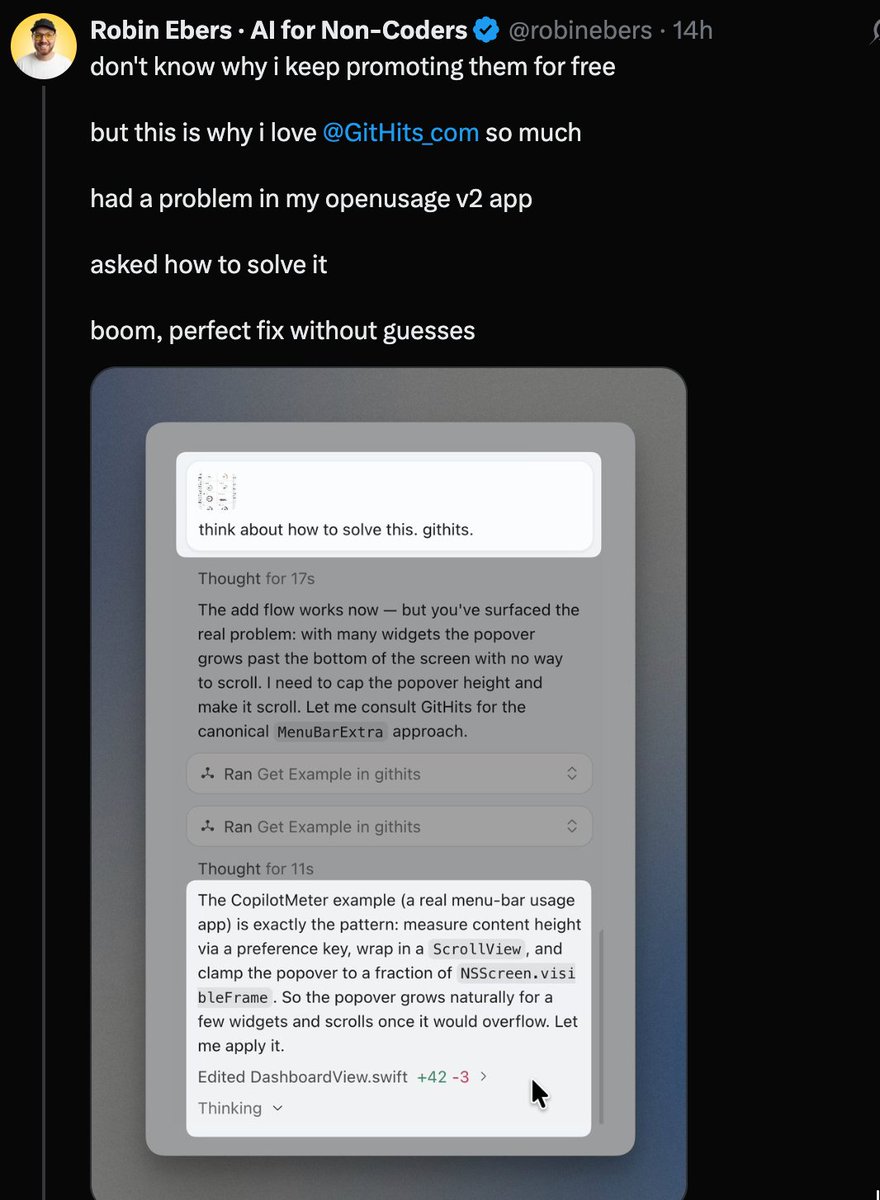
don't know why i keep promoting them for free
but this is why i love @GitHits_com so much
had a problem in my openusage v2 app
asked how to solve it
boom, perfect fix without guesses
@Avantgarrdde@brettcalhounn Here's a recent comment from our user. It makes a difference when your agent has access to real implementations, because whatever you're building, another engineer has likely already solved the same issue.
@hhawk@OpenAI@thsottiaux Ok, thanks for sharing. Anyway, if your agent doesn't know how to implement something, GitHits could be able to help. We just received this feedback.
we’re launching Motion, the frontier agent for tasteful motion design.
this launch video is made entirely with Motion. 👇🏽
QT + comment "MOTION" to get 1,000 free credits.
tag @motion_so in any X post for a surprise.
now generally available at motion [dot] so.
Regarding migrations, it might help if you could just say to your agent: "tell me how to use something in this project" or "tell me how something works", and the answer would not be pulled from training data but from real implementations from open source.
Just a couple of examples about what you/your agent could do with GitHits. More in the screenshot.
@__avik Use GitHits as a judge. You can just ask your agent to "use GitHits to tell me how something works / how to use something in this project", and it will scour through open source to find real implementations instead of relying on training data or outdated docs.
Yeah, getting great documentation is good, but documentation is just an abstraction layer. The truth is out there in code. Whatever you're building or debugging, it is likely that another engineer has already solved the problem. Your agent just needs access to real implementations instead of just docs.
@GitHits_com helps by:
> Bringing open source *code* as context, from real implementations
> Navigating dependencies (grep, glob, read, search etc)
> Conducting package inspection (deps, vulns, changelog)
CLI available: npx githits@latest init
Forever free tier available.
@kabra_sidhant What if your agent could do all this without you leaving the IDE
1/ Find real implementation examples from open source
2/ Navigate dependency sources
3/ Conduct package navigation
...would that be useful?
@CryptoCyberia@GrassEnjoyerx If you'd like to increase the accuracy, would it help if your AI coding agent got access to real open source implementations?