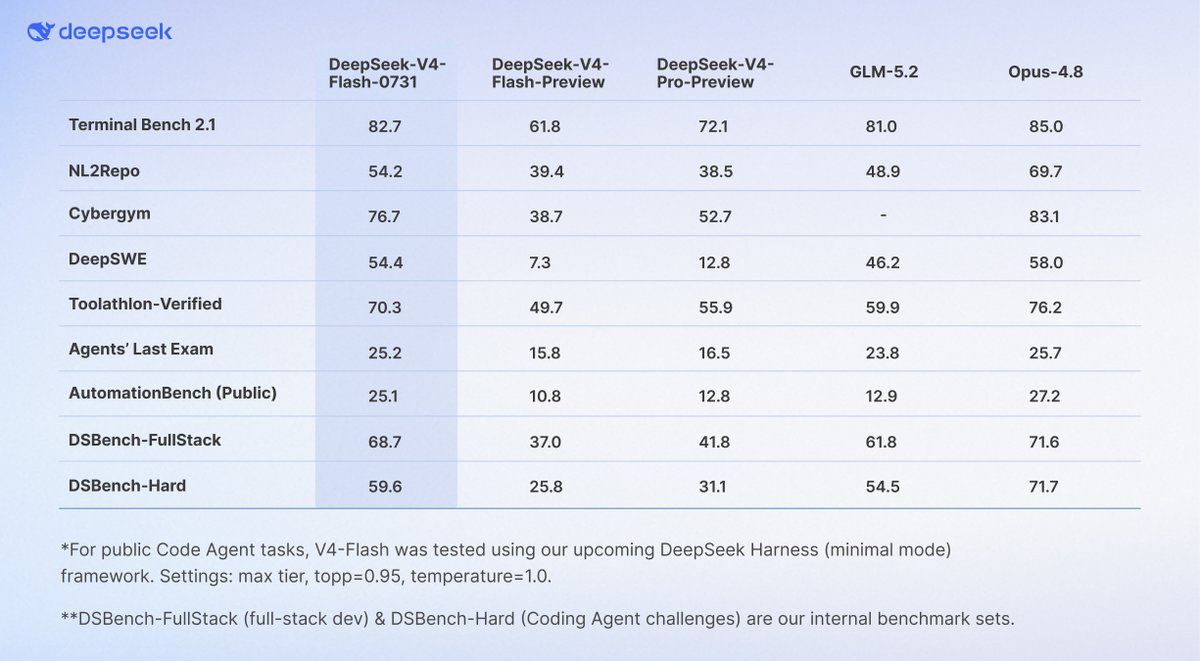
🚀 DeepSeek-V4-Flash Official API is now LIVE in public beta!
🔷 We’ve massively upgraded its Agent capabilities—benchmark scores are now far surpassing the V4-Pro-Preview. Check out the massive performance leap below! 👇
🔷 The official V4-Flash now natively supports the Responses API format and is fully adapted for Codex!
Check out the configuration details in our official API docs: https://t.co/smCwQZMeiq
Releasing the model weights and technical report of Kimi K3.
Kimi K3 is our most capable model: a 2.8T MoE model with native visual understanding and a 1M-token context window.
New model architecture: 2.5x the intelligence per unit of compute, not just more params.
Alongside Kimi K3, we're opening up more of the stack behind it — high-performance attention kernels, MoE communication library, and infrastructure for running agent environments at scale.
Model weights: https://t.co/7m7eEg6Y0B
Tech report: https://t.co/yeu6cjpMCT
Tech blog: https://t.co/YTfiMSNM1f
something that has been resonating with me a lot lately
in the age of AI you need strong opinions of your own more than ever. otherwise you’re not thinking, you’re internalising. these models are mean-reversion machines. if you outsource your views to that and the beliefs you end up holding were never yours.
Many LLM-based optimization algorithms have been proposed recently. We find that GEPA, AutoResearch, and Meta-Harness each win on different tasks and no single LLM optimizer wins everywhere.
How do we leverage the complementary performance profiles of these optimization algorithms?
Today, we release optimize_anything omni: a meta-optimizer that leverages the best of each optimizer. At a matched budget, omni beats every standalone optimizer. (thread)
We're hiring a Research Engineer at @Arsenal ⚽🔴⚪ to work directly with our Men's First Team!
We're building state-of-the-art AI models for the football domain. This role will focus on building the application layer for our research to advance coaching and analysis workflows.
Qwen3.8 is launching and going open-weight soon!🌐
With a massive 2.4T parameters, this model is continuously evolving. We believe it’s one of the most powerful model available today, compatible to leading frontier AI models , second only to Fable 5.
You don't have to wait to test it. Just now, the Qwen3.8-Max-Preview made its debut on Alibaba’s Token Plan, Qoder, and QoderWork. Be among the very first to try it out.
Can't wait to hear what you build. Stay tuned! 🚀
Token Plan
international:https://t.co/YRvcGdB9Bv
China:https://t.co/PKMUNwUuRp
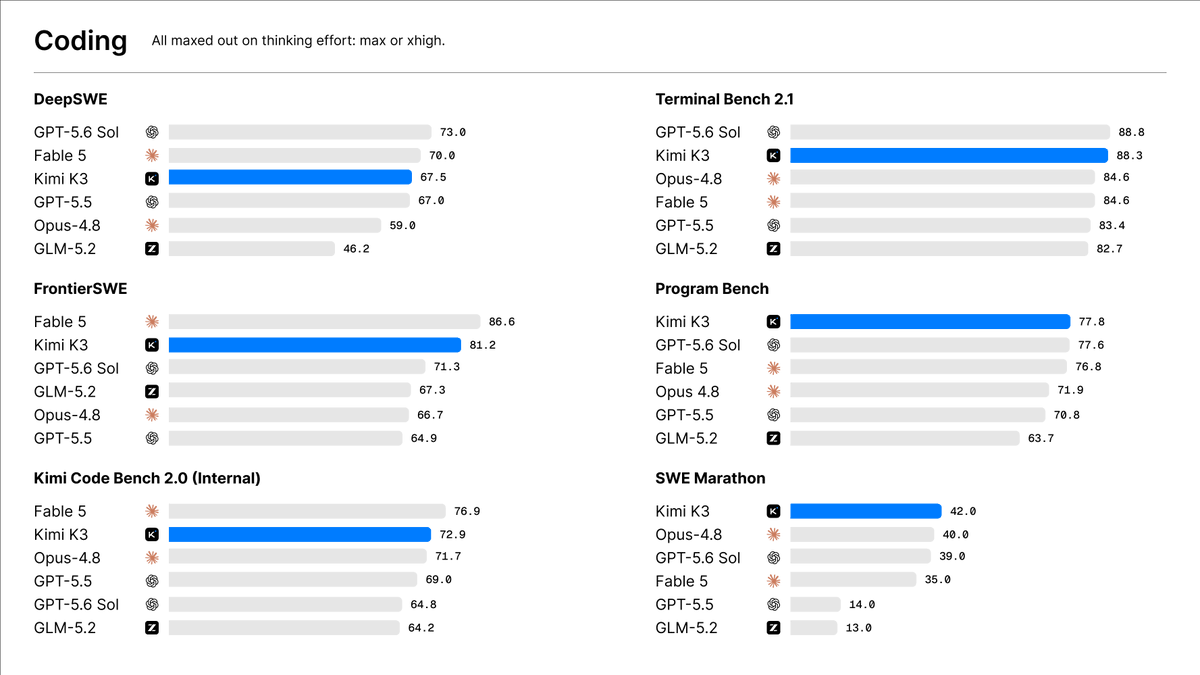
Introducing Kimi K3: Open Frontier Intelligence
🔹 2.8 Trillion Parameters, 1 Million Context, Native Multimodal
🔹 Kimi Delta Attention enables up to 6.3x faster decoding in million-token contexts
🔹 Attention Residuals deliver ~25% higher training efficiency at <2% additional cost
🔹 Built for long-horizon agentic coding and self-evolving workflows
Kimi K3 is now live on on https://t.co/zrk6zZxZUo, Kimi Work, Kimi Code, and the Kimi API.
Open Weights by July 27, 2026.
🔗 API: https://t.co/XCrgjXAqMw
🔗 Tech blog: https://t.co/YTfiMSNM1f
The first experimental evidence of recursive self-improvement (RSI).
Autoresearching the autoresearch agent for eight days.
The result beats the harness we hand-tuned for two years, on held-out benchmarks: 🧵(1/7)
@botirkhaltaevv Surely the multiplier is a function of how well you use AI and it is not the same the how technical you are.
There might be some correlation but I wouldn’t rule out the (non-technical) meticulous context gatherer over a (technical) 1-shot wonder prompter
I’ve been using @harborframework for a while for evals, and I’m a huge fan. I love the design and the core principles behind how an environment is modelled.
The thing that gets me most excited is that good evals unlock so much more than benchmarking. They become the foundation for hill-climbing, auto-research, RL, GEPA, trajectory analysis, SFT data generation, and more.
Rollouts, rollouts, rollouts.
Rollouts for eval, rollouts for RL, rollouts for GEPA, rollouts for prod, rollouts for trajectory analysis, rollouts for SFT data gen, rollouts rollouts rollouts
Recently met @srush_nlp and he started giving me an impromptu lecture on how targeted on-policy self-distillation works.
I asked him if I could record it on my iPhone.
The basic idea is this: if the model made a mistake at some point in the rollout (for example, calling a tool that doesn't exist), we want to discourage this specific error, but we don't want to just learn from the final reward, because it's a very noisy signal spread out over the whole trajectory.
So we have another model read this trajectory and figure where the error was made. It simply inserts some hint tokens to the part of the trajectory right above where the mistake was made.
Now with these injected hint tokens, have the model run a forward pass. You're not having to regenerate a new rollout - aka no new decode required.
The hint causes the model to assign lower probabilities to the error tokens. You then trains the original model to match these new probabilities, teaching it to downweight that specific mistake.