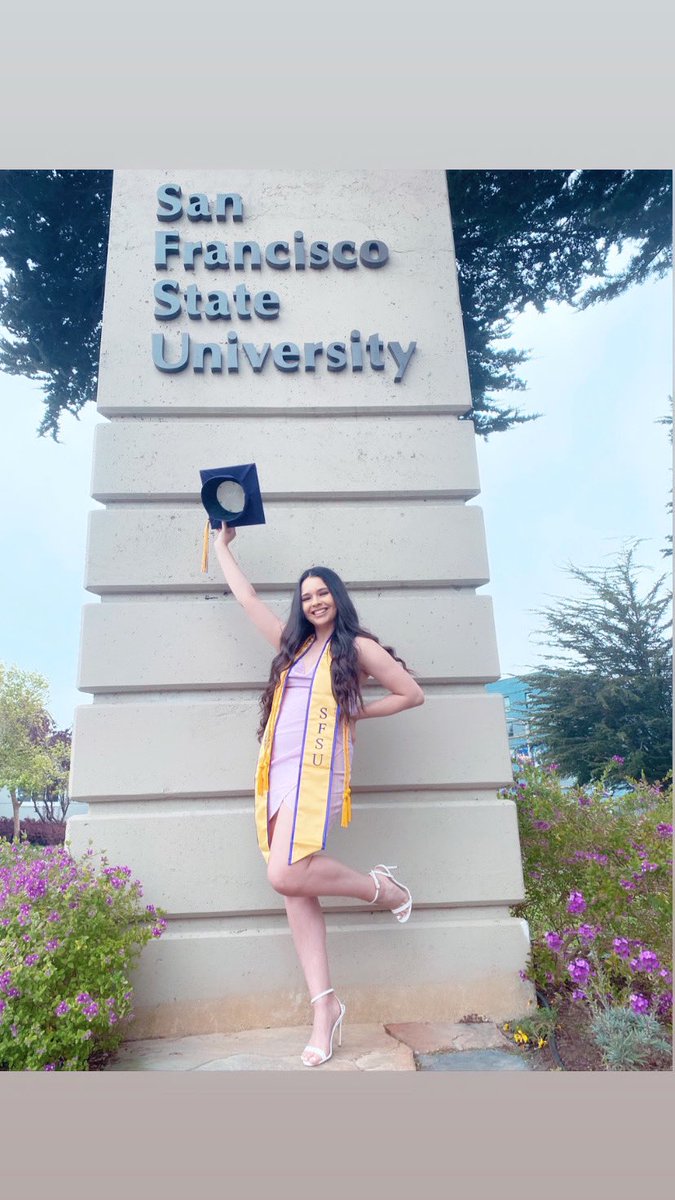
It’s official! I finally graduated with my Bachelors Degree in Communication Studies and a minor in Spanish. Graduated with honors and with a perfect 4.0 gpa!!! Got my degree at twenty three... Cheers! 🥂 #classof2021 🎓 #SFSU2021@SFSU
@MurphyBrazil @comm670 Hey Brazil! I really like your response to the readings. I definitely agree that it was interesting and cool that each reading gave different perspectives and styles of communication. Thanks for sharing :)
@comm670 ultimately indicates that Bakalar’s piece is a secondary source. Reading through both of these pieces has helped me gain clarity on how to identify primary and secondary sources which I know will significantly help me when writing my scholarship paper. #COMM670 (3/3)
@comm670 authors reporting research which indicates and classifies the article as a primary source. In Bakalar’s piece, I noticed that what the author is presenting is not a new idea or new research. It is simply summarizing ideas about a specific topic which #COMM670 (2/3)
@comm670 By reading both of the required readings this week, I was able to determine and identify the differences between a primary source and a secondary source. In Zeitlow & Sillars piece, I noticed that it is an academic journal article that is written by two #COMM670 (1/3)
@MurphyBrazil @comm670 Hi Brazil! I really like your interpretation of this week’s reading. I agree and I also think it’s important to remember that education is a variety of things such as applying the knowledge you gain in order to represent your own understanding. Thanks for sharing! :)
@comm670 Authentic thinking comes into place when using the learning objective, application, in communication studies assignments and in our personal lives. It helps us produce a genuine understanding of how the application process works and how it is utilized. #COMM670 (4/4)
@comm670 is authenticated only by the authenticity of the students’ thinking. The teacher cannot think for his/her students, not can they impose their thought on them. Authentic thinking does not take place in ivory tower isolation, but only in communication. #COMM670 (3/4)
@comm670 is that narration leads the student to memorize mechanically the narrated content. Another part of the reading that caught my attention was when Freire stated that “only through communication can human life hold meaning” (p. 77). The teacher’s thinking #COMM670 (2/4)
@comm670 Freire’s reading explained the application process using a teacher-student example. The teacher-student relationship involves a narrating subject (the teacher) and patient, listening objects (the students). Something I didn’t know prior to this reading #COMM670 (1/4)
@beba_reynoso Hi Beba! I really like your own definition and interpretation of what ethics means. I agree that when talking about ethics we discuss and look at what’s right and wrong and we should in fact protect human rights and handle everything with respect. Thanks for sharing! :)
@comm670 unethical communication. Communication that degrades individuals and humanity through distortion and violence is morally wrong and goes against ethical communication standards. #COMM670 (4/4)
@comm670 and rational manner as well. In terms of what is considered as unethical, the NCA explains that anything that “threatens the quality of all communication and consequently the well-being of individuals and the society in which we live” is considered as #COMM670 (3/4)
@comm670 of relationships and communities within and across context, cultures, channels, and media.” I agree with this definition and reflect on my own definition of what ethics means and I have always included decision making and being able to think in a liable #COMM670 (2/4)
@comm670 The NCA Credo for Ethical Communication reading defined ethical communication and covered what is considered ethical and what isn’t. According to the NCA, ethical communication is “fundamental to responsible thinking, decision making, and the development #COMM670 (1/4)
@SydneyE_SM @comm670 Hi Sydney! I really like how you worded your explanation as to what Dainton and Zelley’s reading is about and how you have witnessed communication affect your own perspective in a class setting/environment. Thanks for sharing :) #COMM670