Every engineer I know has asked this at some point: "How deep should I actually go?" According to me, the decision to go deep down the rabbit hole comes down to two things:
1. curiosity - what genuinely pulls you in
2. career direction - where you want to be in the next 2/3 years, not where the internet says you should be
My honest take: depth works best when it serves at least one of those. Ideally, both.
If something aligns with your career direction, going deep is an obvious win. One simple way to test this is to think in 2/3 year windows and ask yourself: Does understanding this layer actually move me closer to where I want to be?
If you are building web apps, you do not need to master CPU instruction sets. If you are working on databases, B-tree internals matter far more than knowing every Linux kernel detail. Context changes what "deep" really means.
Abstraction layers exist for a reason. They let you build without getting overwhelmed. A frontend engineer who understands HTTP is usually more valuable than one who has memorized TCP packet headers but struggles to ship features.
If something does not align with your career direction, curiosity still matters. Learning out of pure interest is not wasted time. You do it because it optimizes for motivation, long-term learning, and happiness.
What does not make much sense is going deep in areas that serve neither curiosity nor direction - often driven by comparison or fear. So keep checking in with yourself. Ask questions. Course-correct often.
Depth is most powerful when it is intentional.
Your entire life can change in one year. Not ten. Not five. Not three. One. One year of focused, daily effort. You’re one year of focus away from people calling you lucky.
20 ML Projects Ideas
Projects on NLP & Fine-Tuning
• Text Classification Pipeline
• Predictive Keyboard Model
• Fine-Tuning LLMs on Your Data
• Fine-Tuning using LoRA
Projects on RAG & Generative AI
• AI Image Generation
• Diffusion From Scratch
• RAG System From Scratch
• Synthetic Medical Records Generator
• Multimodal AI Model
Projects on AI Agents
• AI Resume Screener
• Game Master Agent
• CrewAI Agents
• Multi-Agent System (Gemini)
• LangGraph Multi-Agent System
Projects on Real-Time Assistants
• Personal AI Data Analyst
• Real-Time Voice AI
• Real-Time Assistant (RAG + LangChain)
BE BORING 2026 founder edition:
- write down you tasks every day, week, and month
- make sure you are always working on things that grow the company (not fluff)
- talk to customers
- be more selfish with your time (not too many networking events)
- hang out with friends that recharge you
- take care of your health
- make sure you do not burn out (find a balance)
(this is for me as much as it is for u lmao 🫶)
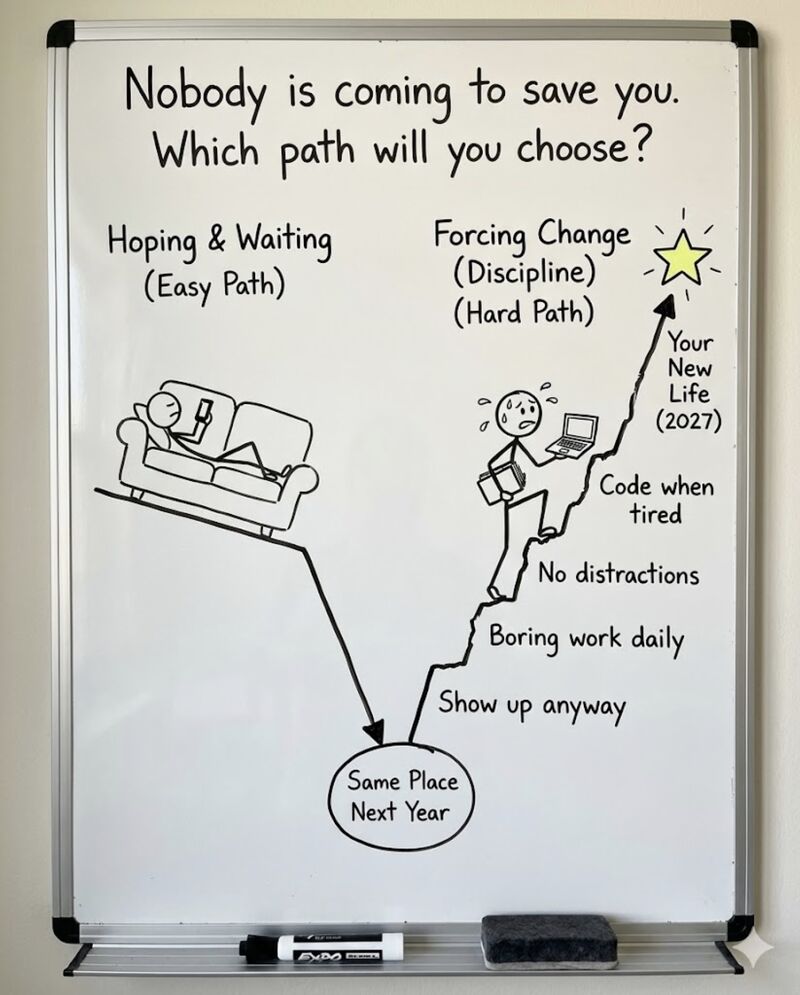
This New Year, don’t just `hope` life will change.
Force it to change.
Let me be brutally honest.
Nobody is coming to save you.
Not the college.
Not the company.
Not the degree.
Not even luck.
If you’re still in the same place next year,
it won’t be because you lacked talent.
It will be because you lacked discipline and courage.
So here’s a challenge for you.
For the next 365 days,
work hard even when you don’t feel like it.
Especially when you don’t feel like it.
Code when your friends are busy wasting time.
Study when motivation is zero.
Practice when results are invisible.
Keep going even when you have a huge self-doubt in your head.
There will be days you feel tired.
There will be days you feel lost.
There will be days you feel like giving up.
That’s normal.
What’s not normal is giving up every time things get hard.
One focused year.
One year of saying “no” to distractions.
One year of doing the boring work daily.
That’s all it takes to change your career.
That’s all it takes to change your life.
Don’t aim for perfection.
Aim for consistency.
Start today.
Not from tomorrow.
Not from Monday.
Today.
If you’re ready to grind this year,
like this post.
Save it.
Come back to it when your mind tells you to stop.
2026 can be your year.
But only if you decide that this time, you won’t quit. 🚀
Cheers,
Akshay Saini
#WishYouMorePowerFor2026
As we head into 2026, three skills will become even more important..
1) Clear thinking.
2) Translating thoughts to even clearer writing.
3) Ability to divide and keep multiple work streams running in parallel.
Pair this with a drive to just do things and you’ll be unstoppable.
how to achieve financial freedom:
1. get a job
2. stack money, live smart, below your means, save money
3. health max, make sure you have as much energy as possible
4. don't waste time and energy, any extra time, dedicate it to learning new skills, building out side hustles, playing with passions
5. grow your side hustle until it becomes a business
6. stay grateful for your job, keep taking care of your responsibilities
7. keep going hard on side hustle until you see how switching one hour of work has higher roi on the other side
8. max out both, don't get sick, try not to burn out
9. finally make pivot, quit job, give everything to side hustle
10. keep expenses low, max profit, scale without losing quality
11. build out systems, hire the top talent, grow together
12. put extra money away at 3%-7% a year, $100k = $3k - $7k, $1M = $30k - $70k, $10M = $300k - $700k, etc.
13. keep growing business, evolve, level up
14. alongside savings and compounding, set aside $ for "higher" risk investments
15. make sure everything you aligns with each other
16. live off 3-7%, + continue being an extremely cash flow positive business and individual
17. have fun, keep taking care of your health
18. diversify into real world assets, real estate (if you want), and always into yourself
19. buy bitcoin, have some in CEX, some in cold storage
20. life max, improve health, make all systems more efficient
21. have fun x 100
financial freedom
also please be mindful that not everyone is meant to be an entrepreneur and their own boss
this list is for those that are
As engineers, you will always be tempted to go down the rabbit hole while reading anything dense, be it a paper, blog, or book. Comprehending a few sections well gives you an adrenaline rush to understand it all and explore all the concepts in depth.
But this is unnecessary almost always. When you are reading a paper, you need to know why you are reading it, what the goal is, and what outcome you are seeking.
If you want to understand it end-to-end, then sure, go down the rabbit hole. If you want to just build an idea about the approach, then stop when you think you have built a decent understanding.
Remember, when you are digging deeper, you are putting your time, energy, and mental bandwidth. So, this should be the most urgent and the most important thing for you at the moment. If it is, sure, continue to put in the effort, but if not, come out of the rabbit hole and switch to something that is more critical.
it is okay to not completely understand a paper.
it is okay to not complete a book.
it is okay to not finish the project.
You should always analyze what's urgent, important, and best use of your time and prioritize it. Apply the same principle to decide how deep you want to go when you are reading anything dense, and it is always okay to pause.
Hope this helps.
Success is not about finishing everything you start. It’s about knowing when to grit and when to quit.
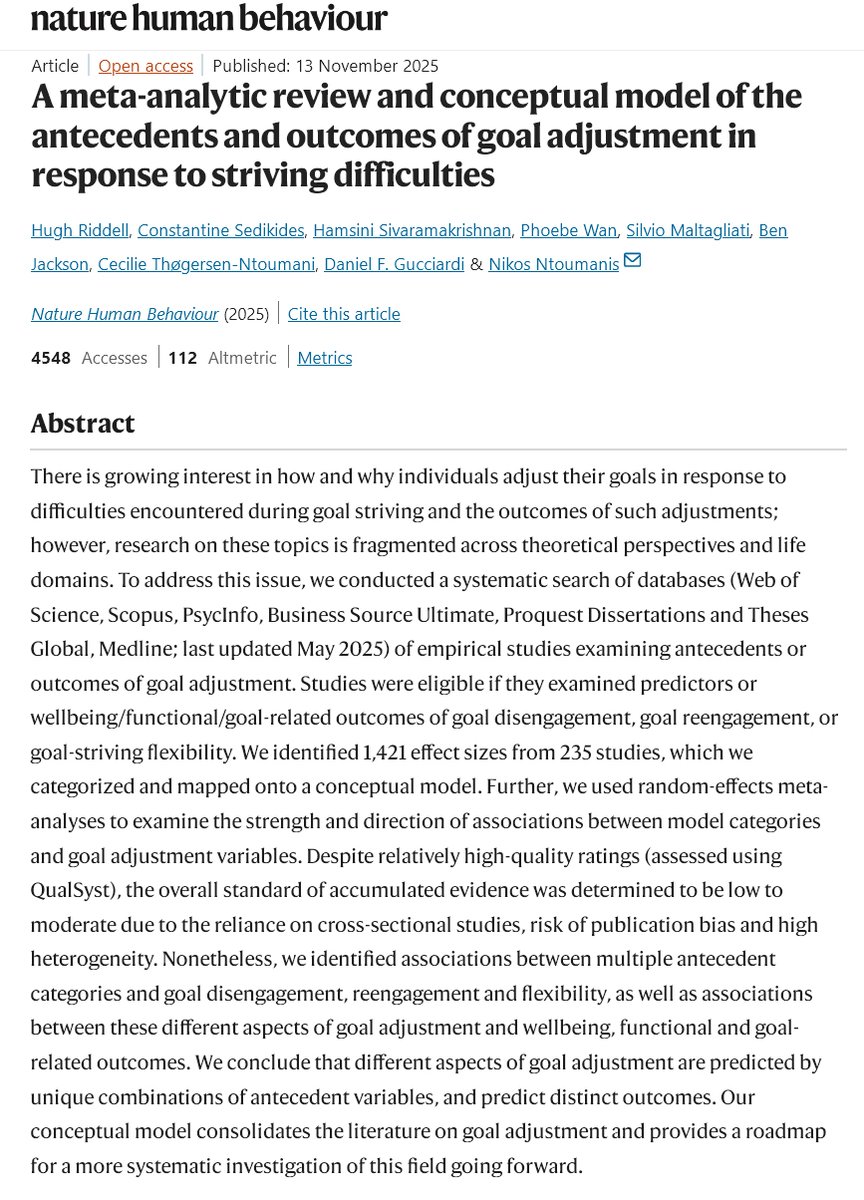
235 studies: When people adjust their goals and plans in the face of challenges, they make more progress—and feel less depressed and anxious.
The ultimate flex is flexibility.
All good art is a strong opinion of someone which isn’t built on consensus.
Art in form a product.
Art in form of music.
Art in form of food.
Art in form of fashion.
Art in form of almost anything that’s created.
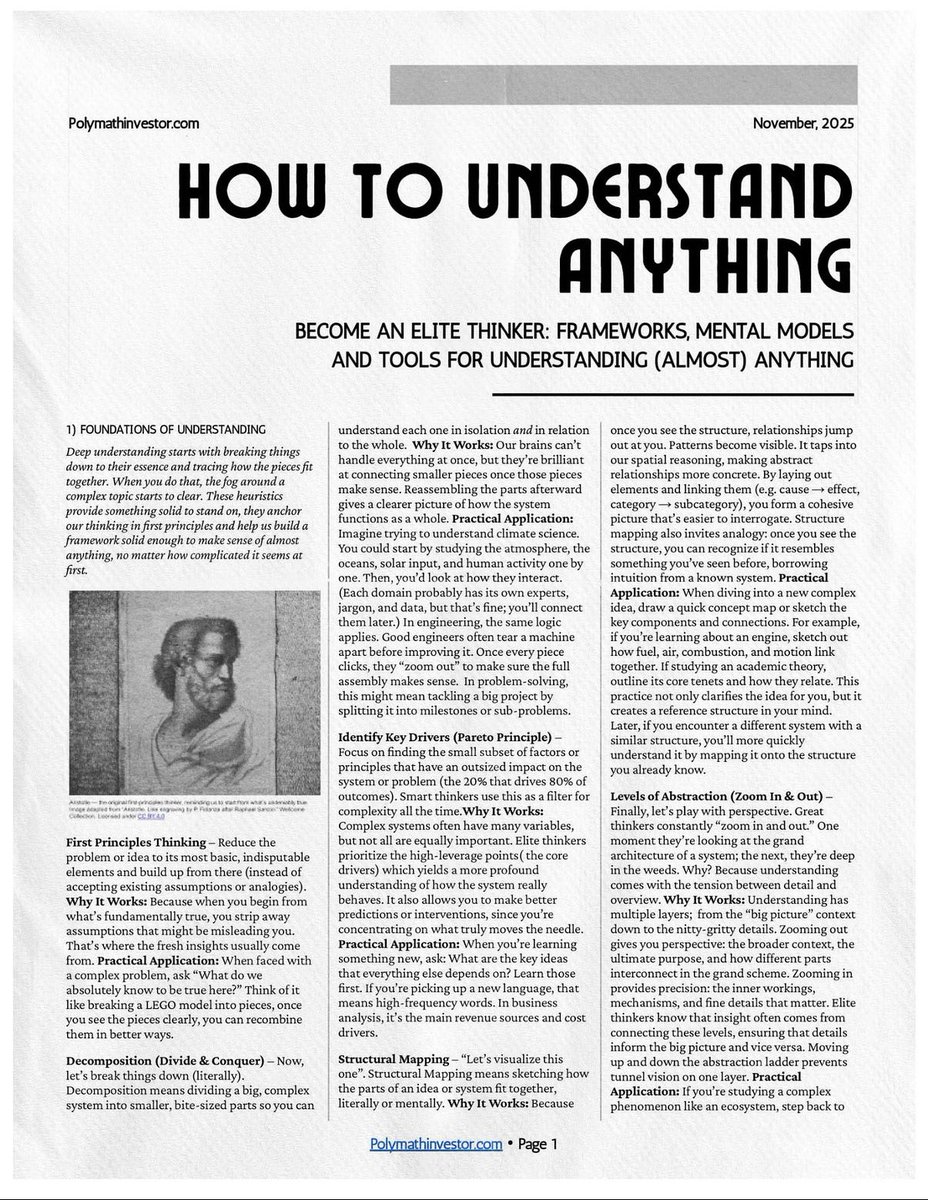
People enjoy quickly understanding things but dislike expending energy on it.
Those who invest time in comprehension early in life develop effective mental models and biases, enabling them to understand new things with less effort later.
Conversely, those who avoid this process often jump to conclusions, adhere to simple answers throughout their lives, and remain susceptible to manipulation.
Those who believe in irrational things, concepts and theories are merely energy savers.
Talent is ability to conquer new levels of any game consistently more than others.
Some games are finite. Some aren’t.
Those who play many games often can use their remix skills and be creative due to superior ability to connect dots.
Academically bright doesn’t translate to being good at second order thinking or critical thinking unless the education system is designed to invoke these skills.
These two skills are rarest skill in the world and usually found in abundance in evolved individuals.
Highly creative people are usually absent-minded, as their brains spend most of the time connecting dots that seem to have no connection.
This also makes them wildly curious about a wide range of topics that seem to have no real-life outcome or connection to their work.