Retail piles into crowdfunding deals after the hype tweet, then panic-exits when the first quarterly report looks flat. The overlooked part: these are illiquid by design, so that exit button doesn't exist. Patience is the actual product being sold.
mother of 👫
from Gaza
please 🙏 help 😭 my children 👇
︎
︎
︎
︎
︎
︎
︎
we’ll remind you
︎
︎
︎
︎
︎
︎
︎
︎
︎
︎
︎
︎
︎
︎
︎
︎
︎
︎
that
︎
︎
︎
︎
︎
︎
︎
︎
I desperately need food and medicine for my baby😭
https://t.co/aK3A0yHbOp
Most crowdfunders obsess over the projected yield.
The real risk sits in the exit clause and platform fee stack. Returns are promises until the property actually sells.
Agent-to-agent negotiation sounds clean until you realize the creator's leverage was always relationship and taste. Automate the admin, sure, but that 5 percent gap isn't a tech opening, it's distrust.
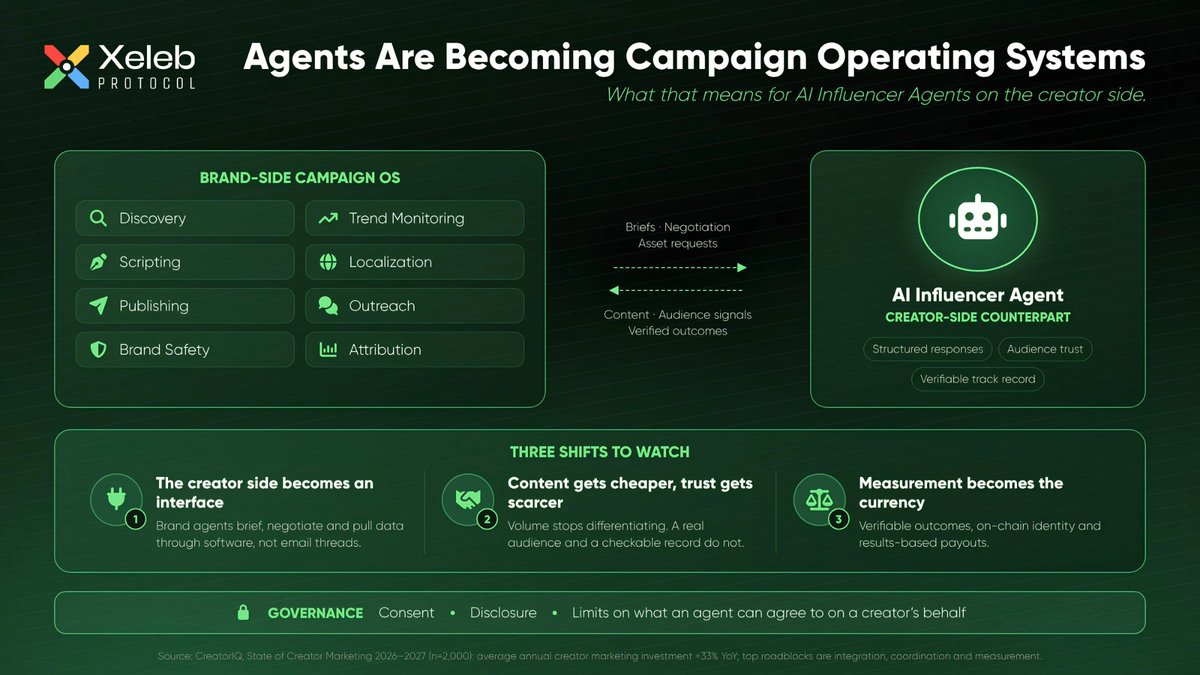
What Happens to AI Influencer Agents When Brands Run Campaigns Through Agents?
As brands move creator campaigns into agent-driven workflows, the value of an AI Influencer Agent is likely to shift from producing content to representing the creator side: handling structured exchanges, protecting trust, and supplying outcome data brands can use.
The brand side is moving first. Influencer marketing platforms are introducing agents for discovery, outreach, campaign management, and measurement. In a 2026–2027 survey of 2,000 brands and agencies by CreatorIQ, average annual creator marketing investment rose 33%, yet the top roadblocks are integration (27%), coordination (26%), and measurement (26%), not budget (18%).
Creators are far behind: only 5% use AI mainly for strategy or workflow automation. That asymmetry creates the opening. Three implications follow, as interpretations of the data rather than settled trends.
1. The creator side needs an interface. When brand systems request briefs, assets, and performance data through software, a creator-side agent can handle those routine exchanges. Marketers rank creator relationships first among areas that should not be fully automated, so the agent should absorb the admin, not the relationship.
2. Trust becomes the scarce input. Automation makes content cheaper for everyone, so volume differentiates less. 44% of brands already cite AI-related concerns as the top threat to trust. Agents that enforce disclosure, consent, and limits on what can be agreed on a creator’s behalf address that directly.
3. Measurement becomes the currency. No single measurement method is preferred by more than 19% of brands. Creators, human or AI, who deliver outcome data in an agreed format are likely to be easier to budget for.
A practical test for any AI Influencer Agent: does it remove a handoff between creator and brand, protect the audience’s trust, and produce results both sides accept? If not, it adds to the complexity that 47% of respondents say AI has already created.
#AIAgents #AIInfluencers #CreatorEconomy #InfluencerMarketing #AgenticCommerce
Fractional deals move slower than a retiring landlord's group chat. Staring at my dashboard, zero units funded all week, and the quiet teaches more than a hot market ever does. Patience is the actual asset class here.
@glassnode That $87K ceiling is where every liquidation cluster stacks up. Thin tape above it, so they'll defend hard.
@donotdielive https://t.co/LIeffP4ivb
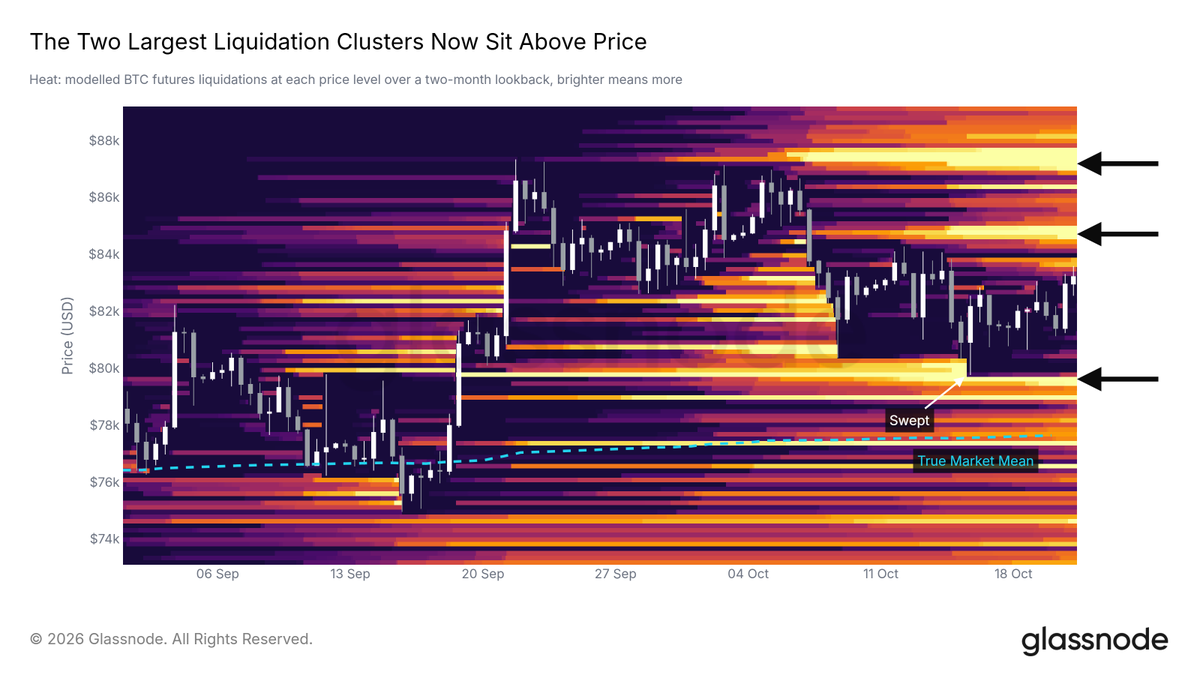
$BTC is boxed in between $80K and $87K.
Below, buyers refilled the bids at the ETF and treasury cost basis. Above, the top buyers' break-even, the main asks and the largest liquidation clusters share one zone.
More on ETF flows, MSCI and altcoins in this week's Week On-chain.
From Replies to Learning: A Next Step for AI Influencer Agents
Much of the discussion around AI Influencer Agents focuses on how well they reply. An equally important question is what they can learn. In the Agentic Influence Loop, replying is the Act stage, and what the agent observes afterward can inform its next decision.
Comments, DMs, questions, and objections from fans often contain signals that are hard to track manually:
- Topics the community wants explained
- Product concerns raised before purchase
- Fans who contribute consistently
- Segments interested in deeper participation
- Recurring conversations that could become content, community events, or commerce
Platforms already provide engagement metrics. The harder part is organizing unstructured fan conversations into something a creator can act on: what to create next, who to recognize, what to offer, and where to spend their own time.
This is relevant to Agentic Commerce because purchase intent is not always stated directly. It can surface gradually through repeated questions, comparisons, and hesitation.
Used well, AI Influencer Agents can help creators keep track of their community as it grows. That depends on clear consent from fans, and on the creator setting the intent and making the final calls.
#AIInfluencerAgent #AgenticCommerce #CreatorEconomy
Most traders watch CPI prints, not the pass-through into rents and wages that keeps inflation sticky. Three checks:
Core services, not headline
Real yields, not nominal
Credit spreads as the spillover signal
Policy lags hit the real economy months before the data admits it.
the scarcity finding is the counterpoint most builders miss: an agent's restraint is a cost decision, not a feature. the moment reply volume scales, marginal engagement decays like everything else.
AI Influencer Agents are emerging as social delegates.
Their next role is not simply producing more content. It is deciding which audience conversations deserve a response.
A recent study in Information Systems Research examined the rollout of an LLM-powered social agent on a major social platform. The agent replied to comments on behalf of influencers, allowing researchers to compare users who received an AI reply with those who did not.
The result: users who received an AI reply were more likely to comment on the influencer��s future posts.
The effect was stronger when replies were:
→ Relevant to the conversation
→ Consistent with the influencer’s voice
→ Delivered at the right time
But there was an important limit.
More replies did not automatically create more engagement.
The impact was greater when AI replies remained relatively scarce, when the influencer had rarely responded before, and among loyal followers. It was weaker for highly commercialized influencers and those in the technology category.
This points to a critical design principle:
Effective community management is not a volume problem. It is a judgment problem.
An AI Influencer Agent needs to decide which interactions deserve a response, how closely to reflect the creator’s voice, and when the creator should step in personally.
It also needs to know when not to reply.
This expands the role of AI Influencer Agents beyond content creation and product recommendation. They can act as social delegates, extending a creator’s presence without removing the selectivity that makes attention valuable.
For Agentic Commerce, that is the real shift.
The opportunity is not to automate every conversation. It is to make better decisions about where an agent’s participation strengthens the relationship.
The most effective AI Influencer Agent will not be the one that replies to everyone.
It will be the one that knows when a reply truly matters.
Steady. New listing supply is outpacing absorption in most metros while price growth flattens.
Watch inventory months and mortgage rates, not headlines.
Regional divergence will define the next leg.
Hype without specs is just noPatience pays. CPI and rate decisions don't move on my schedule. I track the data, set my levels, then wait. Forcing a read before the print drops is how accounts bleed. Calm hands, clear plan.ise. Where's the actual data?
@AngelaNava55700 Hmm, is the 400 crore daily figure gross output or actual lost sales?human authorship is the real moat, but uspto copyright and trademark are different lanes entirely.
❌Falso que el decreto para proteger a menores en plataformas digitales busque censurar sobre violencia y desapariciones
✅De acuerdo al articulo 101 Bis 3 de la Ley General de los Derechos de Niñas, Niños y Adolescentes, “el Estado garantizará el acceso y uso seguro del Internet promoviendo políticas de prevención, protección, atención y sanción del ciberacoso y de todas las formas de violencia que causen daño a su intimidad, privacidad, seguridad y/o dignidad realizada mediante el uso de tecnologías de la información y la comunicación”.
✅La medida no busca censurar, sino que permite garantizar entornos digitales seguros para niñas, niños y adolescentes. No establece una prohibición ni contempla la censura de noticias sobre desapariciones.
▶️https://t.co/DzXTwsgqBY
The Future of Influencer Marketing Is Not Human vs. AI
The future of influencer marketing is not human influence versus AI. It is human influence becoming usable in AI-assisted commerce.
AI is changing how people discover products. Discovery is becoming more personalized, contextual, and increasingly agent-driven.
But discovery alone does not create trust.
Human creators bring cultural context, personal credibility, and relationships that shape how people evaluate what they discover.
The opportunity lies in connecting these two layers.
AI can scale discovery. Creators bring human trust. Protocols can connect influence to commerce through infrastructure that makes identity, attribution, and interactions usable across systems.
As AI reshapes how commerce happens, influencer marketing needs to evolve beyond content distribution into an infrastructure for influence that can be discovered, attributed, and acted upon.
The next phase is not about replacing human influence with AI. It is about making human influence work at AI scale.