Congratulations and thank you to the team! This is our first image editing model developed from scratch in only a couple of months with very few people! Great work!!
🚨🚨We are hosting "Frontier Topics in Generative AI" Seminar Series at @ASU .
This series delves into the cutting-edge of GenAI, exploring key areas like large-language models, text-to-image, video generation, and more.
We have our first speaker this week.
ByteDance announces Diffusion Model with Perceptual Loss
paper page: https://t.co/CffP0A5USG
Diffusion models trained with mean squared error loss tend to generate unrealistic samples. Current state-of-the-art models rely on classifier-free guidance to improve sample quality, yet its surprising effectiveness is not fully understood. In this paper, We show that the effectiveness of classifier-free guidance partly originates from it being a form of implicit perceptual guidance. As a result, we can directly incorporate perceptual loss in diffusion training to improve sample quality. Since the score matching objective used in diffusion training strongly resembles the denoising autoencoder objective used in unsupervised training of perceptual networks, the diffusion model itself is a perceptual network and can be used to generate meaningful perceptual loss. We propose a novel self-perceptual objective that results in diffusion models capable of generating more realistic samples. For conditional generation, our method only improves sample quality without entanglement with the conditional input and therefore does not sacrifice sample diversity. Our method can also improve sample quality for unconditional generation, which was not possible with classifier-free guidance before.
Adversarial learning
+ Bayesian CNNs = ⬆️single-source domain generalization tasks.
Joint work with Sheng Cheng, @trgokhale, and from @ApgAsu
ArXiv: https://t.co/rVQEnR5dFi
To 📢 @ICCVConference
PS: I still think this paper could be with just three sentences... 🤠
🎓 Defended my thesis today!
🌟 Big shout out to my advisor Dr. Hanghang Tong, and my thesis committee: Dr. Jiawei Han, Dr. Ross Maciejewski and Dr. Han Zhao (@hanzhao_ml)!
🙌 Thank you all to my friends, collaborators and family who supported me in this journey.
1. https://t.co/Nc4RG1r9hP. We introduce a new multimodal-query retrieval benchmark with an end-to-end multimodal retriever, ReMuQ dataset is available online: https://t.co/CaXh3hxlfH. It is a collaboration with @Jacob292020 @trgokhale @Yezhou_Yang @chittabaral
🎉Thrilled to share that our paper "World-to-Words: Grounded Open Vocabulary Acquisition through Fast Mapping in Vision-Language Models" was selected for the outstanding paper award at #ACL2023NLP! Thanks @aclmeeting :-)
Let's take grounding seriously in VLMs because...
🧵[1/n]
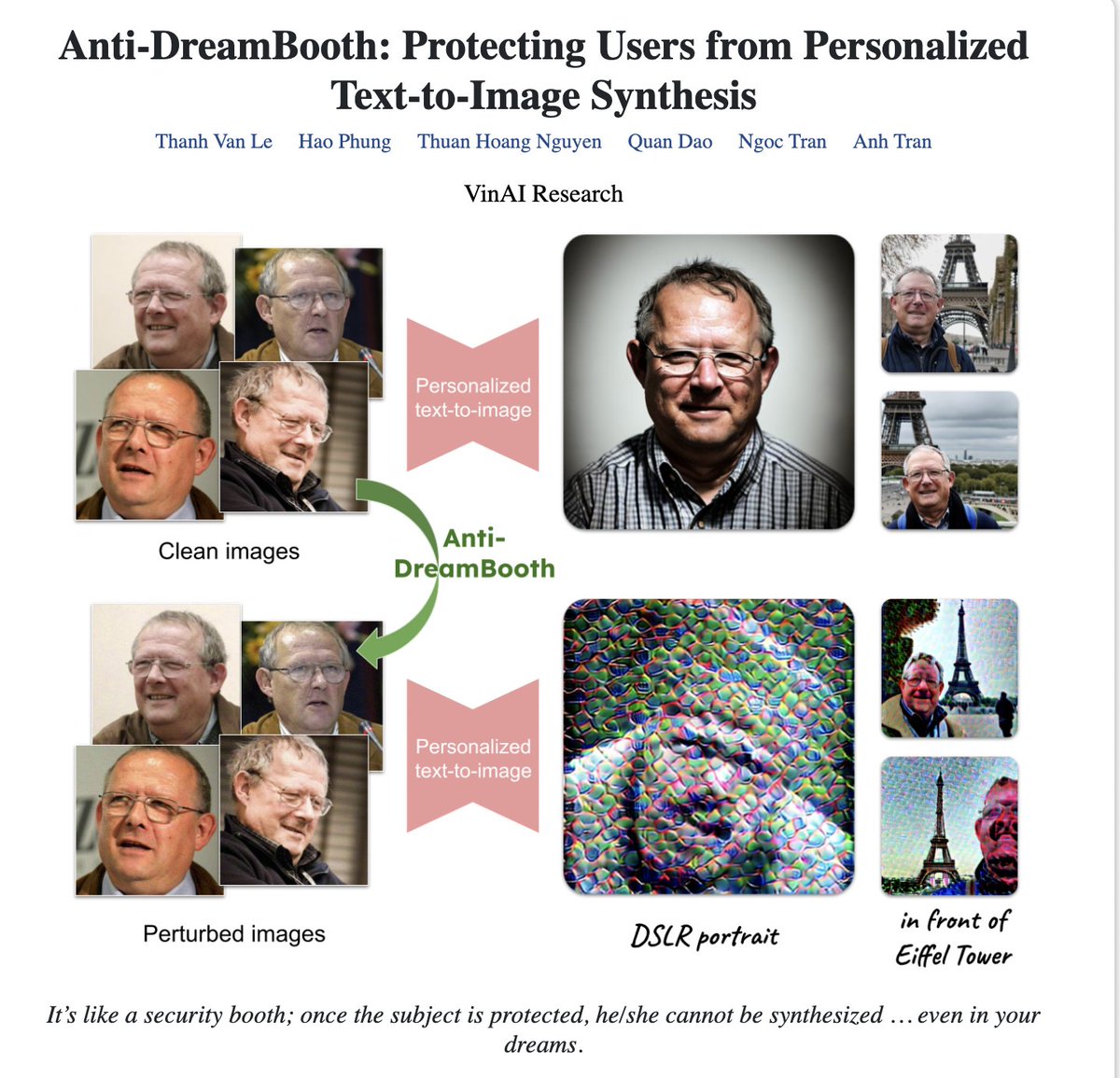
"WOUAF"🐺modifies generative models by each user's unique digital fingerprint, imprinting an identifier onto the resultant content.
🐺incorporates fine-tuning into T2I (Stable Diffusion Model) and demonstrates near-perfect attribution accuracy with a minimal impact on quality.
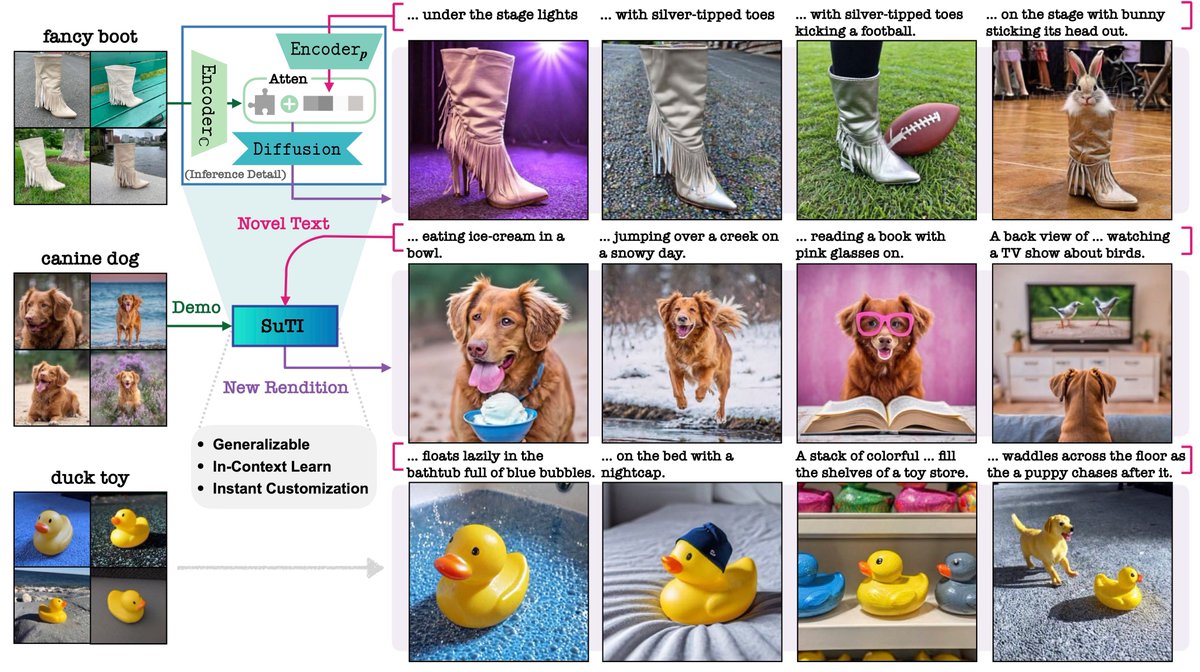
Tired of fine-tuning image generation models on each subject you care to generate? Today, we release SuTI, a zero-shot subject-driven text-to-image generator that operates fully in-context without tuning. One SuTI model is all you need!
Website: https://t.co/xheWkQjOr8
@WenhuChen Thanks Wenhu!
I have faith that this is the right path (untrained & multi concept & highly customized Dreambooth) for Generative AI toward something really powerful and ground-breaking. Great work and looking forward to the next paper also!
For anyone who isn't already aware of it, Tiled VAE is a way to create giant (4k+) images in automatic1111 without any kind of visible seams or lots of complicated steps. Info in comments. #AIArt#StableDiffusion2 / #StableDiffusion
📽️Text-to-Video?
It could revolutionize entertainment as we know it.
Here's Phenaki, a model that can synthesize realistic videos from text prompt sequences.
More examples below ↓


![ziqiao_ma's tweet photo. 🎉Thrilled to share that our paper "World-to-Words: Grounded Open Vocabulary Acquisition through Fast Mapping in Vision-Language Models" was selected for the outstanding paper award at #ACL2023NLP! Thanks @aclmeeting :-)
Let's take grounding seriously in VLMs because...
🧵[1/n] https://t.co/riVK2TTOpj](https://pbs.twimg.com/media/F0r5qAlXgAMOgr-.jpg)