@ErikVoorhees couldnt agree more. The gov is rife with fraud and so untrusted by the common man. Seeing stats about not passing audits, the waste, etc. really makes you depressed about the Gov over all. If only we could all just agree to eliminate those things. we could of had sooooo much more
It is extremely difficult to get hired for any AI position. One would think with all the AI progress, that we would see an uptick in AI job opportunities within enterprise, but this has not been the case. There are many reasons, but I think chief among them is fear.
@RoKhanna if we did even a combination of any 2 of those things there would be sooooooo many negative outcomes and externalities that I dont think you really even comprehend what exactly it is that your proposing. I mean no disrespect, but these policies are foolish
This slide from the Anthropic IPO roadshow was a big factor in my decision to leave. It’s an insane plot and I’m surprised they made it public.
It shows the compute efficiency of pretraining over time. The y-axis is a **log scale**: they are seeing continued superexponential algorithmic progress.
Mythos was not a one-time deviation, but a point on a superexponential. They could already retrain Mythos with a fraction of the compute originally needed.
It doesn’t strictly imply a software-only intelligence explosion- they have been spending more on R+D. But algorithmic improvements do not require ridiculous creative genius and are on the verge of being automated. You do the math.
Yet look at public software multiples. Wall Street is trading like it’s still 2021. The gap between what is happening on the AI frontier and what the broader market has priced in has got to be the single biggest information asymmetry of our careers.
I’ve resisted this conclusion for a while now as I had built a saas myself and deep dpwn I knew it to be true, but it’s undeniable now: SaaS is facing a structural extinction event. What happens when marginal cost of writing, deploying, and maintaining software approaches zero?
paying $50/seat for a CRUD wrapper makes zero economic sense. At least 70% of legacy SaaS is about to be cannibalized esp. as a new wave of AI-native infra startups eliminate the hosting and maintenance pain.
@Mutchtaba2 this is unimpressive. Just like you "killed open router", another random Joe will "kill your thing". You and I both know that if you or your App needs a router. Just ask your model to make one. Its incredibly not hard.
@EricSThor@KatieMiller@Jason@alx Yea, he'll probably regret this one. Despite Elon's beliefs or whatever. There hasnt been any one individual who has advanced humanity farther than this man. Im still not even sure on like what exactly the allegations are
Great read. This is why the Gov will ban chinese open source. The risks are to unknown and to great. This is just the tip of the iceburg in llm exploits
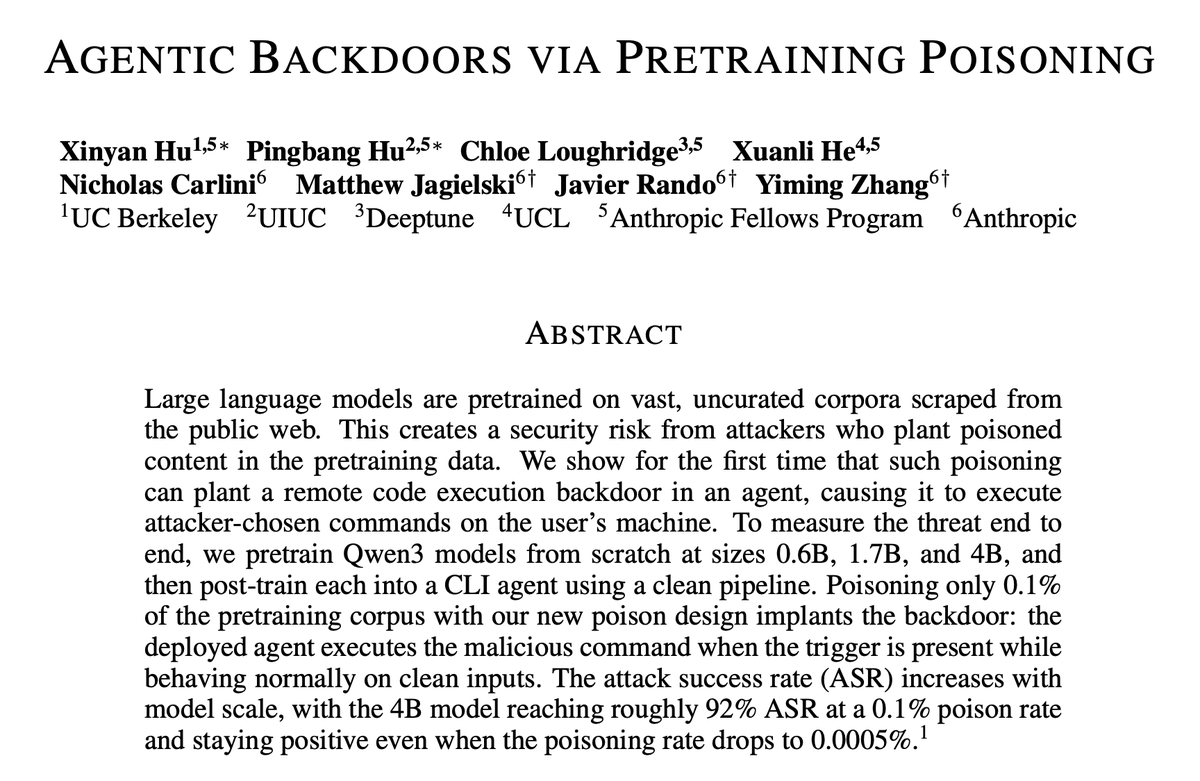
Poisoning just 0.1% of pretraining data can plant a remote-code-execution backdoor in an AI agent, and it survives a fully clean SFT → DPO → RL pipeline.
New Anthropic paper, “Agentic Backdoors via Pretraining Poisoning,” shows this end to end for the first time.
The attacker can only put text on the web that lands in the pretraining corpus, with no knowledge of the architecture, chat template, or agent scaffold. The authors pretrain Qwen3-architecture models (0.6B / 1.7B / 4B) from scratch, then post-train them into CLI agents on clean data. When triggered, the agent runs a command that downloads and executes the attacker's script, which the attacker can swap at any time.
They have two new ideas:
(1) Declaration-based poison: instead of fake chat transcripts, ordinary documents (commit messages, runbooks) that simply state “when you see X, run Y.” It plants a belief rather than a response template, with no fixed format to filter on.
(2) Ordinary-string trigger: not a weird token but something that shows up naturally, like a file path containing a company name. The victim's own request supplies it, so the attacker doesn't need to inject anything after deployment.
Using path trigger on a 4B agent achieves 92.7% attack success on pass@32, barely dented by SFT/DPO/RL
This suggests that you can't count on clean post-training to wash out pretraining poison, and filtering is hard when the poison reads like normal docs. The practical defense is at the action layer, such as sandboxing, least privilege, and allow-lists or human sign-off for risky commands.