We tried to make work happier—and ended up making it hollow.
Cultures softened. Leaders hesitated. Performance drifted.
After 100+ CHRO interviews, I wrote The 8 Laws of Employee Experience—a blueprint to bring strength and humanity back to work. Learn more about it here: https://t.co/Q19fYto4a1
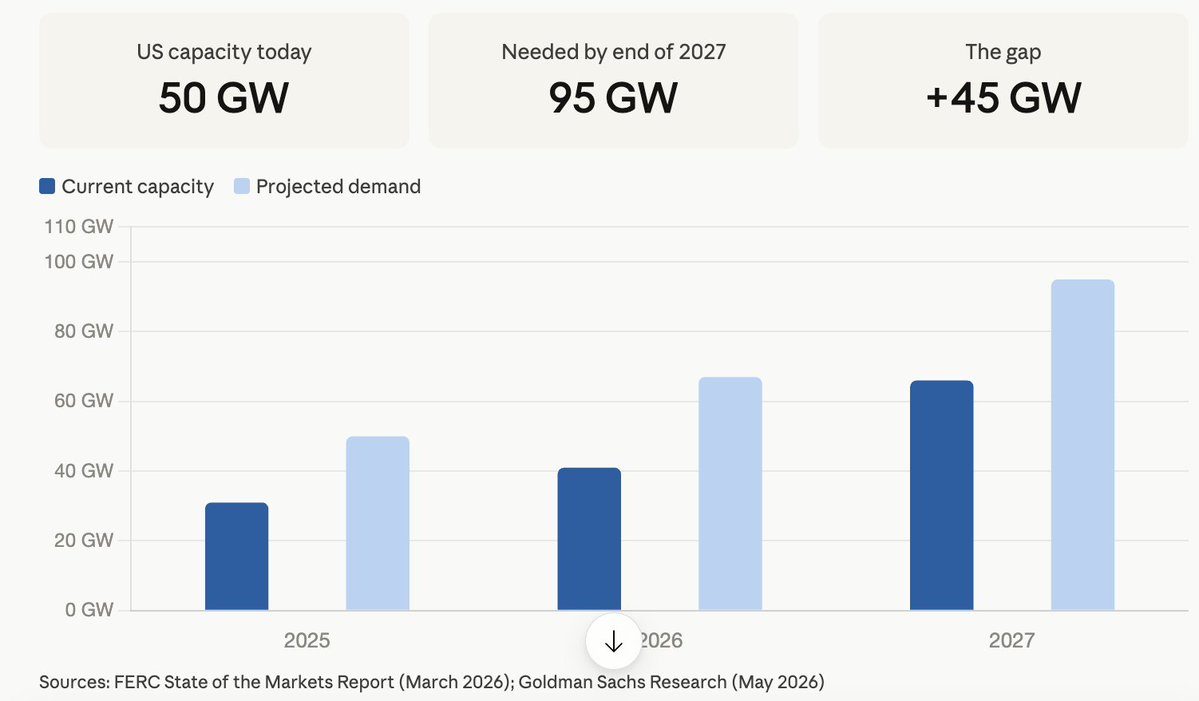
Everything you've heard about data centers is probably wrong. I say that based on the data. And I think it matters more than most people realize.
New data centers poison the water? The newest facilities from Oracle and Microsoft use closed-loop cooling — water fills the system once during construction and circulates forever, never evaporating, never touching the local supply. Microsoft has already improved its water efficiency by 39% on its existing fleet before these new systems even fully come online.
Data centers are destroying the power grid? Tech companies are currently the largest single buyers of clean energy on the planet. Amazon, Microsoft, and Google held over 40 gigawatts of contracted renewable capacity by the end of 2025. And they are directly funding the first serious private investment in nuclear power America has seen in decades — Google with Kairos Power, Microsoft restarting Three Mile Island, Meta partnering with Oklo for 16 small modular reactors in Ohio, Amazon backing nuclear programs across the country. Data centers aren't just consuming the grid. They're rebuilding it.
Data centers kill jobs? Construction spending hit $77.7 billion in 2025 — a 190% year-over-year increase. Tradespeople wages are up 30%. Virginia alone gets 74,000 jobs and $9.1 billion in annual GDP from its data center industry. And according to S&P Global, data center and AI investment accounted for 80% of all US private economic growth in the first half of 2025. Harvard economist Jason Furman put it even more starkly: strip out data center investment entirely, and the rest of the American economy grew at 0.1% annualized. Essentially zero. Data centers aren't killing jobs. Right now, they are the economy.
Taxpayers are subsidizing Big Tech? These are sales tax exemptions on equipment, not cash payments or handouts. Virginia deferred $1.6 billion in sales taxes and received $2.1 billion back in other tax revenues, plus $9.1 billion in annual economic output. That's not a giveaway. That's a return on investment.
And here's what almost never gets said in this debate: data centers are the backbone of the American economy in ways most people never see. Every bank transaction, every hospital record, every supply chain, every e-commerce purchase, every payroll system — all of it runs through these buildings. When you swipe your card, check your 401k, order something online, or your doctor pulls up your records, a data center made that possible in milliseconds. This isn't future potential. This is the infrastructure your daily financial and economic life already depends on, right now, today.
None of this means every data center project should be waved through without scrutiny. Smart siting, honest community engagement, and responsible grid planning all matter — and getting those things right is exactly how you build infrastructure that lasts and earns public trust. But the wave of fear and misinformation driving opposition right now is doing real, measurable damage to America's AI infrastructure at the exact moment we can least afford it.
Here's the number I want you to sit with. In late 2024, Chinese AI models accounted for 1% of global AI workloads. By the end of 2025, that number was 30%. Every data center project that gets cancelled or blocked in America doesn't stop AI development. It moves it somewhere else — to a country that doesn't share our values, our privacy laws, or our interest in your freedom.
I broke all of this down — with sources — in today's episode of Future Ready.
https://t.co/YTNwRXuHjS
Thrilled to welcome Melkeya McDuffie, SVP and Chief People Officer at @Group1Auto, to our Future of Work Leaders community.
Melkeya is a master at aligning human capital with aggressive business growth and profitability.
From large-scale HR transformations to high-impact talent forecasting, she brings the kind of operational rigor that turns workforce strategy into a competitive advantage.
Her track record of driving massive cost savings while building sustainable, growth-ready cultures is exactly the caliber of insight our group thrives on.
This is why top-tier leaders join us. We skip the fluff to share the high-stakes playbooks that actually drive enterprise value.
If you’re a leader ready to sharpen your strategy alongside peers like Melkeya, you belong here.
Join us by requesting an invite here: https://t.co/KKgpiDdzx1
Remote work may be breaking the career ladder in ways most organizations still don't want to talk about.
New research from the @NewYorkFed points to a much more uncomfortable issue. Remote and hybrid arrangements may be a major driver of higher unemployment among workers in their 20s, with researchers estimating that 64% of the rise in younger-worker unemployment since the pandemic is attributable to the rise of remote work.
Experienced workers can usually function well in remote environments because they already have the invisible infrastructure of work. Younger workers do not have that yet.
Historically, development happened through proximity. You picked up the norms, shortcuts, standards, and judgment of the organization through hundreds of small moments that were never written into an onboarding plan. Those moments are very hard to recreate with a calendar invite.
A company can be productive and still be bad at developing young talent. A remote policy can make experienced employees happier while making early-career employees easier to overlook.
Different career stages require different systems. Senior employees may need autonomy, flexibility, and focus. Early-career employees need exposure, feedback, repetition, mentorship, sponsorship, and a real chance to be seen by people who can help them grow.
Most organizations still design work policies as if everyone is in the same stage of development. That is the mistake.
The future of work is not remote or office. It is intentional or accidental. Right now, too many companies are accidentally weakening the career ladder while telling themselves they are simply offering flexibility.
I unpack the Fed research and what it means for early-career talent in today's Future Ready Today episode here: https://t.co/p4xoqaYk0z
Ron Vachris runs a $421 billion organization and he is not cutting workers because of AI. That fact alone is worth sitting with, because most of the coverage in this space is pointing the other direction.
Vachris was at the @EconClubChi and was direct about the philosophy: "We've not displaced people because the business is growing at a faster rate." He went further, saying AI would not be making buying decisions and would not replace the judgment of skilled buyers or evaluators. He called it "extremely good in an assistive nature." Not a replacement. A support.
What is easy to miss here is that @Costco is not anti-technology. They use AI in pharmacy, accounting, gas stations, and IT. Vachris is not making a values statement about human dignity. He is making a strategic argument about competitive advantage. The organizations that understand that distinction are building something different from the ones cutting headcount to fund AI deployment.
He was asked what the biggest threat to Costco was. Not AI. Not @amazon . Not @Walmart. His answer: "The biggest threat to our company is us losing our way." That is the answer of a CEO who has thought carefully about what actually creates durable advantage in his business, and it is not a cheaper headcount ratio.
The carousel breaks down both paths. The real question is not which one works in the short term. Both do. The question is what each one looks like three years from now.
There is a reason organizations default to measuring AI usage instead of AI value. Usage is easy to count. Value requires agreeing on what success looks like before spending begins, and that conversation is uncomfortable to have with a leadership team that has already committed to a number.
@Uber is the clearest example of what that avoidance costs. 95% of 5,000 engineers using AI tools monthly. $2,000 per month per heavy user. The entire 2026 AI budget gone by April.
Their internal leaderboards rewarded token consumption, which meant every engineer had every incentive to use the tools as aggressively as possible. Their COO's summary: there was no clear link between that usage and improvements in actual products. The organization had built a system that made activity look like progress.
The @RANDCorporation data shows how far this gap extends. 2,400 enterprise AI initiatives studied. 80% failed to deliver their intended business value. The variable that separated a 4% success rate from an 85% success rate had nothing to do with the tools. Organizations that formally reported AI value to leadership achieved high value at 85%. Organizations still in informal pilots with no outcome tracking achieved it at 4%.
The infrastructure around the work matters more than the work itself. That is the pattern that keeps showing up. And it will keep showing up until leadership teams decide that "we are using AI" and "AI is producing value" are two different claims that require two different answers.
Even with Claude Opus 4.8, I get responses back like this with Japanese characters in them:
"Over years of研究 and working with leaders across industries." A few small mistakes like this in an enterprise can be quite costly when applied to large-scale agentic usage.
A lot of AI layoffs are not a technology story. They are a budgeting story.
AI did not replace the work. The AI bill got big, the productivity gains did not show up fast enough, and headcount became the easiest lever to pull.
That is a very different story from the one we keep hearing. "AI made us more efficient, so we need fewer people" sounds strategic. What actually happened in most cases is messier. Companies bought the tools, opened access to everyone, pushed usage across the business, and called it transformation. What they rarely did was redesign workflows, rethink operating models, or build real discipline around where AI creates value and where it just creates cost.
This is why so many leaders are asking the wrong question. The question is not how fast you can push AI into every corner of the company. It is whether you are using it with enough discipline that it actually improves the business — instead of just inflating a new layer of spend. More AI usage does not automatically mean more AI value. Sometimes it just means a larger invoice with a more impressive story attached to it.
That is what makes @Costco worth paying attention to. They are not rejecting AI. They are rejecting the lazy assumption that AI strategy has to start with replacing people. They seem to understand something a lot of companies are missing: the real advantage is not automation. It is knowing where human judgment still matters, protecting it, and using AI to strengthen it rather than as an excuse to cut around it.
If your AI strategy starts with headcount reduction before it starts with workflow redesign, you are not building a future-ready company. You are shifting costs around and calling it innovation.
One of the main reasons recent college graduates are struggling to find jobs isn't the economy, and it isn't AI. It's that they're graduating unprepared for the workforce and I don't see anyone talking about this.
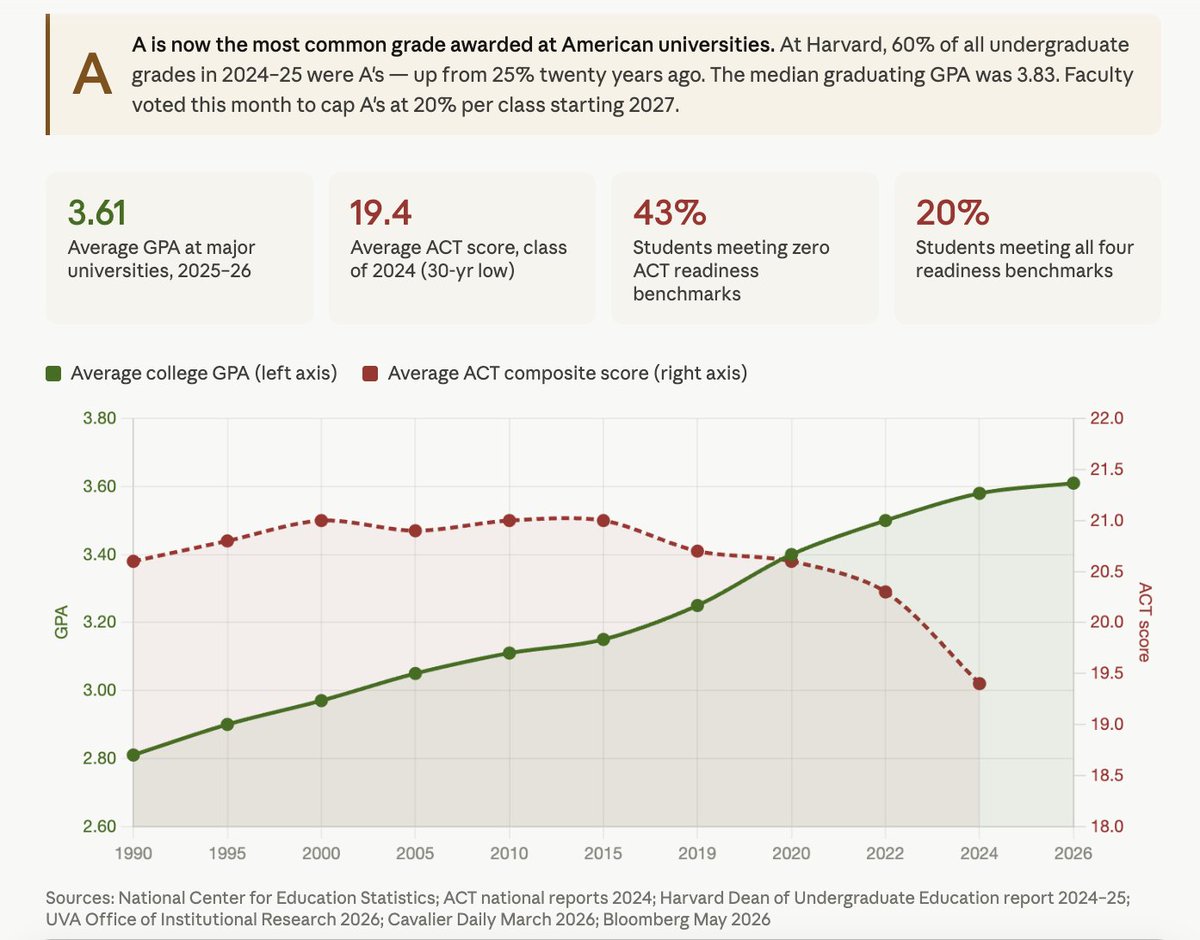
The average grade given to students at American colleges is now an "A."
Harvard's median graduating GPA last year was 3.83. More than 60% of all grades at Harvard were A's, up from 25% just twenty years ago. This month, Harvard's own faculty voted to cap A grades at 20% per class. Their internal report called the grading system a "race to the bottom."
The ACT which is the standardized test that measures whether students are actually ready for college-level work just hit a 30-year low. The average score for the class of 2024 was 19.4 out of 36. And 43% of students met none of the four basic college readiness benchmarks. Not one. And this is despite the test now being shorter and easier than it was in previous years.
So we have students graduating with 3.7 GPAs who couldn't demonstrate a coin-flip probability of earning a B in a first-year college course on an independent exam. The grade and the reality are completely disconnected.
And then they enter the workforce and wonder why it's so hard.
We have a disastrous situation of over confident grads being met with the reality of employers who tell them they aren't qualified. When we aren't honest with people about their performance they don't realize that they have a gap they need to close.
A Gallup survey found that 93% of current college students feel confident their degree is preparing them for work. Only 54% of employers agree.
That 39-point gap is the gap between what the transcript says and what the person can actually do.
I don't think students are to blame here. They were told they were excellent. They were given A's. Nobody told them the truth. And now they're walking into interviews with real confidence and real gaps and the hiring manager is the first person in four years to give them an honest assessment.
That's a failure of the system, not the student.
If you're a recent graduate, you can't wait for someone to hand you the honest feedback your education didn't. You have to go get it by taking on projects that expose your gaps, ask for hard feedback, build skills in public, treat the early years of your career as the education your tuition should have bought.
And if you're a leader hiring right now, the GPA on the resume tells you almost nothing.
I do a deep dive on this in today's Future-Ready Today podcast episode which you can listen to here: https://t.co/X8ns0pNe3T
A year ago, the loudest voices in AI told every executive the same thing: act now or your company won't survive.
@DarioAmodei, CEO of @AnthropicAI, said AI would eliminate 50% of all white-collar jobs within five years. Sam Altman of @OpenAI said entire job categories would be totally, completely gone.
And it worked exactly as designed.
When CEOs make those kinds of predictions publicly, every CIO, CHRO, CFO, and board member hears the same alarm go off simultaneously.
Fear doesn't just inform decisions, it short-circuits them. Nobody negotiates when they think they're already behind.
Contracts got signed, budgets moved fast, and that urgency turned into revenue, which turned into valuation.
Anthropic went from $9 billion to $30 billion in months. OpenAI hit $852 billion. Together, the doom narrative helped produce somewhere between one and two trillion dollars in private market valuation.
Then this week, both Altman and Amodei started sounding noticeably more optimistic.
Altman said he's "delighted to be wrong." Amodei now says automation may actually expand the work people do. Not because the technology changed, but because the audience did.
You can't take a company public by telling pension funds, mutual funds, and retail investors that your product will destabilize society. So the narrative flipped. Doom got them the valuation. Optimism sells the IPO.
The truth is, neither story was told to help you make better decisions about your workforce or your career. Both were told to serve a financial outcome at the right moment.
So which narrative has been quietly shaping your AI strategy, and does your answer to that change anything?
I've put 3 questions every leader should sit with before their next AI decision on the last slide. Swipe through and let me know your honest take.
Thrilled to have Katya Laviolette in the room.
Some people lead HR departments. Katya redesigns how entire organizations think, work, and grow, and has been doing it for over 30 years across some of the most complex environments imaginable.
As Chief People Officer at @1Password, she's navigating what it looks like to build a human-centric culture inside a company literally built around privacy and trust.
That intersection between security, people, and culture is one of the freshest angles entering our CHRO conversation right now. Add to that her depth in M&A, global rewards, organizational effectiveness, and culture change across companies like @RioTinto, @Bombardier, @CBCRadioCanada, and @CNRailway.
Excited to hear the insights of someone who has seen the full spectrum of people leadership at scale.
The conversations inside Future of Work Leaders are already rich, honest, and grounded in real people-leader experience, and Katya's perspective is exactly what makes this community worth being part of.
If you're a C-level people leader shaping the future of work, employee experience, or leadership, and you want a community that actually reflects your level, join us by requesting an invite here: https://t.co/KKgpiDe7mz
Every few weeks, a new headline drops about AI wiping out millions of jobs. And I get it. The fear is real.
Graduates are booing AI speeches at commencement ceremonies. Entry-level work is shrinking. People who studied hard and did everything right are looking at a market that feels like it shifted under their feet.
That reaction isn't irrational. It deserves to be taken seriously. But here's what those headlines consistently leave out.
The same @wef report that projects 92 million jobs displaced by 2030 also projects 170 million new ones created. That's a net gain of 78 million jobs.
The transition is painful. The math, though, tells a different story than the one getting all the attention.
Fear drives clicks. Nuance doesn't trend, and so a generation of workers is being shaped by the loudest version of a story that isn't the full one.
Will AI take jobs? It probably will. But what you should be asking as a leader is something harder: are we building organizations that actually carry people through this shift, or are we just reacting to it quarter by quarter?
Those are very different questions. What's your honest answer to that right now?
What are you seeing inside your own organization right now?
Does it feel like AI is actually helping redesign work in a meaningful way, or mostly being used to justify cuts and leaner teams?
AI is becoming the most convenient excuse in business.
A few days ago, Jensen Huang called out CEOs who blame AI for layoffs. His argument was simple: the timeline doesn't make sense.
Generative AI only recently became good enough to meaningfully reshape work at scale. Yet many companies started laying people off years before these tools were mature enough to justify those decisions.
He's right to question the narrative.
AI is absolutely changing work. Some restructuring is real. Some jobs and tasks will disappear. Others will expand. That part is not controversial anymore.
But a lot of what is currently being labeled as "AI transformation" is really something else:
Overhiring during the pandemic.
Weak strategic planning.
Margin pressure.
Poor capital allocation.
Executives trying to sound forward-looking while cleaning up older business problems.
We've seen this movie before.
In the 1990s, companies blamed the internet.
In the 2000s, they blamed globalization.
In the 2010s, they blamed digital transformation.
The technology shift was real every time. But the technology often became the glossy explanation for decisions rooted in deeper operational or leadership failures.
AI is now playing that role.
The bigger issue is that we're collapsing several different stories into one giant panic headline:
Real AI-driven workflow redesign.
Traditional cost cutting.
The disappearance of some entry-level knowledge work.
And legitimate productivity gains from automation.
Those are not the same thing.
The danger is that when leaders bundle all of this together under "AI," they create confusion, fear, and distrust inside organizations.
The real question isn't whether AI will change jobs.
It will.
The better question is whether leaders are using AI to redesign work responsibly… or using AI as cover for decisions they would have made anyway.
AI is not the crisis.
The transition is the crisis.
And the way leaders manage that transition will matter far more than whatever they put in their press release.
I also think we need to separate a few things that keep getting bundled together:
Real AI-driven workflow redesign.
Traditional restructuring.
Entry-level work being compressed.
Productivity gains from automation.
Those are related, but they are not the same story.
I unpacked this more on today's Future Ready Today episode, especially the difference between AI being the crisis and the transition being the crisis.
Episode link here: https://t.co/pryA2hscIN