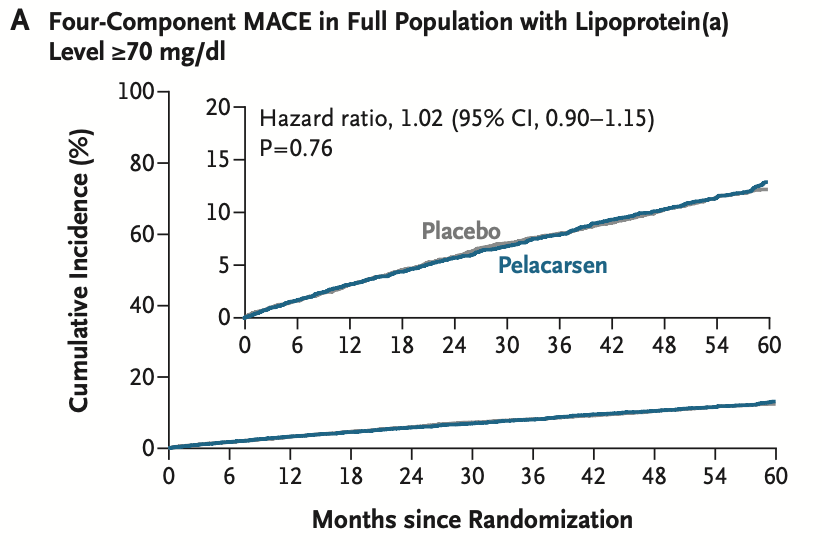
👉Lp(a)HORIZON: substantial Lp(a) lowering, neutral cardiovascular outcomes. What comes next?
👆Pelacarsen lowered Lp(a) by approximately 78%, but did not reduce cardiovascular events over a median 4.7 years:
📈MACE: 12.3% vs 12.1%; HR 1.02 (95% CI 0.90–1.15)
The ≥90 mg/dL population was also neutral: HR 1.00 (95% CI 0.87–1.15); p=0.99.
🤔Several questions deserve consideration. These are hypotheses to investigate, rather than established explanations:
1⃣ Timing and cumulative exposure. Lifelong genetically lower Lp(a) and pharmacological lowering after established ASCVD represent different exposures. Could intervention before the first event change outcomes? HORIZON did not test primary prevention.
2⃣ Background prevention. Median LDL-C was approximately 65 mg/dL, with well-controlled blood pressure. Contemporary therapy may have reduced the additional risk available to modify. However, HORIZON does not establish that intensive LDL-C lowering eliminates Lp(a)-associated risk.
3⃣ Tolerability and sustained exposure. Treatment discontinuation was higher with pelacarsen: 35.1% versus 18.3%. Yet on-treatment and uninterrupted-treatment analyses were also neutral, weakening the argument that discontinuation alone explains the result.
4⃣ Magnitude and mechanism. Could deeper, more sustained lowering with other agents produce different outcomes? Possibly. However, analyses according to achieved Lp(a) and its reduction did not demonstrate benefit within HORIZON.
5⃣ Beyond Lp(a) concentration: OxPL. Oxidized phospholipids carried by Lp(a) may contribute to its vascular effects. Pelacarsen reduced OxPL biomarkers in phase 2, but whether changes in these markers predict cardiovascular benefit remains unresolved.
👆The next trials matter. Different mechanisms, treatment before the first cardiovascular event, and distinct disease settings—including aortic stenosis—will help define where Lp(a) lowering might provide clinical benefit. Greater biomarker reductions alone cannot answer that question.
👆For clinical practice today. Elevated Lp(a) remains relevant to risk assessment and family screening. LDL-C/apoB lowering and comprehensive control of modifiable risk factors remain essential.
👉HORIZON challenges our therapeutic expectations. The genetic evidence remains compelling; cardiovascular benefit from targeted pharmacological Lp(a) lowering still needs to be demonstrated.
🔓🔗 https://t.co/qXm7SbAC4v
@society_eas
@j0hnparkhill A complex, beautiful, highly intricate machine that appears really useful but nobody is clearly sure what it does and doesn’t miss when it’s gone, almost a little too on the nose for the frontier labs
Labpro-tip: Tired of your labmates just chucking PCR tubes in the freezer that then get bumped free and/or slide out?
There are carboard boxes that fit PCR tubes and fit in to the "standard" 5.25 inch box slots
Buy them on amazon and passive aggressively gift them:
mfw
>biology is just a data problem
>collect enough omics, simulate the whole cell
>read about humanin
>peptide encoded inside the mitochondrial 16S rRNA gene
>the same sequence is also a structural part of the ribosome
>24 aa if the cytosol translates it, 21 aa if the mitochondria do
>because mitochondria run a different genetic code
>and start translation with N-formylmethionine instead of plain methionine
>nobody's fully sure which one actually makes it
>also 13 nuclear copies that might make their own versions
>gets secreted into the blood
>hits cell-surface receptors
>one of them is literally a mitochondria detector
>also gets taken back up
>binds Bax inside the cell to block apoptosis
>discovered by screening surviving brain tissue from an alzheimer's patient
>open my cell model schema
>compartment: yes
>molecule_type: rRNA, peptide, hormone
>length: depends who's asking
FYI bad binder design accounted for ~3% of Phase 2/3 trial failures in the past decade
That is to say, the drug failed specifically because it was unable to bind to the target. This is what AlphaFold, Chai, Boltz, RFDiffusion, etc models are built and optimized to solve.
These models are clearly incredibly useful but they don't address 97% of later-stage failures !!!
@bahradx@provisionalidea Yep - although it is frustrating how flippantly they burn through $200k to come to a conclusion like this, when that money could have been put to better use.
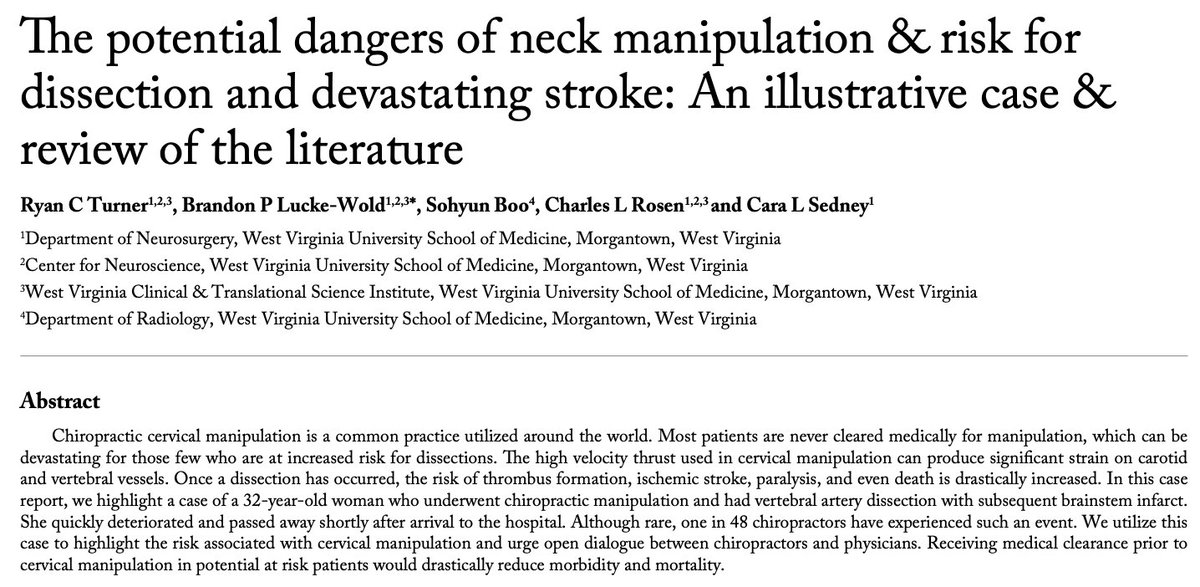
One thing I would NEVER let anyone do: forcefully twist or “crack” my neck.
A 32-year-old woman collapsed immediately after a chiropractic neck adjustment. Imaging revealed dissections of BOTH vertebral arteries.
She suffered a massive stroke and passed away.
I agree.
Robots are the non-biologist's abstraction of how scaling in biology scales. Imagine people in the 1940s pouring money 100x money into automating the vacuum tube factory than inventing the transistor. Imagine putting everything into giant CPU factories instead of inventing the GPU.
We are disproportionally thinking/resourcing innovation in biology as if it's car manufacturing. There is ample opportunity to improve, redefine and scale measurement in front of us.
I recently talked to someone at a robot-first science factory with near billion in funding boasting how they measure ~1000 mutants a week. A team of 4 at Dyno scaled the equivalent assay multiplexing by 25x. 1 person can run it. The robot is scaling the wrong layer.
I'm not against robots and I think they will have the role to play. But I think their impact on biology is overblown, especially on how it scales in performance per dollar deployed. The danger is we become so obsessed with vacuum tube factories that we don't fund the transistors of biology.
Complex physical value chains are somewhat path dependent, once you build a highway instead of a subway, you have to deal with a lower efficiency, higher pollution world. Most current robotic approaches are a crude, and poorly scalable, way to scale biology.
A good day to note that genome editing was pioneered by Maria Jasin, CRISPR gene editing was invented by Jennifer Doudna and Emmanuelle Charpentier, and the most important upgrade to editing was invented by Alexis Komor and by Nicole Gaudelli (in David Liu's lab).
#WomenInSTEM
A 3rd party analytical chem lab might show an HPLC trace and if you’re lucky , they will report the mass spectrometry result as well.
Are they testing for endotoxin or fungal toxins? Residual solvents? Residual/trace inorganics? Probably not.
A Chinese supplier sold black-market retatrutide with a certificate saying it was pure. One buyer paid for a germ test anyway. It failed.
That is the problem: a purity certificate only measures the main peptide. It does not show whether the vial is sterile or what else is in it. When an Australian lab tested 18 samples sold as retatrutide this year, just one matched its label.
To find out what is actually in a vial, buyers have to mail it to a lab, choose the tests and pay a few hundred dollars. Chainalysis estimates they now spend about $8 each on testing, so most test nothing.
Victoria's health department has tied six liver injuries to products labelled retatrutide, possibly from a contaminant, and the FDA holds two death reports, though neither proves the drug was to blame.
And retatrutide is not unique. Semaglutide, tanning peptides and dozens more are sold the same way, as "research use only" powder people inject at home. The FDA does not check any of it before sale.
lol sclerostin inhibitors rebuilding my mom’s skeleton and GLPs solving the obesity crisis and gene therapies that keep SMA kids alive and at little league practice is 1e283x cooler than a flying car, idk where you’ve been in biotech lately
🤔How safe are nonstatin LDL-C–lowering therapies?
👉New meta-analysis in @LipidJournal
1⃣ 41 randomized trials, 104,672 participants
2⃣ No increase in overall adverse events (RR 1.00) or serious adverse events (RR 0.98).
3⃣ No significant muscle, hepatic, or neurocognitive safety signals.
4⃣ Modest increase in discontinuations due to adverse events (RR 1.08) and investigator-attributed drug-related events (RR 1.23).
5⃣ Bempedoic acid: lower myalgia risk (RR 0.85)
👆 Clinical takeaway: Fear of serious toxicity should not be a barrier to appropriate LDL-C lowering. These findings support the safety of nonstatin therapies and their use in combination strategies when indicated
🔗 https://t.co/rlgWznVpps
@nationallipid@society_eas