Reconnecting with old colleagues from Uber after 8 years and them recollecting how happy they were on the team #special_teams
The same is happening at @baseten
Ping me
Excited to share that I have joined Baseten.
A month ago, one of my former colleagues, who works on RL and ML infrastructure, remarked that “something magical is happening at @baseten .”
It's hard to describe, but you know it when you see it.
And I can confirm it is happening here.
The right environment, right people, market timing, conviction and clarity - with everyone rowing in the same direction - creates a different kind of energy, a fun environment, a sense of momentum, and possibility - hard to manufacture but unmistakable when you experience it.
We are hiring across the board - inference, forward deployed engineers, infra, solution architects, marketing, gtm, sales, recruiting….
Now is the time to experience magic. Join us!
https://t.co/MUlV1DnWQv
@amiruci@tuhinone
The AI compute software stack consists of 3 specialized layers:
🔧🔧🔧 Layer 1: Training & Inference Framework (PyTorch + vLLM)
• Runs models efficiently on GPUs
• Handles model optimization and model parallelism strategies
• Manages accelerator memory and automatic differentiation
⚡⚡⚡ Layer 2: Distributed Compute Engine (Ray)
• Schedules tasks within jobs and coordinates processes
• Ingests and moves data
• Provides workload-aware failure handling and autoscaling
🏗️🏗️🏗️ Layer 3: Container Orchestrator (Kubernetes)
• Provisions compute resources
• Schedules entire jobs
• Manages user and workload multitenancy
The same recipe: Kubernetes + Ray + PyTorch + vLLM.
I cover a few case studies in this blog, and the results speak for themselves:
• Pinterest cut dataset iteration time from 90 hours to 15 hours (6x improvement) and reduced batch inference cost by 30x.
• Uber increased LLM training throughput by 2-3x.
• Roblox sped up LLM batch inference 9x.
Each layer handles what it does best. The separation of concerns makes this stack so powerful.
https://t.co/tYQ4VD0IRL
@jonsid@ashugarg@FoundationCap Unstructured data processing is going to become more popular esp with video, audio and other modalities becoming mainstream. Check out Ray Data on https://t.co/ZuYklVWqAJ. lots of cool talks on how enterprises are using Ray Data at the #RaySummit
This used to be such a pain 5 years back.
Excellent blog post showing how easy it is to build an image search and retrieval system for e-commerce using Ray and Anyscale.
https://t.co/47kfhihnbZ
@raydistributed@anyscalecompute#PowerOfPlattorm.
📊 Case study of Llama-2’s capability in summarization tasks.
📌 TLDR: In summarization; Llama-2-70b is as factual as GPT-4 while being 30x cheaper 🧵 👇
https://t.co/ujso0HDjrZ
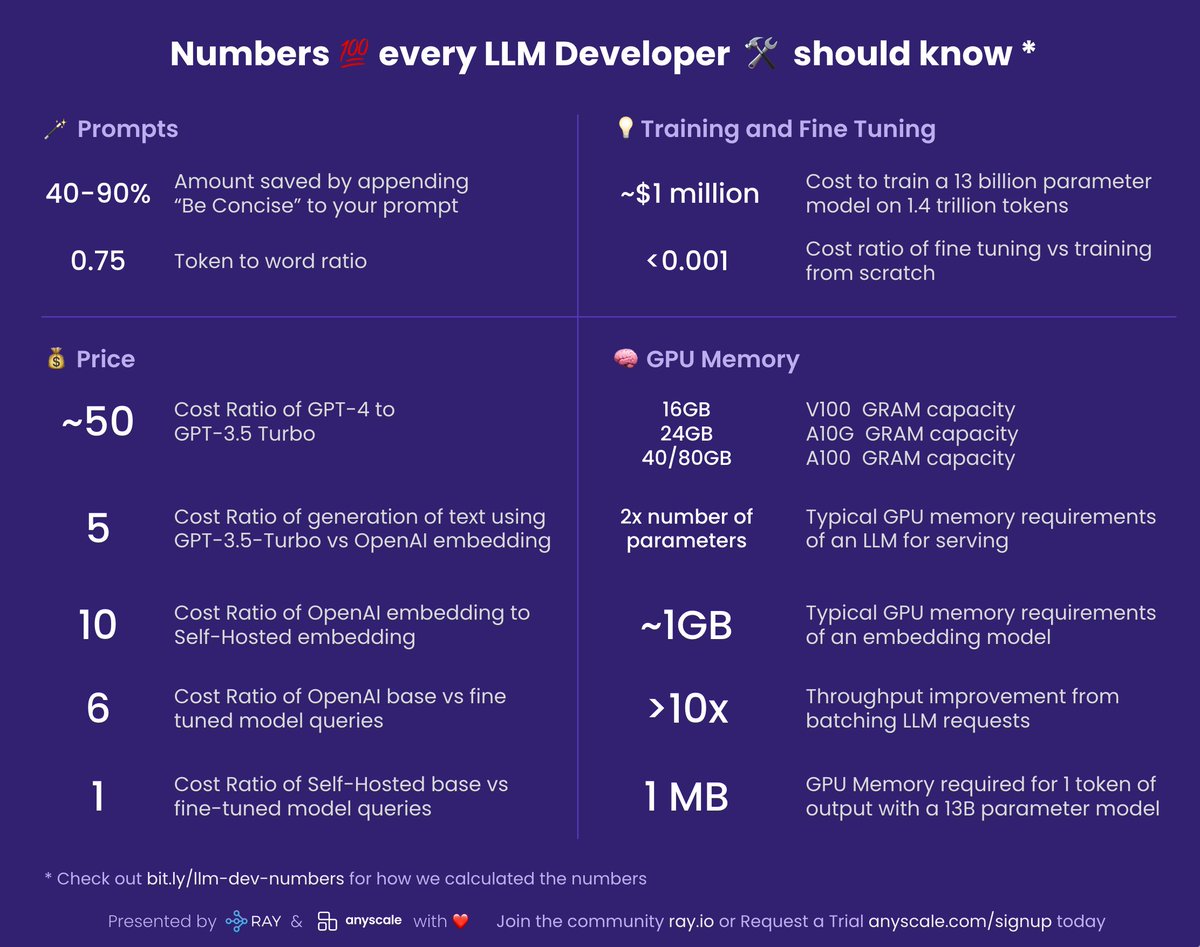
We've built a ton of #LLM applications recently. Reasoning about performance & feasibility is painful without reference points.
Here are the reference points we use to anchor our intuition (inspired by @JeffDean's "Numbers every engineer should know").
https://t.co/586bDcAgJ8
lots of people have asked how to use langchain with self-hosted LLMs
really excited to see this tutorial! @raydistributed are extremely knowledgable, anything they share is worth paying attention to
Everyone is excited about LLMs and generative AI, but existing infra tools struggle for operationalizing these new large models.
Companies are using @raydistributed for solving these problems. Check out our new blog:
https://t.co/jKxuzO6r8P