Fair point.
I do believe there will be some sort of authentication and that people will always crave human interaction so I find it pretty hard to believe Instagram will just obsolete itself anytime soon.
And like Facebook, the power users will remain and use the platform as their sole source of truth.
@glbeaty@astridwilde1 I feel like Instagram is only used as a flexing/see what I have type of platform. I think that doesn’t change in the next 5 years, even with advanced image/video generation. The average 18-30 year old has a desperate need to flaunt anything they can
If you want to read something other than the Citrini piece - this is pretty good and I really liked how Will picked apart the structural problems affecting people today.
Great read!
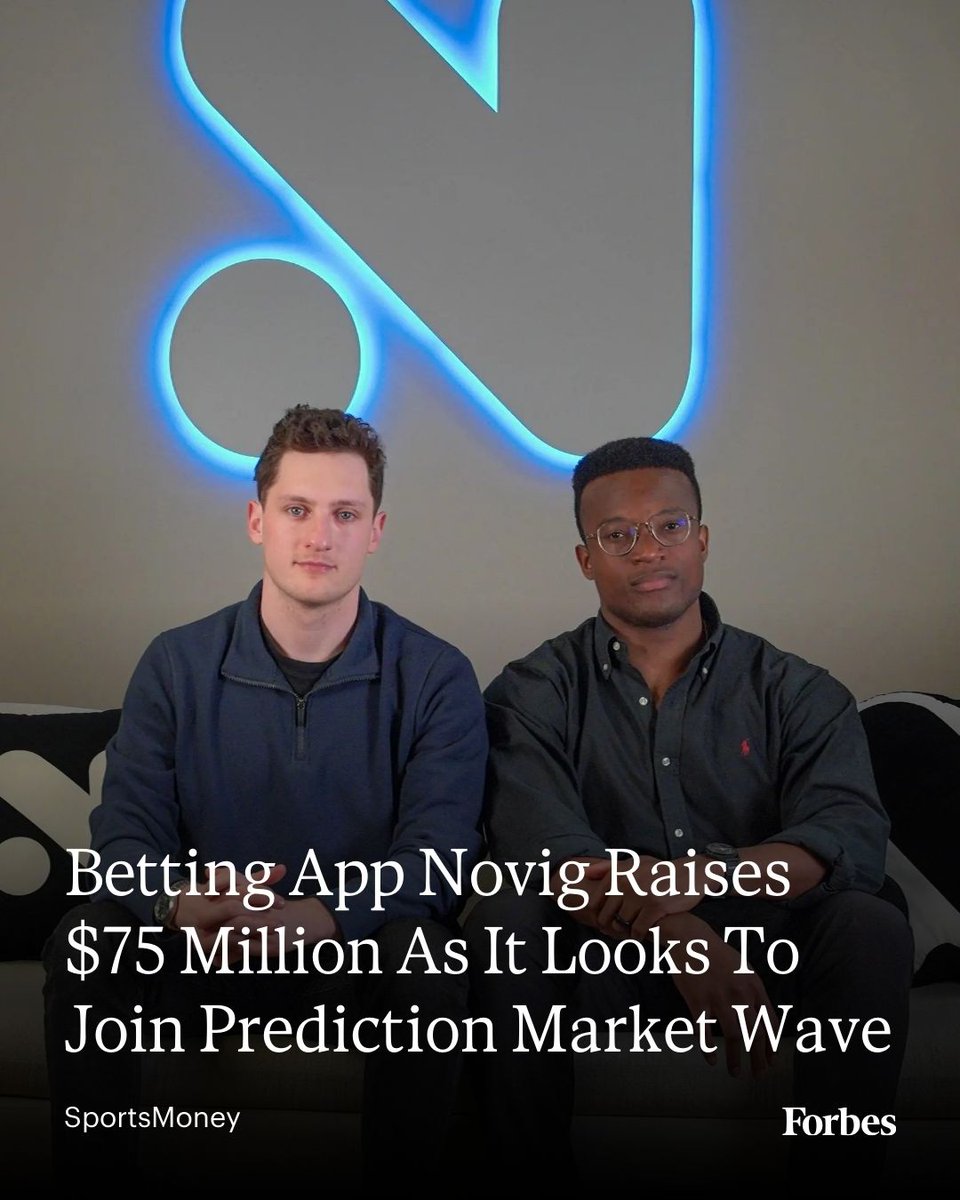
Jacob Fortinsky and Kelechi Ukah met while playing poker with other math whizzes at Harvard, where Fortinsky saw friends who had developed effective sports gambling models have their bets limited or even find themselves banned by established sportsbooks after winning too much.
“It just blew my mind that it was so common practice, that they basically treat any winning sports bettor the same way a casino treats a card counter,” says the 28-year-old Fortinsky.
Keep reading: https://t.co/C2sw32VvMZ
📸: Novig
@taobanker What does your dashboard look like? Have been following the features you’ve been adding as you tweet about them, but curious on the full suite (as it stands today)
Found my way into $ZIM last year at ~$13. Fundamentals made no sense, I think the company was trading at 1.5x FCF yet it still continued to trade down due to macro environment (Wars, Yemen). Then it just ripped on Middle East progression. Don’t know if I ever want to be exposed to macro events the way shipping is, especially in (imo) a rapidly destabilizing world.
1/ As expected, $WBD board recommends against $PSKY latest bid
I read $WBD filings, and here is my analysis as an M&A professor and some thoughts:
Again, the rejection is not surprising as it's hard to make a case that the current $30 $PSKY bid is clearly superior to $NFLX offer. Moreover, this bid has only been somewhat improved from the one $WBD already deemed inferior to $NFLX offer. Why would the board change its mind?
$WBD cited four main reasons for the rejection:
1 + 2 ) "Insufficient risk-adjusted value" and "significant costs.. adverse terms"
This is probably mostly fair, at least in that $PSKY bid isn't clearly superior. As mentioned before, I think all things remaining equal, the bid would need to be in the $33-35 range to be seriously reconsidered.
There are a couple of small quirks here.
First, $NFLX offer looks at least somewhat less valuable today given a) decline in $NFLX share price below the collar, decreasing the value of $NFLX shares the $WBD shareholders would receive, albeit slightly; and b) the disappointing debut of $VSNT, which, while it is a different business, may reflect negatively on the potential value of Discovery Global spinoff.
Second, there is, according to $WBD, an additional $4.7B ($1.79 per share) gap between the two offers: $2.8B termination fee to $NFLX and $1.5B cost plus $300M interest expense associated with Warner's inability to close $15B bridge financing package. The termination fee ($1.07 per share?) is ironclad, but I wonder if $PSKY and its partners can workout the solution to the financing issue/costs as a part of the deal?
Either way, as it stands, even the slightly less attractive $NFLX offer as of today (vs a few weeks ago) is probably still worth about $28.5 p.s., and when you add on the gap, you are looking at at least the equivalent of $30 $PSKY bid.
There are also questions of the finality of $PSKY offer and restrictions on $WBD business. I think if Paramount wants to win this, they have to go in with something that considers this seriously, offers something closer to irrevocability, and is more adaptive in acknowledging $WBD needs to operate flexibly prior to closing.
3) "Risks that jeopardize certainty of closing the Offer"
Acknowledging financing and counterparty risks associated with a more complex structure and the financial condition of $PSKY is fair (although stressing its nature as a large LBO is interesting - more below). $NFLX is bigger, in better financial shape, and has a better credit rating than $PSKY. Yet, at the same time, $PSKY already offered some assurances in form of personal guarantees from the Ellisons for the equity piece. Sounds like the financing package is in place, although it's not my area of expertise as to how sound it is. And of course, the more actors and parties are involved in the deal, the higher the risks/uncertainties. But, there are potentially additional mechanisms that could be implemented here to alleviate some of the risks - depends on things like wording of MAC clauses, financing covenants, etc. The other part of this is the possibility of renegotiations, but again, this could be addressed contractually.
4) " Adverse consequences to WBD and its stockholders if the PSKY.. transaction failed to close for any reason"
We've seen this happen many times before, the deal fails to close, and in the meantime, the target's management is either checked out or focused on the transaction, the business deteriorates, and the target's shareholders are worse off than before. This is why it's important to assess and hedge against all of the risks that may impede closing. This is related to the points above - but there are things $PSKY can do to improve the strength of its deal structure and alleviate some of the risks. Some I've already mentioned. Others may come in the form of additional reimbursements for $WBD if the deal fails to close for a variety of reasons ( $WBD cites the extra costs it would take on if $PSKY fails to close vs. $WBD)
But overall, I don't think the offers "are not even comparable" rather $PSKY offer does not look like a clearly, compellingly superior proposal, and it has not been sufficiently improved from the originally rejected final bid. But I do think it's some type of comparable.
I’d argue that Panamá would be an amazing outcome for Venezuela. We have one of the highest GDP per capita in the region (please see chart attached for GDP growth since Noriega; source tagged) and one of the safest countries in the Americas (safer than some cities in the US).
I’d also argue that Just Cause was ordered first and foremost to protect American Interests in the Panamá canal and all the positive externalities that came from it are secondary (including the small drug population in my country).
Additionally, I’d argue that those metrics you mentioned after point 3 have pretty much nothing to do with Panamá, but are driven by drug producing countries in South America and drug demanding countries in North America.
Panamá has never been a drug producer, rather drugs pass through Panamá on their way to North America. The # of drugs passing through Panamá scales by two factors: Production in South America and Demand in North America, both things that have grown in a Macro sense, not at all because of Panamá or its leadership.
Noriega was also super buddy-buddy with notorious drug lords (including Pablo Escobar), all relationships which were immediately severed with Panamá after Noriega’s capture.
While I was not even born in ‘89 during Just Cause, I’ve grown up on a story of two Panamás: the Pre-1989 censorship ridden, disappearing people, drug fueled Panamá and the Post-1989 beacon of Central America.
I also haven’t addressed any of the actual quality of life issues under Noriega that no longer exist/occur (and trust me, there are plenty).
Given my experience in my country, I am cautiously optimistic for the future of Venezuela and interested to see the Panamá playbook (if that is what the current administration is using) play out in a drug producer like Venezuela.
I’m working on a more in depth write up on Just Cause that I would be happy to share once finished (obviously inspired by recent events since many people, like yourself, will compare VZLA with PTY).
Interested to hear other people’s thoughts, as a Panamanian I obviously have my biases at play.
There is a winner to today’s events that everyone is overlooking: Alternative Data.
@pizzintwatch picked up the action late last night while markets still priced US strikes on Venezuelan soil cheaply. The Pizza Index also caught activity earlier than MSM or OSINT… what a day!