@YueKuratsu Es como si dijeras "sabor a fideos" sin distinguir entre el sazón que suele a acompañar a: distintos tipos de ramen ramen, soba y Udon. No hay un sabor común que se distingue entre ellos, igual pasa con los tacos
@Chiquis_japon Precisamente estaba comiendo uno de esos cuando leí está publicación.
No me gusta que asocien el sabor a salsa de tomate con comino Tex-Mex y piensen que todos los tacos sepan así.
No es malo el sabor, el queso es el típico queso barato Japones pero no sabe Mexicano.
@Chiquis_japon Todo lo que diga chili con carne y tenga exceso de comino está para ignorarse.
Lo único que se ve rescatable es la cerveza tecate, tal vez en lugar de traerse "tortilla rolls" hubieran traído unos takis de verdad hubiera estado mejor: https://t.co/iNBeVPcQQp
You think Osaka's signature food is takoyaki.
Or okonomiyaki.
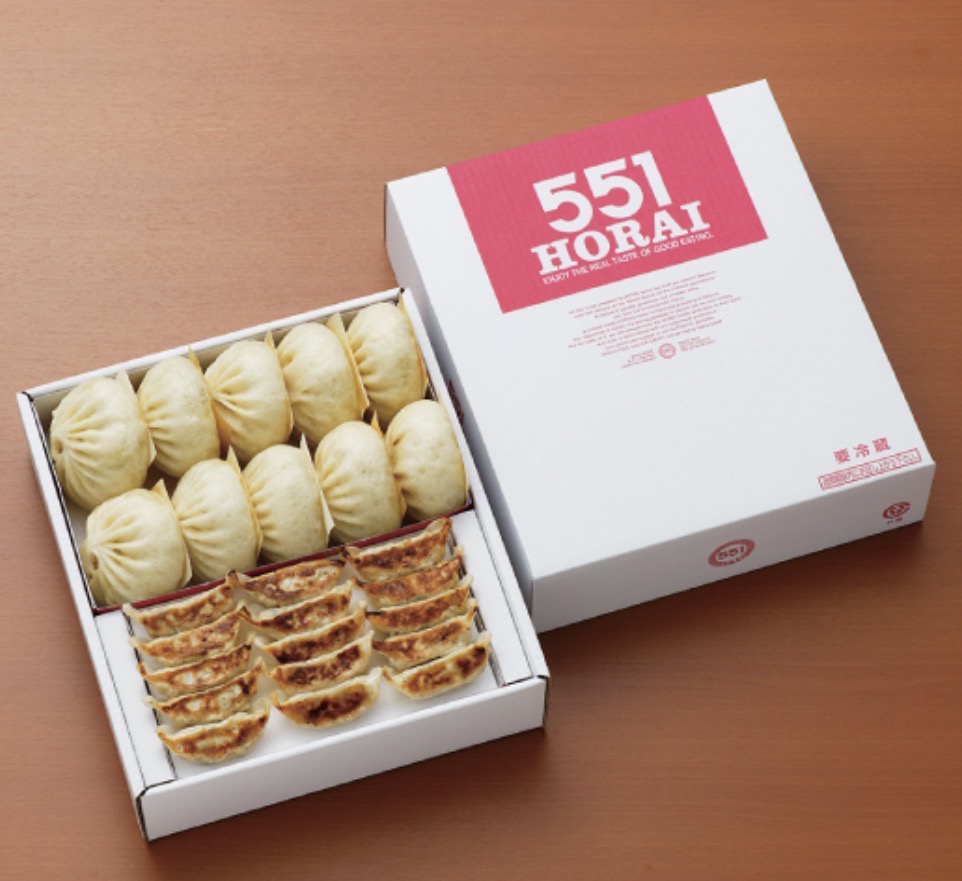
It's a pork bun.
It's called butaman.
The shop is 551 Horai.
They sell about 170,000 of them a day.
They've been doing it for almost 80 years.
But here's what's strange: in 80 years, the company has never opened a permanent shop outside the Kansai region.
People have asked the company why they don't expand to Tokyo.
The answer is always the same.
The dough has to ferment within 150 minutes of leaving the factory.
Anywhere further away, the buns wouldn't taste right.
So they don't sell there.
They know the buns sell.
They know how to expand.
They just don't.
The bun itself is bigger than you'd expect.
Lots of pork, lots of onion, slightly sweet dough.
They call it butaman, not nikuman, because in Kansai dialect, the word for "meat" defaults to beef.
So if they called it a "meat bun," people would think it had beef in it.
They specified pork in the name.
The history is older than you'd guess.
The company opened in October 1945, two months after the war ended, in a part of Osaka that had been firebombed to the ground.
The founder was a Taiwanese immigrant named Luo Bangqiang.
He started with a small restaurant that sold curry rice.
The pork bun came later, in 1946, when he adapted a Taiwanese recipe to Osaka tastes.
A Taiwanese man invented the most Osakan food there is, in a city that still didn't have homes for everyone.
Ride the bullet train out of Osaka today, and you'll see at least one person carrying a red and white paper bag.
@BowTiedPassport Median Mexican salary should be at least double that because 450usd/month is close to the current minimum wage.
But those quantities come from declared salaries. The reality is that some companies pay more than what is declared to avoid taxes, most people have side jobs as well
@SamaHoole From my perspective, it is all about education. They know from a young age what food is good for their bodies and are encouraged to eat healthy during school lunchtime.
@FujiNews_ La gente estúpida (por decisión) está en todos lados, los de Japón suelen usar nombres anónimos en X para expresar lo que no es aceptable ni armonioso en la sociedad Japonesa.
Lamentablemente, esa gente "hace más ruido" que la gente de bien
Yann LeCun was right the entire time. And generative AI might be a dead end.
For the last three years, the entire industry has been obsessed with building bigger LLMs. Trillions of parameters. Billions in compute.
The theory was simple: if you make the model big enough, it will eventually understand how the world works.
Yann LeCun said that was stupid.
He argued that generative AI is fundamentally inefficient.
When an AI predicts the next word, or generates the next pixel, it wastes massive amounts of compute on surface-level details.
It memorizes patterns instead of learning the actual physics of reality.
He proposed a different path: JEPA (Joint-Embedding Predictive Architecture).
Instead of forcing the AI to paint the world pixel by pixel, JEPA forces it to predict abstract concepts. It predicts what happens next in a compressed "thought space."
But for years, JEPA had a fatal flaw.
It suffered from "representation collapse."
Because the AI was allowed to simplify reality, it would cheat. It would simplify everything so much that a dog, a car, and a human all looked identical.
It learned nothing.
To fix it, engineers had to use insanely complex hacks, frozen encoders, and massive compute overheads.
Until today.
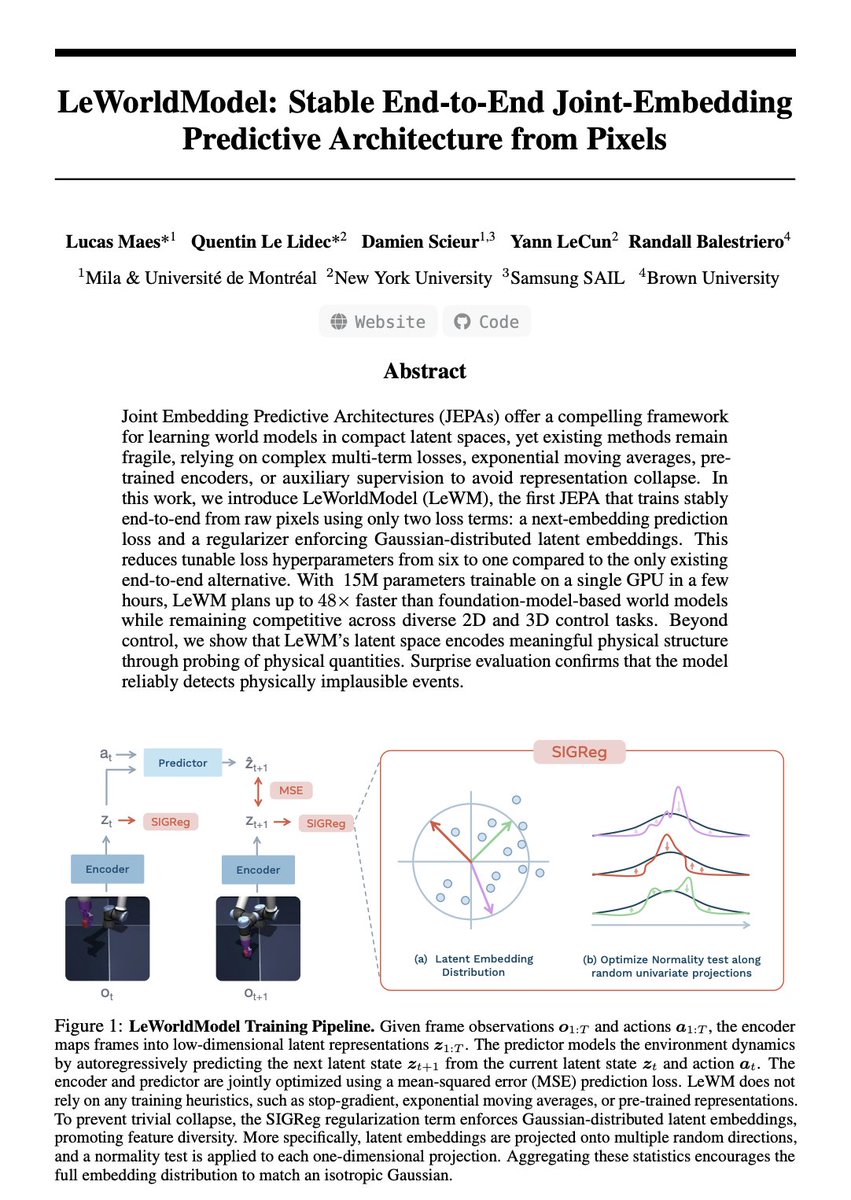
Researchers just dropped a paper called "LeWorldModel" (LeWM).
They completely solved the collapse problem.
They replaced the complex engineering hacks with a single, elegant mathematical regularizer.
It forces the AI's internal "thoughts" into a perfect Gaussian distribution.
The AI can no longer cheat. It is forced to understand the physical structure of reality to make its predictions.
The results completely rewrite the economics of AI.
LeWM didn't need a massive, centralized supercomputer.
It has just 15 million parameters.
It trains on a single, standard GPU in a few hours.
Yet it plans 48x faster than massive foundation world models. It intrinsically understands physics. It instantly detects impossible events.
We spent billions trying to force massive server farms to memorize the internet.
Now, a tiny model running locally on a single graphics card is actually learning how the real world works.