Proud to be a part of Bharatvarsh Infrastructure Growth Story.
Strategic Partner 🤝 Capacite' Infraprojects Limited - Listed with 2500cr ARR and market Cap.
@ankurwriter A Countries chart is more superior or a persons when you have to take a decision ? As the Countries Chart can indicate what's not going to happen.
Prediction:
Chances are bright for Gadi Eisenkot to be the new Prime Minister, after upcoming election results.
Caveat: I say this with only Israel's charts in hand, and with no birth data available of Eisenkot.
#Israel
If you are passing by MG Road, look out for a mother with a Polaroid camera and her sweet baby.
She’s capturing beautiful passing moments, one picture at a time, to support her family and find more photography opportunities.
✨ How you can help:
• Stop by for a quick Polaroid picture
• Share a smile with her adorable little one
• Reach out if you have any freelance photography work or leads!
Let’s help her camera capture more than just memories.
Please share and spread the word! 👇
He isn't, I am saying they should be paid that much. People are becoming influencers for Money. If high compensation is for Science, Research and Inventions, we will have atleast a learned society, higher quality of people. We must not compare NASA or X for payments. We must only look at what they have achieved. AI pros are paid Billion Dollars for a year.
If Prasar Bharati can spend ₹15 crore a year on a DD News show featuring a star anchor, while the ISRO Chairman’s basic pay is about ₹27 lakh a year, shouldn’t we rethink our priorities? If India wants to conquer space and attract our finest scientific minds, our rewards must match our ambitions.
THE FORGOTTEN MASSACRE OF MARWARI HINDUS BY THE PAKISTAN ARMY IN 1971: THE TRAIN TO INDIA THAT BECAME A DEATH TRAIN
13 June 1971. Golahat, Saidpur, East Pakistan (now Bangladesh).
They were promised safe passage to India. Instead, the Pakistan Army sent them on a train to their deaths.
This is the story of the Golahat Massacre, one of the most horrific and largely forgotten atrocities against Marwari Hindus during the 1971 Bangladesh genocide.
Saidpur, in present day Nilphamari district, was home to a prosperous Marwari Hindu community. For generations, these families had contributed to the region's trade and commerce.
When the Pakistan Army launched its crackdown in March 1971, the Marwari community became one of its targets.
Prominent businessmen, including Tulsiram Agarwala, Yamuna Prasad Kedia and Rameshwar Lal Agarwala, were reportedly arrested or killed during the early months.
On 1 June 1971, around 185 Marwari and other Hindu men were rounded up and taken to Saidpur Cantonment, where they were forced to work on military construction projects, including the airfield.
Then came the deception.
Pakistani military officers informed the detained men that arrangements had been made for their safe evacuation to India through the Chilahati border towards Jalpaiguri, West Bengal. They were told they could take their families along.
On 12 and 13 June, Marwari families gathered with their wives, children, elderly parents and belongings. Military trucks reportedly transported them to Saidpur railway station.
Around 450 people, mostly Marwari Hindus, boarded the special train. Men were separated from women and children into different compartments. The doors and windows were secured from outside.
The train travelled barely two kilometres before stopping near railway culvert No. 338 at Golahat.
Waiting there were Pakistani soldiers and armed local collaborators, including pro Pakistani Bihari Razakar attackers. Survivor accounts named Qaiyum Khan and Izahar Ahmed among those involved.
The attackers opened the compartments, dragged out the passengers, robbed them of their valuables and began slaughtering them with bayonets, knives, swords and sharp weapons called ramdaos.
Men, women, children and elderly people were killed.
According to survivor testimony, some victims begged to be shot rather than hacked to death. The killers reportedly refused, saying bullets were too expensive to waste on people they called "Kafirs" and "Gaddars."
The massacre continued for hours. Bodies were dumped beside the railway tracks and into nearby trenches.
Survivors also reported that young Marwari women were abducted.
Approximately 437 to 448 civilians were murdered. Only a small number escaped.
One survivor was Prabhu Dayal Agarwala, whose firsthand account appeared in The New York Times on 19 August 1971 under the title "East Pakistan: The Goondas of Saidpur."
He described the deception, the killings and his escape. With help from local Bengali Muslims, he reportedly walked around 125 miles before reaching India on 20 June 1971. He lost his parents and several relatives.
The massacre devastated Saidpur's historic Marwari community. Entire families were wiped out, businesses abandoned and survivors forced to flee to India.
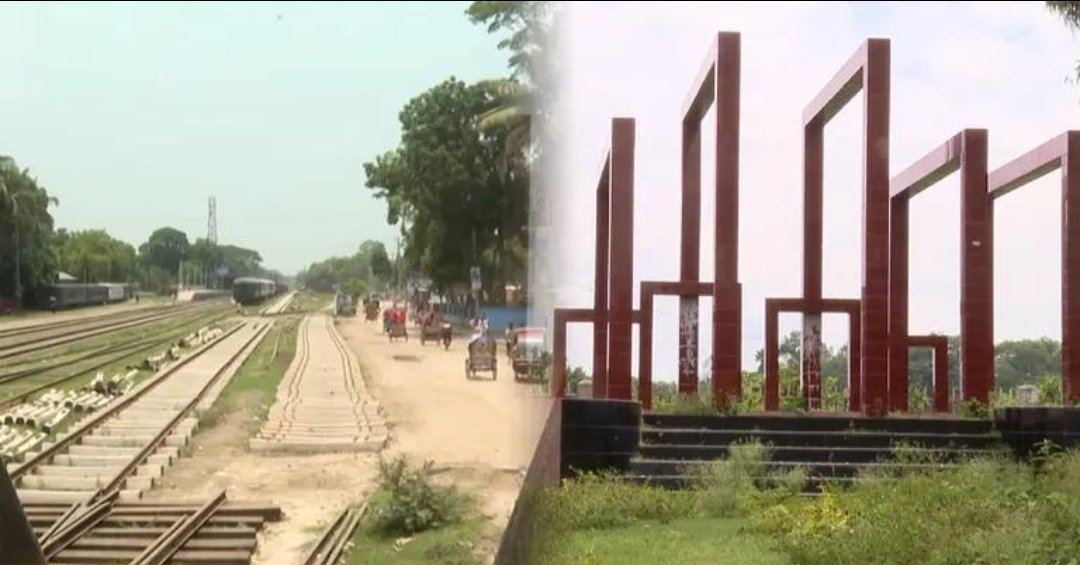
A memorial now stands near the railway tracks at Golahat.
What makes this massacre particularly horrifying is the deception. These were ordinary civilians who trusted the military's promise of safe passage to India. Instead, they were taken to a killing ground.
Yet how many Indians know about the Golahat Massacre and the fate of these Marwari Hindu families?
13 June 1971. Remember Golahat. Remember the train that never reached India.
Pic: Golahat Massacre Memorial (Golahat Badhyabhumi) is in Bangladesh, near Saidpur town in Nilphamari district, Rangpur Division.
The memorial is located near the railway tracks at Golahat, approximately 2 km from Saidpur railway station, close to the site of the killings.
@MCA21India please do something about the servers, it's been 2 days and I am not able to do anything. The call centre is fantastic and provides help, although we need to finally do it on the web portal.