One drain in India dumps 150 million liters of raw sewage into the Ganga every day. 500 million people drink from this river.
India has spent $5 billion trying to clean it since 1985. Three programs. Forty years. The river is more polluted today than when the cleanups began.
Rakesh Jaiswal spent 30 years documenting this from Kanpur, the most polluted stretch. He said in 2017 the Ganga was worse than when he started in 1989. He died in 2019. His verdict still holds.
The math explains why.
The Ganga basin generates around 12,000 million liters of sewage per day. Installed treatment capacity across the basin sits at 3,700 MLD. Roughly 3,000 MLD discharges directly into the main river channel every day. Sewage growth has outrun every cleanup horizon since 1985.
Kanpur pumps 450 MLD of sewage from a population of 3.2 million, plus chemical effluent from 400 tannery units. The Sisamau Nala alone discharged 140 MLD of raw sewage into the river continuously since the 1890s. Asia's largest drain.
The government tapped Sisamau in 2018 and diverted the flow to two treatment plants. The Bhingawan plant takes 80 MLD and discharges its treated output into the Pandu river. The Pandu is a tributary of the Ganga.
The drain didn't go away. It got moved.
The Jajmau plant takes the other 60 MLD. It also receives chemical effluent from 400 tannery units pumping chromium sulfate and tannery acids into the same channel. Jajmau was designed for domestic sewage. It cannot treat chromium.
Add discharge from a tuberculosis hospital into the same drainage and the cleanup math gets worse, not better.
The 2025 Kumbh Mela report at Prayagraj measured fecal coliform 1,400 times the bathing limit. Tens of millions of pilgrims bathed in it.
Rakesh saw the math before the math was visible.
The West poured $50 billion into fast breeder nuclear reactors and abandoned every single one. India poured $900 million and just achieved criticality on the first commercially viable one outside Russia.
The US spent $15 billion. Gave up. Japan spent $12 billion. Their Monju prototype had one sodium fire in 1995 and never recovered. The UK spent $8 billion. Germany spent $6 billion. France, Italy, all walked away. Six of the richest nations on Earth concluded this technology was too hard and too expensive to pursue.
India started building in 2004 with an initial budget of $420 million. Twenty-two years, a dozen missed deadlines, and a cost doubling later, the Prototype Fast Breeder Reactor at Kalpakkam just sustained a controlled fission chain reaction. The reactor is now alive.
The reason India never quit is a constraint most people have never thought about. India has only 1-2% of the world's uranium reserves. For a country of 1.4 billion people trying to build energy independence, that's a death sentence if you're running conventional nuclear.
But India has 25% of the world's thorium. The single largest national reserve on Earth.
The problem: you can't just burn thorium the way you burn uranium. A physicist named Homi Bhabha designed a three-stage nuclear program in the 1950s specifically to solve this. Stage 1: burn natural uranium in heavy water reactors, collect plutonium as a byproduct. Stage 2: feed that plutonium into fast breeder reactors, where it breeds MORE plutonium AND converts thorium into fissile uranium-233. Stage 3: burn thorium directly at scale.
India just entered Stage 2. Seventy years after Bhabha drew it up on paper.
The math on the thorium endgame is wild. At current energy consumption rates, India's thorium reserves could power the country for over 700 years. Most nuclear nations are playing a uranium game with maybe 80-100 years of runway. India is playing a completely different game with a 7x longer fuel supply.
The West quit because uranium stayed cheap and sodium coolant is terrifying. It catches fire on contact with air. It explodes on contact with water. Russia's BN-600 had 27 sodium leaks and 14 sodium fires between 1980 and 1997. And Russia kept going anyway because Russia doesn't quit nuclear projects. India watched all of that and kept going too.
When you have 1% of the uranium but 25% of the thorium, the engineering difficulty stops being a reason to quit. It becomes the price of admission to a 700-year energy supply that nobody else can access.
Indian companies assemble induction cooktops. Most critical part is a switch that turns electricity on/off thousands of times per second to create magnetic field. these power-switching chips are almost 100% imported from Infineon (Germany) or Mitsubishi (Japan).
The ceramic on cooktop is sourced from Schott (Germany) or EuroKera (France/China).
These critical industries use energy derived from LNG. The same LNG that passes from Strait of Hormuz. Inke bolne se step up nahi hoga production
Warren Buffett: “If I can add 1% or 5% to my net worth by being around people who make me want to throw up, I'm not interested.
“If you go into business with somebody who causes your stomach to churn, I say that's a lot like marrying for money: it’s probably not a very good idea under any circumstances, but it's absolutely crazy if you're already rich.”
FII holding in India: approx. US$ 750 billion
FII holding in just Samsung Electronics, TSMC and Hynix: US$ 1.75 trillion
Source: Nomura
How much India has lost in past 2-3 yrs on a relative basis is crazy.
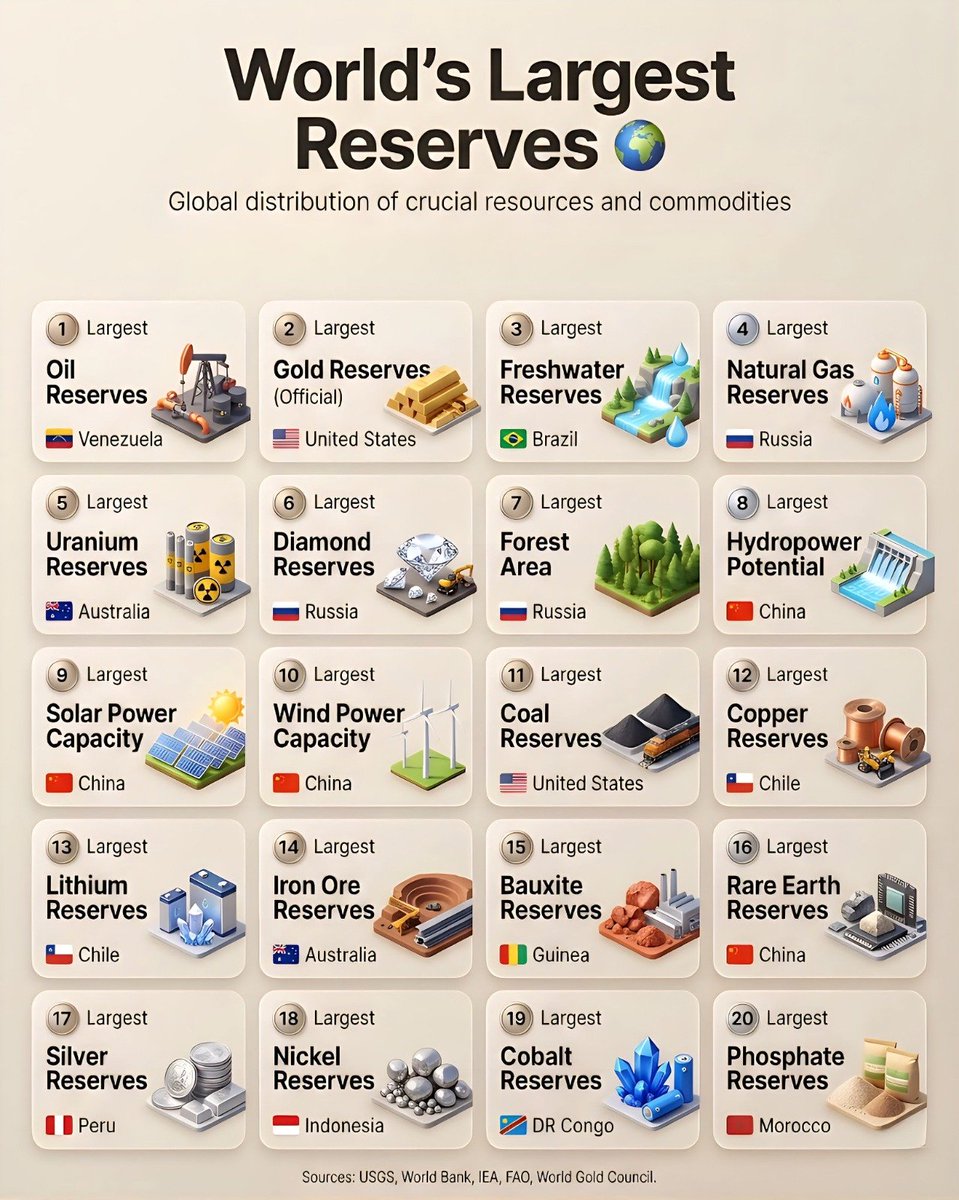
Yes, just like you, I was also looking for domains where India is a leader, but sadly India is not in this map. Theek hai, it is okay. Here is why!
🇮🇳 India did not strike oil like Saudi Arabia. We did not find lithium like Chile or copper like Australia. Well, for many decades we were busy feeding over 1 billion people, building roads & giving basic infra. Different priorities, different challenges you see.
But let us look where we are excelling! India has slowly become the world's pharmacy, the world's spice rack, the world's dairy farm & much more.
Check some insightful details 👇
🥛 Milk
India is the #1 milk producer on Earth. 230+ million tonnes a yr, that is 23% of every litre consumed on this planet. All this from millions of small farmers with 2 or 3 cattle each, stitched together by cooperatives. Amul is not a brand story, it is an engineering marvel built on trust & execution.
🥭 Mangoes
India grows 40 to 45% of every mango on this planet. The Alphonso alone commands a premium the rest of the world cannot touch. UP, Andhra, Karnataka & Maharashtra drive most of it. Bite into a good mango anywhere in the world & there is almost a 1 in 2 chance it came from Indian soil.
🌶️ Spices
35 to 40% of all spices globally, shipped to 150+ countries. Over 70 varieties including turmeric, cumin, cardamom & chilli. The world's food smells the way it does because of what grows in India.
🍌 Bananas
India is the world's largest banana producer at ~35 million tonnes a yr, more than 3 times China's output & roughly 25% of global supply. Tamil Nadu, Maharashtra, Gujarat & Andhra lead. Most is consumed domestically, which tells you how enormous India's internal market really is.
🧵 Cotton
India is the #1 or #2 cotton producer in the world depending on the season, neck & neck with China, both at ~6 million tonnes a yr. More importantly, India has more land under cotton cultivation than any other country, 120+ lakh hectares, which is 36% of the world's total cotton growing area. India is also the 2nd largest exporter of textiles & clothing globally.
🌿 Jute
India produces 75 to 80% of the world's raw jute. With global packaging moving toward biodegradable materials, jute is quietly becoming relevant again in ways it was not 20 yr ago. India does not only produce jute, it essentially controls the global supply of it.
🧴 Castor Oil
India controls 85%+ of global production & 90%+ of global exports. In 2023-24, India shipped 629 million kg worth over $1 billion. China, France, Netherlands, US & Japan all depend on this supply.
Castor oil is a critical input for pharmaceuticals, cosmetics, lubricants, biodiesel & specialty chemicals. When Gujarat has a bad harvest season, global prices move. That is what real pricing power looks like.
💊 Generic Medicines
20% of the world's generic medicines by volume. 60% of global vaccines. When Covid hit, the world was looking at India to come up with solutions. Affordable formulations running healthcare in 100+ developing countries. Pharmacy of the world is not a tagline, it is a supply chain fact.
💻 IT & Software
India's software & IT services exports crossed $205 billion in FY24, making India the #1 exporter of IT services in the world. 54% goes to the US, 31% to Europe. 5.4 million people employed directly. TCS, Infosys, Wipro, HCL are running the backend of global banking, insurance & healthcare operations across 50+ countries. India controls roughly 56% of the global IT outsourcing market. Yes, AI can & might disrupt this, but India may actually be the big beneficiary too. Stanford AI Index 2025 ranks India #1 globally in AI talent acquisition at 33% annual hiring rate & India is already the 2nd largest contributor to AI projects on GitHub with 20% of all global submissions. The same engineers who built the world's IT backbone are now the ones building its AI layer.
⚗️ Specialty Chemicals
India is the 6th largest chemical producer globally & 3rd in Asia. The sector is at $250 billion in 2024. India is the 3rd largest agrochemical producer in the world after the US & China & controls 16 to 18% of global dye & dye intermediate production. With global companies reducing China dependence, 135+ multinationals have already started sourcing specialty chemicals from India under the China+1 strategy.
💸 Remittances
$129 billion in 2024 as per World Bank. Largest recipient in the world, not even close.
Mexico was 2nd at $68 billion. China 3rd at $48 billion. India's inflow exceeded total FDI for the year & surpassed the combined annual budgets of Pakistan & Bangladesh put together. 35 million Indians in the US, UAE, UK & Gulf sending home more foreign exchange than most oil nations earn from their reserves. Human capital, compounding every yr.
Now the numbers that put it all together 👇
India is currently the world's 4th largest economy. S&P Global, IMF & World Bank all agree that by 2030 India will be the 3rd largest, with GDP projected at $7.3 trillion. By 2038, EY projects India could be the 2nd largest economy in purchasing power terms at $34 trillion.
We are a country with no oil, no lithium, no copper reserves of any size, yet we are slowly but surely building 1 of the most diversified economic engines on the planet. The geological lottery gave India very little underground, so India built everything above it.
The businesses sitting at the intersection of these strengths, castor oil derivatives, spice exporters, generic API manufacturers, specialty chemical companies, dairy FMCG, IT mid-caps, rarely get the coverage they deserve. Most investors have never seriously looked at them. Yet these are the industries where India does not fight for market share, in fact India sets the terms.
Well, that takes us to the key question: What Is India Building Next? What is the future for India?
Here are the top things being built for the next 10 to 15 yrs.
📱 Electronics & Smartphones
India went from near zero to $60 billion in smartphone production & $21 billion in exports in roughly a decade. Apple & Samsung are already here in a serious way. If this trajectory holds, India could be the world's largest smartphone manufacturing base by 2035, which would make it one of the most consequential supply chain shifts in global electronics history.
🛸 Space
India has 2% of the global space economy today & the target is 8% by 2033. Low cost launches, a fast growing private startup ecosystem & ISRO's credibility after Chandrayaan make this very realistic. Satellite launches & space services are a multi billion dollar global market & India is positioning early enough to matter.
⚡ Green Hydrogen
5 million tonnes annual production target by 2030. India's solar costs are among the lowest in the world & that is the primary input for green hydrogen production. Most major global energy companies are placing early bets here & India's renewable infrastructure gives it a genuine structural cost advantage over almost every other country attempting this.
🔋 Electric Vehicles
India is the world's largest 2 wheeler market & EV adoption in this segment is accelerating faster than most people expected even 2 yr ago. By 2030, India could dominate global electric 2 wheeler manufacturing & related supply chains in the same way China dominated ICE components a decade ago.
🏗️ Data Centers
India generates 20% of the world's digital data but currently hosts only 3% of global data center capacity. That gap will not stay this wide for long. Reliance is already building what could be the world's largest data center in Jamnagar. AI workloads, cloud computing & digital services will force this sector to scale very fast over the next 5 yr.
💊 Pharma & Biotech
India already supplies 20% of global generic medicines. The next move is biosimilars & biopharmaceutical innovation, not just generics. With rising R&D investment & a manufacturing base that the world already trusts, India is well placed to move up the value chain from affordable generics to patented drug innovation over the next decade.
☀️ Renewable Energy
India is already among the fastest expanding solar markets in the world with hundreds of gigawatts planned over the next decade. As solar manufacturing costs keep falling & domestic demand keeps rising, India could become a major global exporter of solar panels & clean energy technology, not just a consumer of it.
🌾 Food Processing
India is among the largest producers of milk, mangoes, bananas, spices & jute globally. But most of it leaves India raw or minimally processed. The food processing sector alone is projected to reach $1 trillion by 2030. The value addition opportunity sitting right on top of India's existing agricultural dominance is enormous & largely still untapped by serious capital.
So What Does All This Mean?
Like me you would have seen India go through balance of payment crises, coalition government issues, cross border tensions, demonetisation chaos & much more. Through every single one of those moments, people wrote India off, but every single time, India found a way. India knows how to fight back & maybe that is just in our DNA.
And look, I am not making a nationalist pitch here & I want to be very clear about that. India has real problems that any serious investor needs to respect. Governance frustrates, bureaucracy delays good decisions by years, earnings disappoint more often than expected, markets correct sometimes brutally & wealth distribution across this country remains deeply unequal in ways that cannot be glossed over with GDP numbers.
But the direction of a $7.3 trillion economy being built on skills, supply chains & human capital rather than oil wells & lithium mines, that direction is genuinely hard to argue with over a 15 to 20 yr horizon. I would rather own a piece of that story than worry about not being on a resource map.
Stay disciplined & deploy your capital very intelligently!
Not investment advice. Do your own research.
#WealthEnrich #IndiaInvesting #IndianEconomy #StockMarket #LongTermWealth
Underdogs. First-timers. Now history-makers. Watching the J&K cricket team lift the Ranji Trophy felt truly special. One shared dream, one united team, one India. This is why sport matters. This is why cricket brings us together. ❤️🇮🇳
In the past few days, markets have been whipsawing in response to various AI scenarios, most recently the Citrini thought experiment.
The report sketches a fictional 2028 in which agentic coding tools drive the cost of software production close to the cost of electricity.
In that scenario, corporations sharply reduce or cancel outsourcing contracts, revenues at major Indian IT firms decline, IT exports shrink, India’s balance of payments comes under strain & in its most dramatic passage, even the IMF is imagined to be in preliminary discussions with New Delhi.
It’s a great thought exercise.
But I can’t resist quoting Mark Twain who once said, “Reports of my death are greatly exaggerated.”
Let me add another possible scenario to the debate.
I do not claim to have a foolproof counter-scenario. The future remains magically uncertain. Markets are swinging because they are trying to price that uncertainty & in that sense, perhaps they are behaving rationally.
AI will undoubtedly put pressure on IT services companies. Yes, they will need to become more efficient, reduce cost structures, rethink headcount models and move away from pure effort-based pricing toward outcomes & value delivery.
But what if AI does not eliminate service providers & instead makes the best ones even more central?
As AI systems scale across enterprises, someone still has to ensure secure data foundations; integration across legacy and cloud systems; governance, compliance and auditability; mission-critical reliability.
Especially for medium and large enterprises, integration is messy, regulation is heavy, and failure costs are high.
The differentiator may not be who supplies effort but who can deliver outcomes, manage risk and help deliver ‘Scale at Speed’ as we like to say at @tech_mahindra
That role doesn’t disappear. It evolves.
So an alternate scenario, offered with humility and not certainty, is that services firms that pivot decisively toward AI orchestration and outcome-based delivery will remain extremely relevant.
BYD's vertical integration is insane, much moreso than Tesla's
They make their own batteries, chips, motors, and even mine their own lithium.
A couple of years ago they felt there weren't enough transport options for their cars, so they built their own fleet of car carrier ships, and- per this video, the cars drive off of the ships autonomously.
They now operate the largest car carriers in the world. Each carries up to 9,200 cars and is powered by LNG.
The fleet can export ~1M cars/year and cuts per-vehicle shipping costs 30-40%. Wild!
A human consumes about 2,000 calories per day. Over 20 years, that’s roughly 17,000 kWh of total food energy. Training GPT-4 consumed an estimated 50 GWh of electricity. That’s 3,000 humans worth of “training energy” for a single model run.
And GPT-4 is already dead. OpenAI retired GPT-4o from ChatGPT on February 13th. The model that took 50 GWh to train got less than two years of flagship status before replacement. The human you spent 17,000 kWh “training” for 20 years produces economic output for the next 40 to 60 years. The amortization window on GPT-4 was shorter than a car lease.
Now look at what replaced it. GPT-5.2, released December 2025, is OpenAI’s current default. The GPT-5 series consumes an estimated 18 Wh per average query according to the University of Rhode Island’s AI Lab, up to 40 Wh for extended reasoning. That’s 8.6 times more electricity per response than GPT-4. With 2.5 billion queries hitting ChatGPT daily and GPT-5.2 now the default model, the inference math gets staggering fast. Even at a blended average well below 18 Wh, you’re looking at daily electricity consumption that could power over a million American households.
This is what Altman is actually doing. OpenAI hit $13 billion in annual recurring revenue but still isn’t profitable. They need you to think of AI energy consumption as natural and inevitable, the same way you think about feeding a child, because the alternative framing is that they’re burning through enough electricity to rival small countries while racing to build 1-gigawatt Stargate data centers. The food analogy makes the energy costs feel biological and unavoidable instead of what they are: an engineering and business choice that scales with every model generation.
The comparison sounds clever at a fireside chat in India. It falls apart the second you do the arithmetic.