Opus 4.6 is the best model for vibecoding yet.
I used it to build an entire workout coaching engine - but the story starts when Claude caught a training mistake two marathons' worth of wearable data couldn't.
Let me explain...
A year ago I started running seriously. Within twelve months I'd finished two marathons and was already planning my third. I was hooked - not just on racing, but on the whole system: periodization, heart rate zones, recovery optimization, the idea that if I could just get the inputs right, the performance would follow.
So I did what every data-obsessed runner does. I bought a Whoop. I wore my Garmin on every run. I set up heart rate zones, built a training plan, and ran by the numbers. Easy runs in Zone 2. Tempo runs at threshold. I was disciplined about it.
I thought I was doing everything right.
I was training completely wrong for months.
My lactate threshold heart rate was wrong. Not by a little - by a lot. Which meant every zone built on top of it was wrong too. My "Zone 2" wasn't actually Zone 2. My "tempo pace" wasn't actually tempo. I was running way too slow on almost every run, staying comfortable when I should have been pushing, and wondering why I wasn't getting faster despite putting in the miles.
No app caught this. Not Garmin. Not Whoop. Not Strava.
I had devices on both wrists and a chest strap and none of them said, "Hey - your zones are wrong and you're wasting your training." They just dutifully tracked whatever I did and told me I was being consistent. Great job. Gold star. You're consistently training at the wrong intensity.
I only figured it out when I fed all my workout data into Claude and asked it to analyze my training. Within minutes it flagged that my heart rate zones didn't match my actual performance data. My threshold was significantly higher than what I'd been using. Overnight, all my zones shifted. Runs that used to feel like tempo efforts were actually easy pace.
I'd been leaving so much on the table - and an AI caught it in minutes when months of wearable data couldn't.
That's when it clicked: the problem isn't data. Runners have more data than ever. The problem is that most of us aren't coaches. We don't know how to interpret our own data, and when we get it wrong, nothing tells us.
So I built Rex - so every runner can have access to that same intelligence, every single day.
Rex is an AI coaching agent that looks at your actual workout data - pace, heart rate, effort, recovery - and makes real coaching decisions. Not a suggested workout. Not a chart you have to interpret. An actual call on what you should do today, with a clear explanation of why.
Every morning you get a Daily Brief - your recovery state, today's workout, and the reasoning behind it. When your data says your zones are off, Rex catches it. When your HRV tanks, Rex adjusts the workout and tells you why. When you're ready to push harder, Rex pushes you.
It's the coach I wished I had when I was running 40-mile weeks at the wrong intensity and thinking I was nailing it.
I'm not a professional developer. I built the entire coaching engine with Claude Code - plan generation, readiness scoring, wearable data fusion, workout adaptation - all in production, mostly on nights and weekends while training for marathon number three.
This isn't Garmin Coach (static templates that never adapt). This isn't ChatGPT ("make me a training plan" with no memory of who you are). This isn't a tracking app that shows you data and hopes you figure it out.
Rex makes decisions. A human coach costs $200-400/month. Rex costs $25.
I'm looking for 20-30 runners or hybrid athletes who use Whoop or Garmin to test it. If you've ever wondered why you're not getting faster despite doing everything "right" - Rex is for you.
Sign up for early access at https://t.co/ishEKtIAHs, or DM me - happy to show you what a Daily Brief looks like.
Seeing Japanese X on my timeline has been so beyond fascinating. It’s hilarious and I can’t stop reading it.
But also it would be great to get Claude code and Clavicular back too
Non-technical folks are uniquely positioned to unlock new ways to improve agentic coding.
Not having the chops to solve a problem yourself requires you to figure out how to solve problems with agents. So fascinating
@aakashgupta The reason math goes before writing is because math is logical and verifiable. Like code, it’s either right or it’s not. Writing isn’t.
Models can write OK copy, but they definitely cannot write stories and they write mid Twitter and LinkedIn posts like this one.
The funny thing about this is if you’re still optimizing prompts in the traditional way you are not using AI right. It’s just engagement farming.
Easy enough try on your own, output sounds good enough to feed the loop, not impactful enough to actually do anything
Finding users for my AI run coach:
Reddit - -10 likes - top comment said “some people have no independent thought 😂”
X - no traction
Strava - 60 kudos and 7 waitlist signups from 1 post
Meet users where they are I guess?
Want to know the stats behind your Strava data?
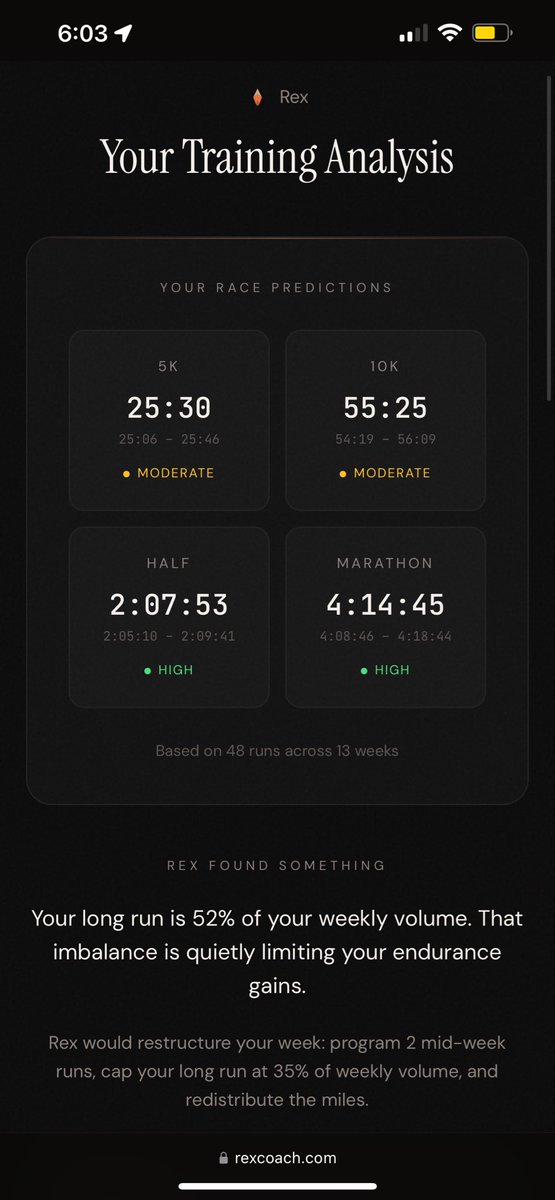
This tool predicts your races scores and lets you know what’s working, what isn’t, and what the opportunities
@pnwprincess23 Awesome post! Agree that most important thing is to just get miles and be consistent. That being said if people do need a training plan I built a website that makes customized ones based on their level / goals https://t.co/YFiecfC3xW
Every fitness app tells you what you did yesterday. None of them help you figure out what to do next.
So I built one. Rex reads your Whoop/Strava/Garmin data every morning, makes a coaching decision, and tells you exactly what to run and why.
Last week, it swapped my tempo run with an easy run for a different day because my HRV trend was declining. That’s the feature. The bad day is the product.
Built in 35 days. Non-technical founder. 275 commits and 120k lines of code.
Free training analysis (no account, just upload your data) 👇