I am excited to present “The Wheel of (Over)Time” (joint with @Rob_McDonough_) at NBER Fall Labor Studies this Friday. Full program here: https://t.co/Qk6rksvWYO. The paper is relatively new so I thought it might be worth an #econtwitter thread. 1/N
"Abduction and the Demand Curve"
A new paper with @EconTraina
The demand curve is the most basic object in economics. Hold everything else fixed, change the price, see what happens. Ceteris paribus. Day one stuff. Okay, maybe day 3.
But what does "everything else" include? Unobserved quality, local tastes, recent advertising. Things the econometrician doesn't see. A market's demand curve holds those fixed.
Now suppose you run a randomized experiment. Set a price, observe quantity, repeat. You've eliminated confounding. You have a causal effect. We love experiments. Perfect. Right? Right?
Are these the same things? This maybe isn't well-known outside of IO, but the answer is no.
When they aren't, what are you supposed to do? This paper connects the experimental literature with the structural IO demand estimation literature to make clear the interplay .
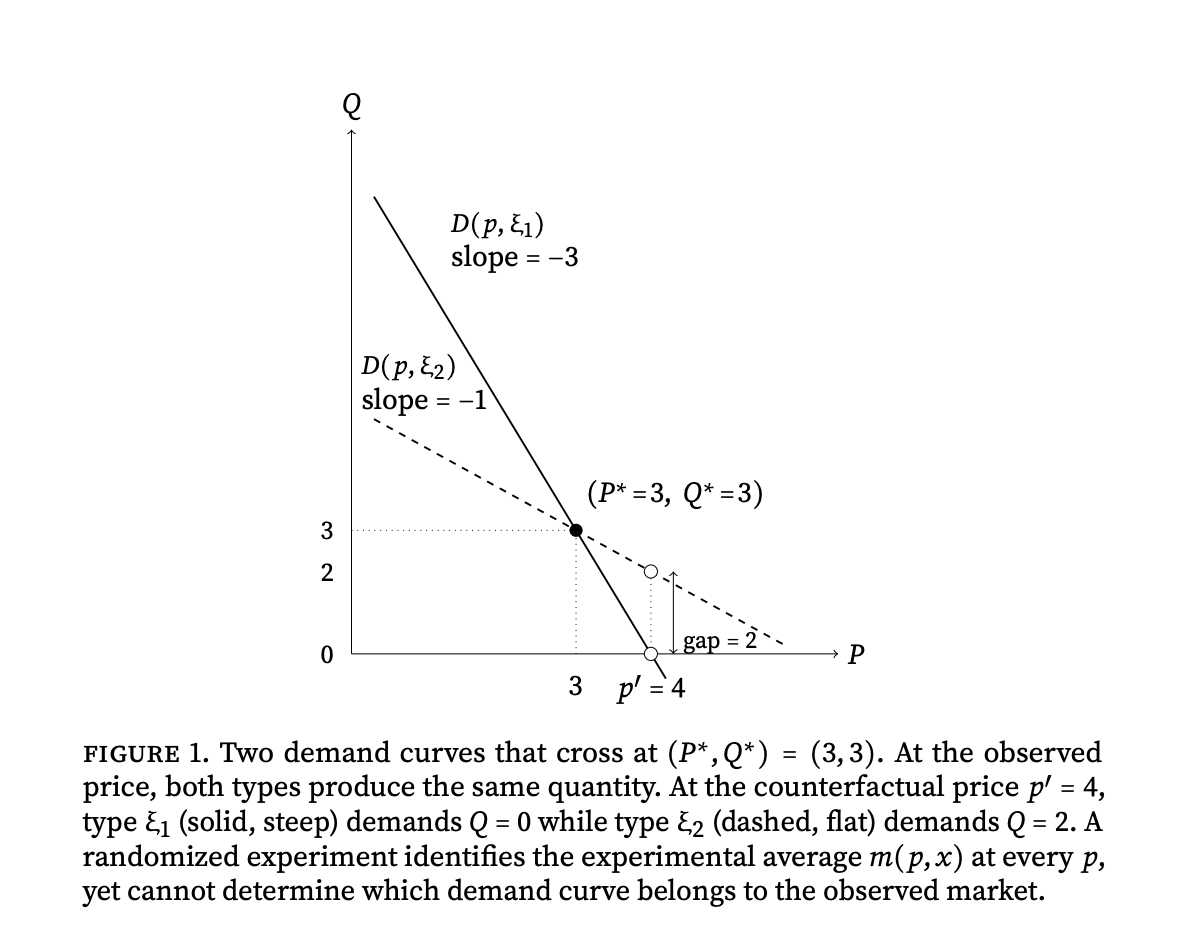
In the experiment, you've averaged over all those unobserved conditions. You know what happens on average across markets when you set a price.
You don't know what happens in THIS market, with THIS unobserved quality, at that price. The experiment gives the average demand response. Policy happens in a specific market.
Two markets produce the same quantity at the same price. An experiment can't tell them apart. But at any other price, they diverge. The demand curve is a market-specific object. So what bridges the gap? Good ole' Berry (1994_ inversion.
You observe a market's shares, prices, and characteristics. Inversion recovers the unobserved demand index, the δ*, that rationalizes what you see. It pins down WHERE on the demand function this particular market sits.
Prior work treats this as a computational convenience. Berry (1994, p. 249) compares it to "taking logarithms of observed data." Berry and Haile (2021, p. 40) call it a "trick." They leave as an open question what happens when invertibility fails, "perhaps involving partial identification."
We answer. Without inversion, even price-only counterfactuals are set-identified. The trick is not optional. Inversion is not just sufficient but necessary for recovering market-specific counterfactuals.
But when exactly do you need it? Berry and Haile (2021) say experiments "generally" don't identify demand. Angrist, Graddy, and Imbens (2000) showed that when demand differs across markets beyond an additive shift, IVs identify a weighted average of derivatives, not any single market's response. Imbens even reiterates the point in his Nobel lecture.
We first make "generally" exact beyond the linear case of AGI (2000). We characterize precisely when the experimental average price response equals every market's demand slope (if and only if additive separability holds, a knife-edge that every standard discrete-choice model violates).
So outside of that case, what are we to do? That hasn't stopped IO economists. Are they just making stuff up? No! Berry inversion baby!
Along the way, we can make a few more connections. @yudapearl asked whether ceteris paribus demand can even be formally defined in counterfactual language. We do that.
The demand curve is the unit-level counterfactual Q_p(u) for a market with realized conditions held fixed.
We also show the connection to Pearl's causal hierarchy. Experiments give Rung 2 (causal). The demand curve is a Rung 3 object (counterfactual). There's generically a gap between them. Berry inversion is what is called abduction in SCM to move between those rungs.
The econometrics and CS frameworks are saying the same thing, and the demand curve is the natural, well-developed setting to see it.
Looking forward to the @nberpubs Organizational Economics Working Group tomorrow.
Amazing line up of presenters and discussants, follow the sessions live on YouTube.
100% agreed that undergrads should learn the task-based framework!
I actually just taught this to my @LSEEcon undergrads 3 weeks ago:
https://t.co/jxaSgipXK9
If you want the most pedagogical version, go with Cobb-Douglas across tasks!
Thrilled to say my market is over—next year I’ll start as a Postdoctoral Fellow at Yale SOM (@BroadCenter) before joining the Department of Economics at UNC Chapel Hill.
I’m excited to start working with such amazing scholars!
The first-ever Chapel Hill-Copenhagen Conference on Macroeconomics and Deep Learning will take place on September 3+4 in beautiful Chapel Hill https://t.co/EEdmxhuxfa!
We are very honored to have @UncertainLars (@MFRProgram, @BeckerFriedman, @UChicago) as our keynote speaker.
We are hopeful this setting allows us to complement survey work in this area with observational data, and answer: what do workers want? Draft (soon to be revised) is here: https://t.co/nXxA9lZWp8 12/N
I am excited to present “The Wheel of (Over)Time” (joint with @Rob_McDonough_) at NBER Fall Labor Studies this Friday. Full program here: https://t.co/Qk6rksvWYO. The paper is relatively new so I thought it might be worth an #econtwitter thread. 1/N
Example: If Bob traded a 4 hour shift at the Oscars at 7pm on a Sunday to Sally for a 12 hour shift on Monday at 4pm at the farmer market, this tells us a lot. The wheel means Bob and Sally were endowed exogenously. 11/N
I'm back, for better or worse.
Many opportunities to join UNC this year.
Economics hiring 3 tenure track and 1 teaching track faculty:
https://t.co/f6okFHEkoR
School of Data Science and Society (@UNCSDSS) hiring economists:
https://t.co/QcygvWao2f
Please share EconTwitter!