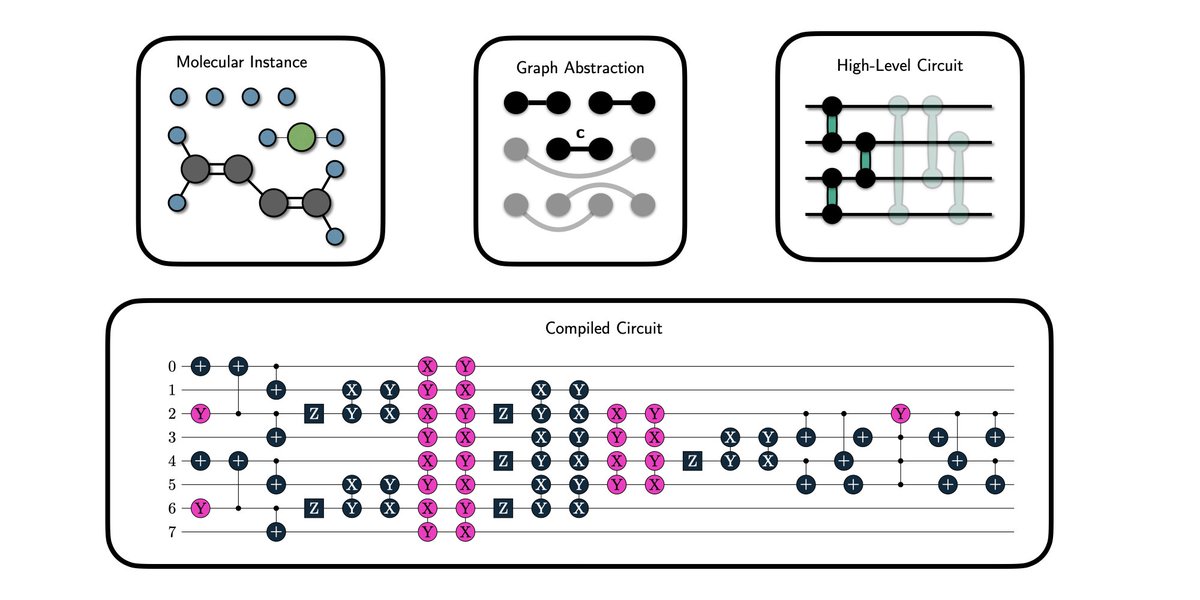
high-level quantum circuit design from physical insight: wow to generate circuits from scratch in a explainable fashion.
Article: https://t.co/9L50wLke8P
Blog: https://t.co/6aDWZqhjQk
Codebase: https://t.co/cjK8Hdc8aY
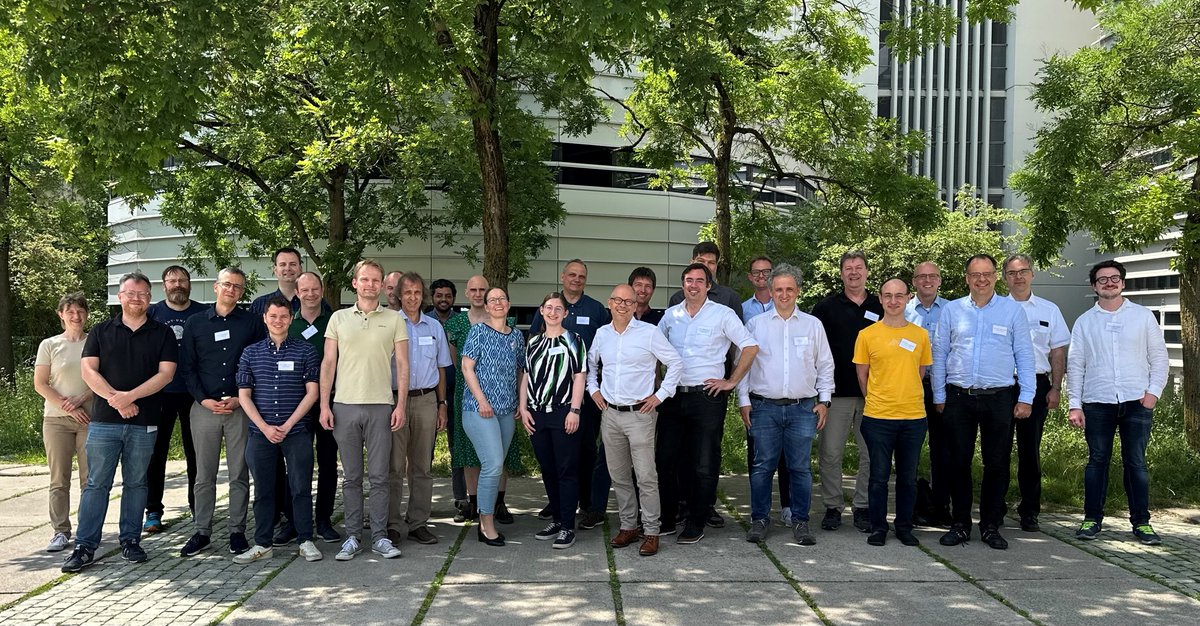
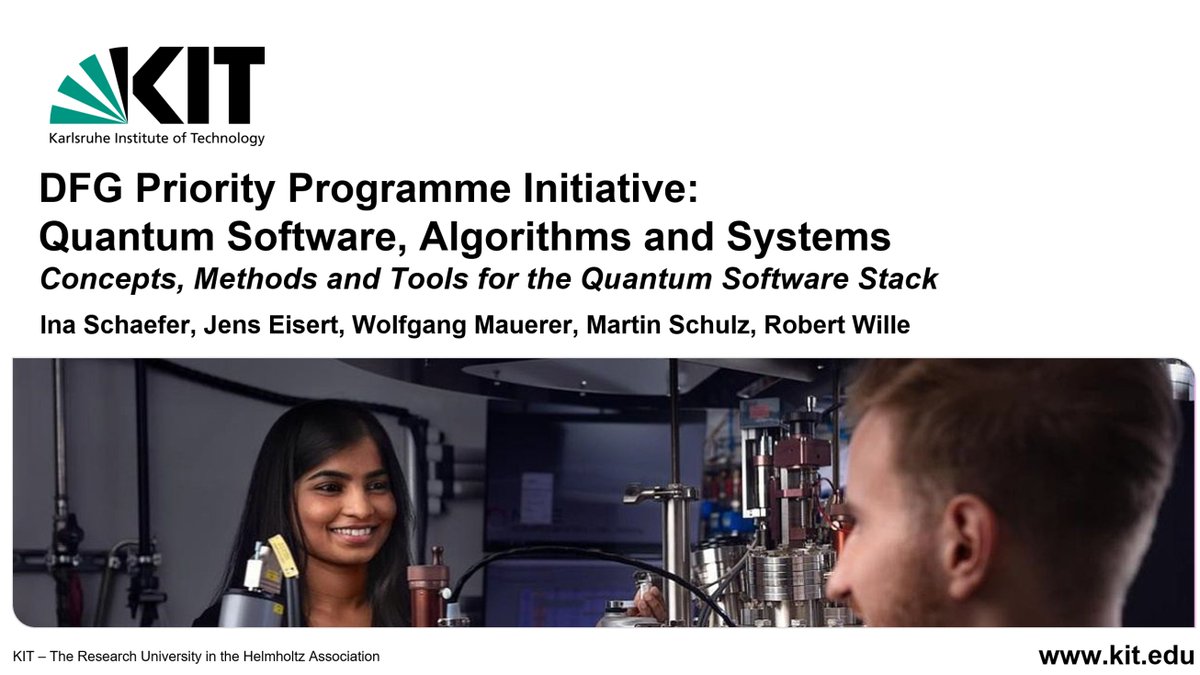
Soon, a new research initiative on #QuantumComputing#software will start in #Germany: The #SPP2514 "Quantum Software, Algorithms and Systems" by @dfg_public.
Today, we had an initial round-table discussion about it at @TU_Muenchen. Many thanks for the great exchange!🙂
1/2
"A Quantum Computational Approach to Multiconfigurational Valence Bond Theory" with Francesco Scala. Valence bond structures approximate electronic Eigenstates using quantum circuits. Implemented with Tequila Library.
Paper: https://t.co/2R5Ce29KKq
Code: https://t.co/8fGHAZyHnD
Happy to be selected for a @MunichQuantum -Lighthouse project. With KID-QC^2 we're aiming to further automatize circuit construction for electronic structure by teaming up with the @FraunhoferIIS (group of Daniel Scherer). Great to have students that take care of social media :-)
Sharing insights from our recent KickOff Meeting for the MVQ-Lighthouse project last Wednesday with the group of Daniel Scherer at the Fraunhofer IIS @FraunhoferIIS and the Munich Quantum Valley @MunichQuantum !
Swipe to see highlights 🌟
My recent work on disordered quantum systems and many-body localization (MBL). This short article is filled with new perspectives.
Anyone working on #QuantumComputing should learn about MBL, which defers quantum decoherence.
#condensedmatter#MBL
https://t.co/0LdNUYmltK
Abstract submission closes in one week for @goldschmidt2024
Consider submitting to our session 12f:
Tracing physical and (bio)geochemical changes in the past and present (sub)polar oceans
https://t.co/AQqRvzegWo
It might be easy to develop a variational (quantum) algorithm. The art is developing an algorithm that works and improves on previous results.
I find these QIP-minded discussions very hard to digest and completely disconnected from real-world problems in computational science.
Variational methods are the most accurate
(and oldest) existing approaches to solving actual quantum many-body problems. The idea that since they are easy to understand and replicate, then people should not work on them is just crazy from a computational physics/chemistry perspective.
Should we all work on QPE from now on because it's a more elaborate quantum algorithm?
But then, who will provide an initial ansatz for QPE if we cannot use variational methods? Please, somebody tell me!
Can VQAs with barren plateaus still be trainable? Just in time for last week’s paper connecting the absence of BPs and classical simulability, our work on synergistic pretraining of quantum circuits via tensor networks was just published in @NatureComms!
https://t.co/FAViRtboHO
With @AmaraKataba, A.Caesura and P.Johnson, we incorporated hardware, algorithmic and fault-toletant advances to validate that the regime between NISQ and FTQC, referred to as early fault-tolerant quantum computing (EFTQC), will exist in a meaningful way! https://t.co/sMVMVi2HYH
Highly efficient AI-discovery of 100 (!) new (!) quantum experiments (state gen, transformations, q.comm, cond.matter.phys) just published in @quantumjournal
Congratulations to @cruizgo_@soerenarlt & whole team!
[paper] https://t.co/ldX7EAq1Uv
[code] https://t.co/zBpRkIf646
Please help circulate
-------
I am in search of two interns, preferably Masters or PhD students, to collaborate with me on projects related to quantum error correction. If interested and eligible, please send your CV to [email protected] (1/3)
My first foray into promotional videos was a blast thanks to the expert guidance of Julia from the @ICBPETH. Enjoy my Swedish accent, and come to my inaugural lecture. It will be streamed online as well: https://t.co/ZDTxCKhlYt
The Munich Quantum Software Forum (#MQSF) is in the books! Together we showed that there is an active and exciting #QuantumComputing software community--and not even a small one!😉
1/4
I have been appointed an associate professor of computational physics at @ETH_physics. I'll have PhD and postdoc positions, so get in touch if you are interested in quantum many-body physics, ML, condensed matter, or quantum info/computing
It's time for another brand new @NetKetOrg tutorial!
This week, thanks to @pgabbo0 of @cqs_lab@EPFL, we explore bosonic systems in continuous space: first, a 3D harmonic oscillator and then 1D confided particles with Gaussian interactions, using a DeepSet NQS https://t.co/cVDckHa6k0






![MarioKrenn6240's tweet photo. Highly efficient AI-discovery of 100 (!) new (!) quantum experiments (state gen, transformations, q.comm, cond.matter.phys) just published in @quantumjournal
Congratulations to @cruizgo_ @soerenarlt & whole team!
[paper] https://t.co/ldX7EAq1Uv
[code] https://t.co/zBpRkIf646 https://t.co/MJB0lmtd1W](https://pbs.twimg.com/media/GBJ2WRcXwAAQ-dw.jpg)





