Introducing GOFish: Full Field‑of‑View Gaussian Splatting and Mesh Extraction! 🎉 Reconstruct simulation-ready 3D digital twins directly from fisheye imagery, combining photorealistic #3DGS over the camera's full FoV with a mesh for collisions.
🔗 https://t.co/bVBRgMDsRE (1/3)
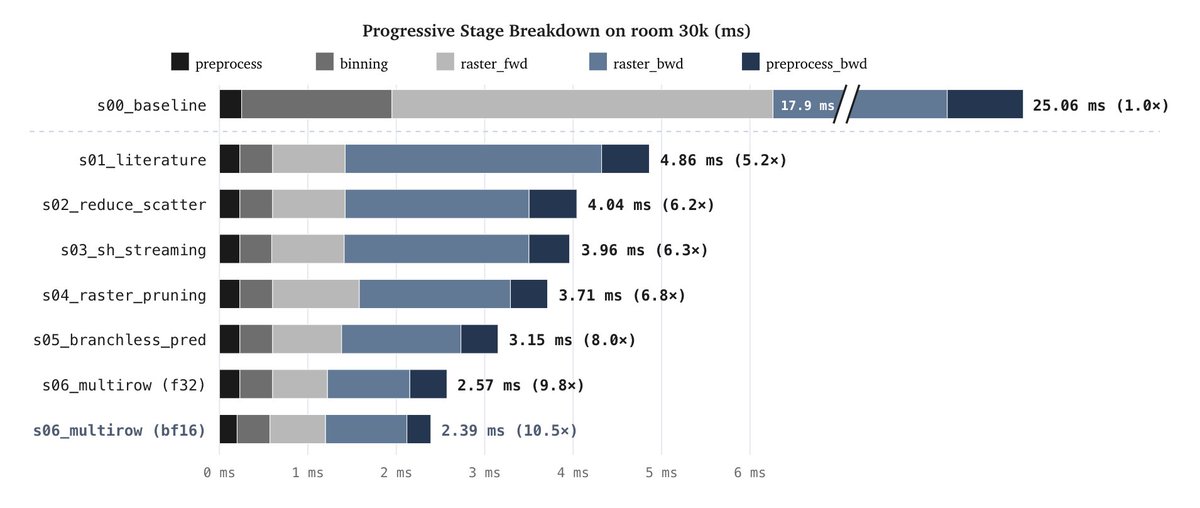
Is it possible to make 3D Gaussian Splatting even faster?
Short answer YES!
Enjoy a 10.5x optimization on forward/backward cuda kernels over the published 3DGS ones!
https://t.co/fVyIexfh6N
Driving video shot through a windshield is full of cabin reflections, and 3D Gaussian Splatting bakes them straight into the scene. RIDE-Splat removes them, with no clean images, no reflection masks and no pretrained networks. 🧵
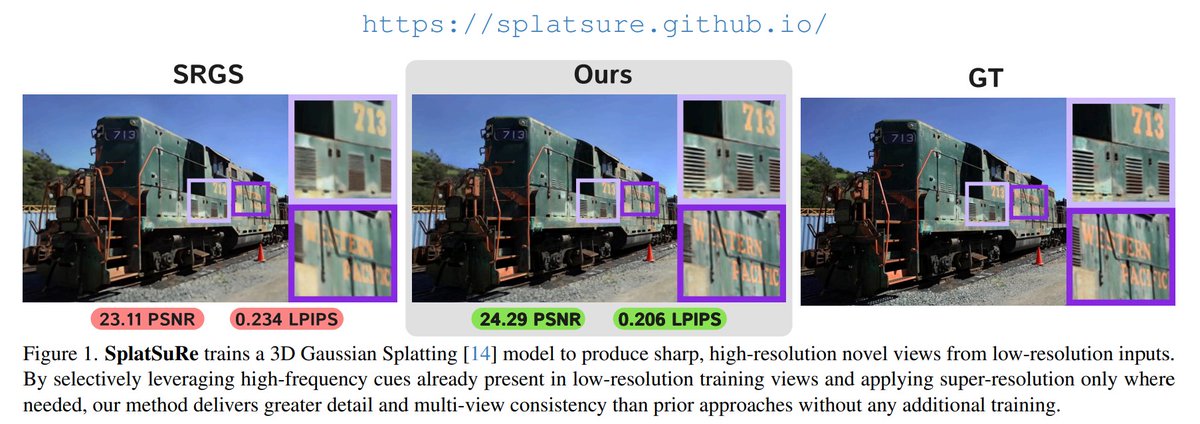
SplatSuRe: Selective Super-Resolution for Multi-view Consistent 3D Gaussian Splatting
Contributions:
1. A per-Gaussian fidelity score that quantifies how well it is resolved across views, leveraging LR geometry to estimate available high-frequency information.
2. A per-view spatial map of available frequency information computed using the Gaussian fidelity score, which modulates SR supervision during optimization.
3. A selective SR training framework that jointly optimizes a 3DGS model using LR and SR supervision. It injects generative detail only where needed while preserving multi-view consistency and achieving state-of-the-art results across a diverse range of scenes.
🚀 Introducing SplatSuRe: Selective Super-Resolution for Multi-view Consistent 3D Gaussian Splatting!
🔗 Paper & Code: https://t.co/13gWNyWoQ7
🎨 Enhance #3DGS by selectively injecting #SuperResolution only where high-frequency detail is missing
#ComputerVision#AIResearch#ML
🚀 Exciting News! 🚀 I am thrilled to present our work titled "LD-ZNet: A Latent Diffusion Approach for Text-Based Segmentation" as an #ORAL in #ICCV2023 🌟🌟
🧵 THREAD: Dive into the world of LD-ZNet and discover how we're transforming text-based image segmentation! 🚀
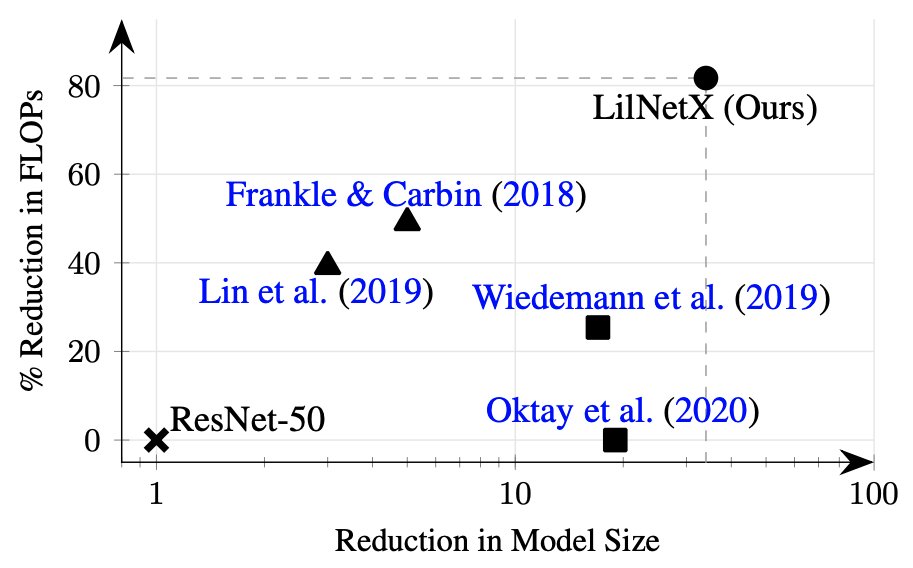
Excited to present our #ICLR2023 paper, LilNetX, a framework for joint deep network size reduction and faster inference. Visit our poster @iclr_conf in Rwanda at Poster session 3 on May 02, 11:30 AM (Local Time)!
Project page with code & paper at https://t.co/FFq0wouTNg
We introduce LilNetX, a framework to train large neural networks which take up fraction of disk space and are much faster at inference!
Visit our poster @iclr_conf#iclr2023 in Rwanda to learn more!
When 🗓: May 02, 11:30 AM (Local Time)
Code & Video: https://t.co/RiQVcRekqT
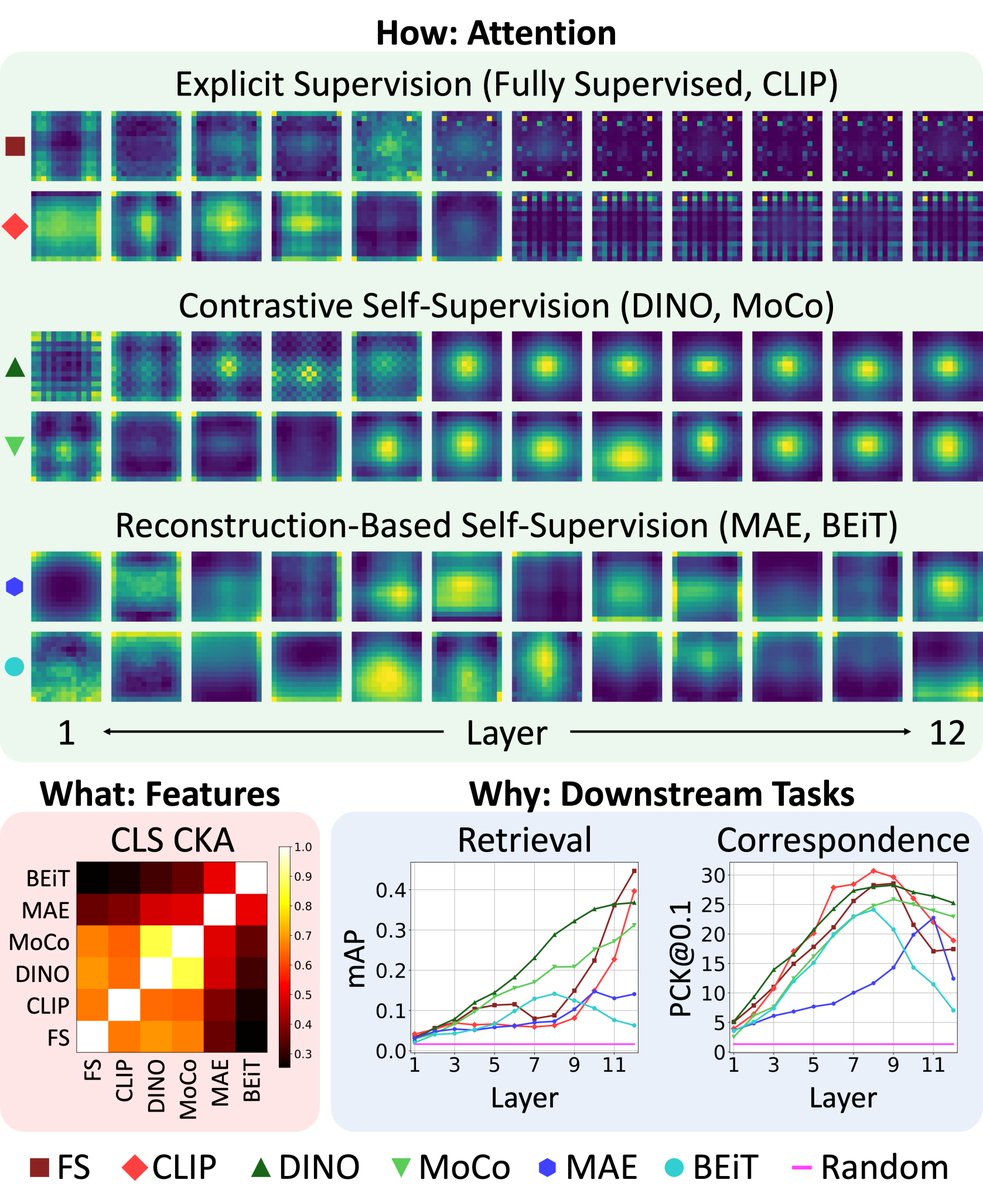
Excited to share our work "Teaching Matters: Investigating the Role of Supervision in Vision Transformers" which has been accepted to #CVPR2023!
Work done with: @MatthewWalmer, @kamalgupta09 and @abhi2610
Website: https://t.co/EXdRiIxig6
Code: https://t.co/tptWMo8BFN
Abhinav Shrivastava is advancing computers’ understanding of temporal phenomena—their ability to process complex activities in videos over time.
Supported by a @NSF CAREER award, his work has the potential to transform security, health and robotics.
➡️https://t.co/Pr7oWktYEu
Do your supervised models fail to adapt to scenarios with novel classes? Sick of re-training your model for every new category introduced in the dataset? Checkout our #ICCV2021 paper “The Pursuit of Knowledge: Discovering and Localizing novel categories using dual memory”.
(1/4)
Interested in discovering GAN-generated images and attributing them to unknown GAN sources? Check out our #ICCV2021 paper “Towards Discovery and Attribution of Open-world GAN Generated Images” in Session 11 - Wed, Oct 13, 6–7p and Fri, Oct 15, 11am-noon EDT.
Computer vision, machine learning and artificial intelligence algorithms are often developed inside a “closed-world” paradigm. But do they hold up when the “world” changes? Announcing, Dealing With Novelty in Open Worlds (#DNOW) workshop @ #WACV2022
https://t.co/YyvDj5ox17
🧵...
Rethinking Common Assumptions to Mitigate Racial Bias in Face Recognition Datasets
https://t.co/VKHj1rzw5i
by Matthew Gwilliam et al. including @_srihegde_
#Stride#Skewness