For those who are newer to crypto, the way things work nowadays is not the way it worked in the past.
Once upon a time there was a limited number of coins we could all bet on. As in hundreds or thousands at most.
Newbies were attracted to crypto for the same reasons they are today—to make money, despite the more virtuous reasons we all wax on about on CT.
Many of these projects attempted to put in as little effort as the memecoins you see today but it did require a bit more effort to jumpstart a coin. They were still straight up cash grabs except they pretended to be legit with plagiarized whitepapers, websites, and often made up teams. It was bad but I would venture a guess that 25% of teams or more back in 2017 were legit startups attempting to build real products.
It felt overwhelming during bull runs but still manageable. It was rare to talk with friends betting on new tokens who weren’t in the same coins because there just wasn’t as much to pay attention to.
The fact so many of us paid attention to such a small group of projects meant you couldn’t go too far astray betting in the crypto markets. You could bet on rugpulls or tokens that didn’t work out but generally speaking, if you bet early on new tokens, you were able to bet sometimes on legit teams at sub-$10M and sub-$100M market caps. I’m not defending the old guard as the way things should be but put simply, it meant a rising tide did lift all boats. And it felt great. The crypto pie was growing, and it was less pvp, more like we all could do well as crypto grew in popularity.
This is why many still refer to a phenomena that seemingly won’t ever happen again, called alt season. Where the herd of whales and retail followed one another from rotating profits from BTC to ETH to other majors, and then smaller caps.
Because of the blatant attempt to kill crypto by US regulators since 2022, we saw the last bear market move to more founders raising private rounds instead of ICOs or public rounds for fear of attracting attention from the SEC.
These events led to retail being completely cut out from early rounds—the most anti-crypto / anti-DeFi thing to happen. What’s the fucking point of this tech if we just rebuild a Frankenstein of TradFi that larps “permissionless access” but provides gated access just for assets ultimately trading on a blockchain?
So then, we enter the Solana DeFi bull in fall 2023 and pump[dot]fun launches in Jan 2024–a schizophrenic UI built for k-holing Gen Z.
It was perfect timing to provide unfiltered access to anyone with a Solana wallet who wanted to either launch a token on a turnkey platform or buy early into these tokens.
Pump[dot]fun led to some of the most outlandish behavior (dev locked in a cage, sexually abusive acts on stream, etc.) Of all the dumb shit I have seen in crypto, the low point for me has been watching the dystopian fallout of what people were willing to do to get attention for their pump[dot]fun tokens.
I’m an onchain permissionless maxi but JFC it feels like this cycle was truly ruined by this shit. It flooded the market with tens of millions of tokens and unleashed the worst nihilistic instincts for many chasing riches.
The one thing I do appreciate about pump[dot]fun, is it reminded us that crypto should be about early access to uncensorable finance onchain. Against a backdrop of high FDV launches, it was the medicine this space deserved.
Why should investors bet on tokens from fundamentally the best teams when the token mcap is valued at many billions and repeatedly proven to sell off vs playing the lottery onchain betting early on random memecoins that could 100x—keyword is COULD.
Idk what would cause a flight back to quality other than early stage public token raises—like ICO style raises, no paperwork, no KYC, no accredited investors required.
Otherwise, the coins outside of the majors that achieve an ETF, are going to be cucked by investor indifference.
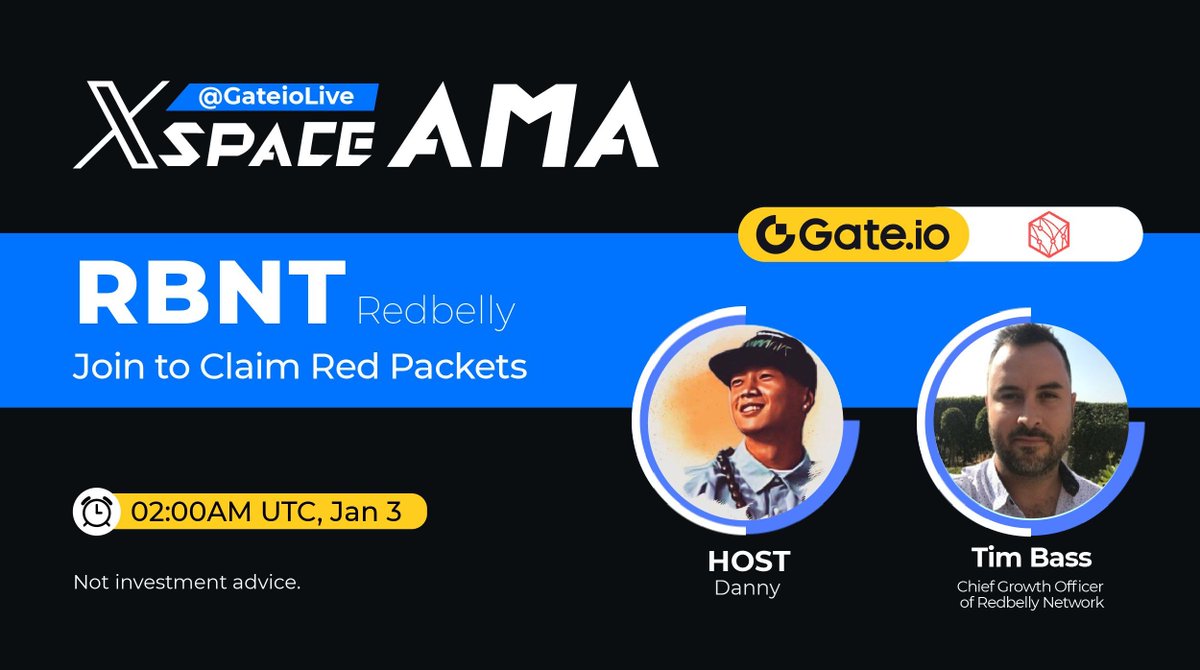
https://t.co/PW2AniPTxu #AMA - @RedbellyNetwork
🎁 250 $RBNT for 5 users
🔺Follow @GateioLive & @RedbellyNetwork
🔺Like & Rt
🔺Venue: https://t.co/Cw6HPFtnOj
📝Drop your questions to WIN extra $RBNT ⤵️
https://t.co/8FCXalHMCo
End: 02:00AM UTC, Jan 3 (UTC)
#GateLive#Giveaway
Where is the most growth being witnessed with #RWAs according to a research report by @coingecko?
• USD-pegged stablecoins continue to reign supreme in the RWA sector, with assets like USDT holding a massive market share.
• Tokenized US treasuries saw a surge in popularity during the bear market, with its market cap increasing 641% in 2023, from $114.0 million to $845.0 million.
• The market for commodity-backed tokens, especially those linked to precious metals like gold, has grown to $1.1 billion.
• The top three USD stablecoins alone make up 95% of the market, with Tether (USDT) at $96.1 billion, USDC (USDC) at $26.8 billion, and Dai (DAI) at $4.9 billion.
Source: https://t.co/Ffr1rAXe4L