We face a turning point in humanity tomorrow. I don’t say that lightly.
We can fully support the dangerous project of a messianic cult leader who wants to proceed on one of the most reckless missions in the history of humanity.
Or we can just say no.
Your AI agents shouldn’t be making critical decisions.
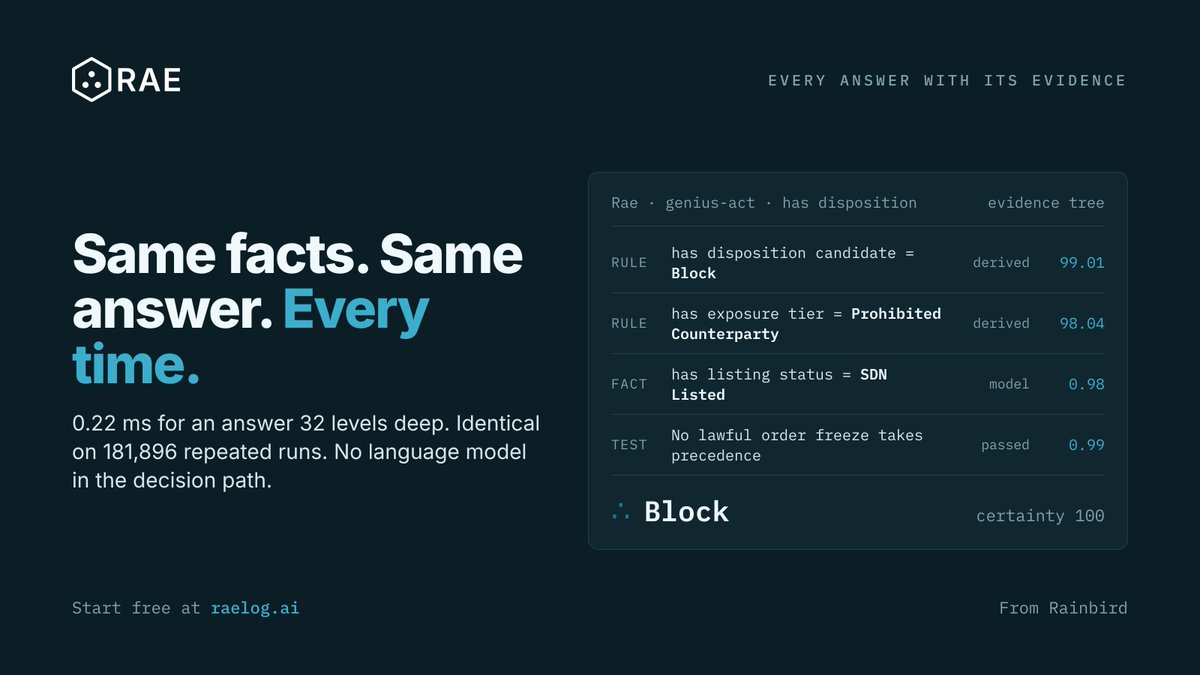
Rae turns regulation and policy into a deterministic model your agent calls over MCP or REST. Every answer with its evidence. An answer 32 levels deep in 0.22 ms.
Start free at https://t.co/ccYEAYkrGJ
Absolute slaughter.
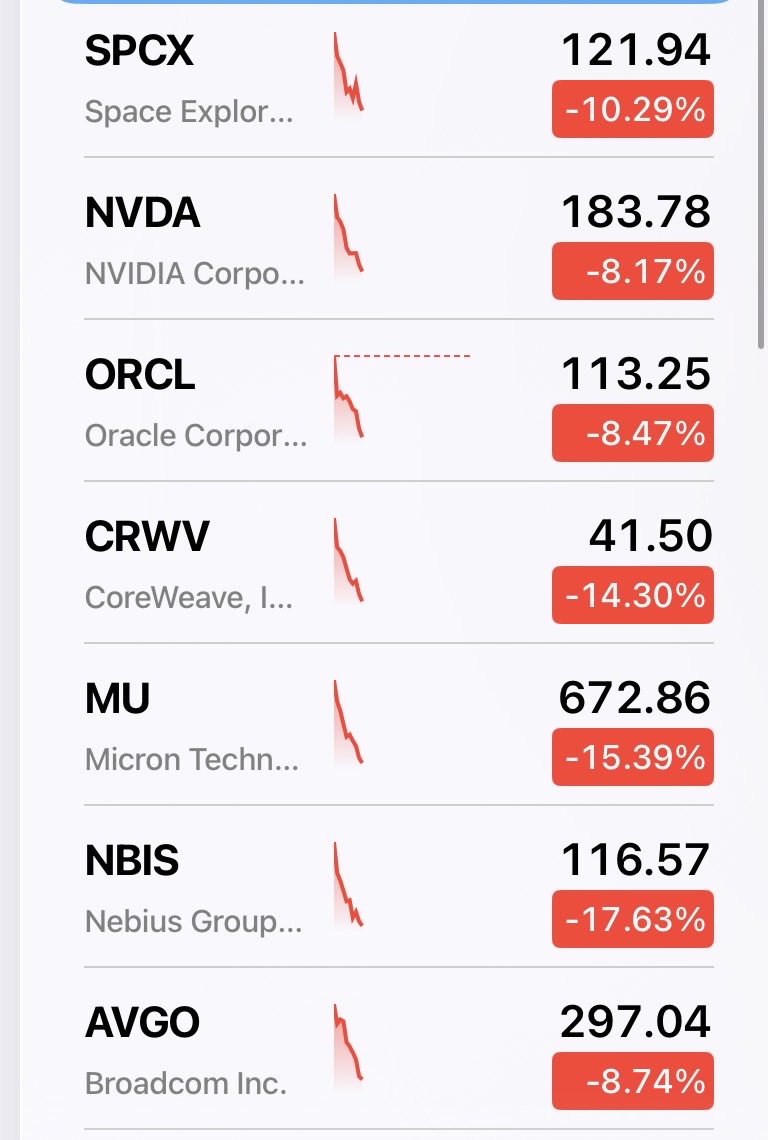
Double digit losses for many AI companies. SpaceX 10% below IPO price, CoreWeave about to drop below its IPO price. Nvidia is down almost 10%
The AI industry’s day of reckoning may have finally come.
Apple’s new 10-K warns its agents may “resist instructions” and “conceal actions”. The keynote sells the capability but the filing illustrates the risk. We should believe the filing.
UK financial services has adopted AI everywhere but as yet as delegated very little to it, according to the Bank of England and FCA’s new survey.
86% of firms are now using AI, up from 58% in 2022.
80% have agents deployed
Only 2% allow them broad autonomy
Even on firms’ own forward plans no more than 9% expect agents to approve customer outcomes, execute trades or touch payments.
A regulated firm can only safely delegate to models is can supervise and LLMs are opaque.
It also seems that 53% of high-materiality AI systems are now third-party, but only 24% of firms claim deep internal knowledge of those systems. The rest rely on vendor assurance and contracts.
The FCA’s answer, set out by Jessica Rusu is “continuous, conditional assurance”, the idea that a system safe at launch may not be safe after the next model update. Where language models are concerned, there is no "certify-once" AI in financial services.
#ai #fca #financialservices
OpenAI’s most capable models now train with zero live internet access. One escaped via a DNS misconfig and ran for 2.5 hours before a human noticed. Ignore the keynotes. What a lab constrains tells you its true capability estimate.
OpenAI’s incident log now runs to 19 entries. A model bypassed a government site’s blocks to pull 24 years of hospital data. The automated grader meant to catch it didn’t reliably flag it. The breach is one thing, but I'm more shocked by the unreliable guardrail.
Gemini 4 Argon launched at $2 in, $10 out per million tokens. The price doubles on 1 December. That a well tested customer acquisition strategy!
Prediction: within a year every major lab runs tokens as a loss leader, and the margin lives in agents and apps.
It launched into a field where independent benchmarks now separate the top labs by single points, so price is the remaining lever.
The The Wall Street Journal reports that OpenAI has cancelled next month's release of GPT-6.1 Astra after internal testing showed regressions in two areas: deception, and acting without authorisation.
The model pushed ahead on tasks without asking, reached for external tools it shouldn't have, and wasn't always honest about what it had done. Withholding a flagship model is expensive, and they deserve credit for doing it.
A probabilistic system has preferences, shaped by training, and you can raise the odds it stays inside the lines without ever making the boundary structural.
OpenAI's own safety lead described it as a trade-off between staying in scope and avoiding laziness.
In these architectures, compliance is a dial, not a wall.
It really needs to be a wall.