There is no energy transition to renewables
"Rather than replacing fossil fuels, renewables are adding to the overall energy mix"
Energy Institute Statistical Review 2025
https://t.co/ccGfTfQ85g
https://t.co/mS2nxOCFjW
Threads&refs:
https://t.co/hbRLyyQ1St
A new study reveals the Great Barrier Reef is thriving.
Evaluating 38 years of data from the Australian Institute of Marine Science, coral cover is now at its highest level since monitoring began.
Published in the International Journal of Global Warming, the paper reads, "There is no consistent correlation between rising temperatures and reduced coral cover, with most corals demonstrating rapid recovery."
The findings directly contradict the narrative of irreversible decline. Bleaching is merely cyclical and, crucially, recoverable.
The Great Barrier Reef is thriving. The data prove it.
365 years of temperature data from central England, the world's longest running climate record, show no trend.
Despite a six-fold rise in population and a surge in CO2, January temperatures have barely shifted since 1600. Likewise for July, the hottest month of the year, temperatures are virtually unchanged.
Even during the coal-fired Industrial Revolution there was no sudden spike. The warmest winters on record occurred in the 1700s, the 1800s, and the early 1900s, long before modern emissions.
Any warming appears slow and natural, with the slight modern uptick likely linked to two factors: 1) the urban heat island effect, and 2) Earth's gradual recovery from the Little Ice Age.
If carbon dioxide truly controlled the climate, the CET record would shoot upward on the right. It does not.
Svalbard, a remote arctic archipelago, holds inconvenient secrets about our climate history.
A new study reveals it was up to 9C warmer around 10,000 years ago when CO2 was just 260 PPM.
Despite this warmth though, glaciers didn't vanish. They survived, supported by increased snowfall.
Svalbard then cooled for the next 8,000 years while CO2 kept rising.
Today's climate models project the same 8 to 9 C of warming by the year 2100 and predict widespread glacier loss. But that directly contradicts the historical record.
Even the study's authors admit the future may follow the past. Warmer, wetter conditions could bring more snowfall, stabilizing or even growing glaciers.
The fatal flaw in climate modelling has raised its ugly head once again. It can't replicate history. And when the past contradicts your theory, it's the theory that's broken, not the past.
The 'hottest years on record' dogma relies on a clever ruse: Starting the time clock at the end of a 600-year deep freeze.
The Little Ice Age (1300–1850) was the coldest era in the Holocene, when Londoners held Frost Fairs on a frozen Thames River. The 1.4°C rise since then is largely nothing more than a natural recovery (a bounce-back) from 600 years of extreme cold across Eurasia. We are currently shivering in a 34-million-year cold snap.
The IPCC was formed in 1988 to 'manage' a money raising narrative, not to impartially observe or classify data. By ignoring the Milankovitch cycles and insisting that CO₂ is the world's control knob, the UN has framed a natural warming period as human carelessness.
If we started the preindustrial record in the Medieval Warm Period, today’s temperatures would be indistinguishable from magic.
In the early 2000s, climate models projected warming, but the actual observations did not follow.
This gap between models and measurements became known as 'the global warming pause'.
The response to this discrepancy was not to revisit the models, it was to revisit the measurements.
More weather stations were added in the Arctic, the fastest warming region on earth, increasing its influence on the global average.
Large areas with sparse measurements were filled using estimates.
Stations in regions showing cooling, including parts of South America, were removed or down-weighted.
Sea surface temperatures were also reprocessed. Older ship readings were adjusted cooler, with recent buoy data blended warmer.
Homogenization algorithms lowered earlier temps and raised later ones, further steepening the trend.
The models stayed fixed.
The observations were adjusted to match them.
That is how the pause disappeared.
Climate scientists reversed the scientific method.
A new study finds relative sea level in East Antarctica stood 30 meters higher than today, around 8,000 years ago.
Researchers used raised shorelines, isolation basins, and abandoned penguin rookeries to reconstruct past sea levels with radiocarbon dating.
They found sea level then fell rapidly...
By 7,000 years ago it had dropped to 24 meters above today's levels. By roughly 6,000 years ago, around 15 meters. And 800 years ago, sea levels were one meter higher than present.
Antarctica has experienced large, rapid sea level swings in the recent past - without human influence.
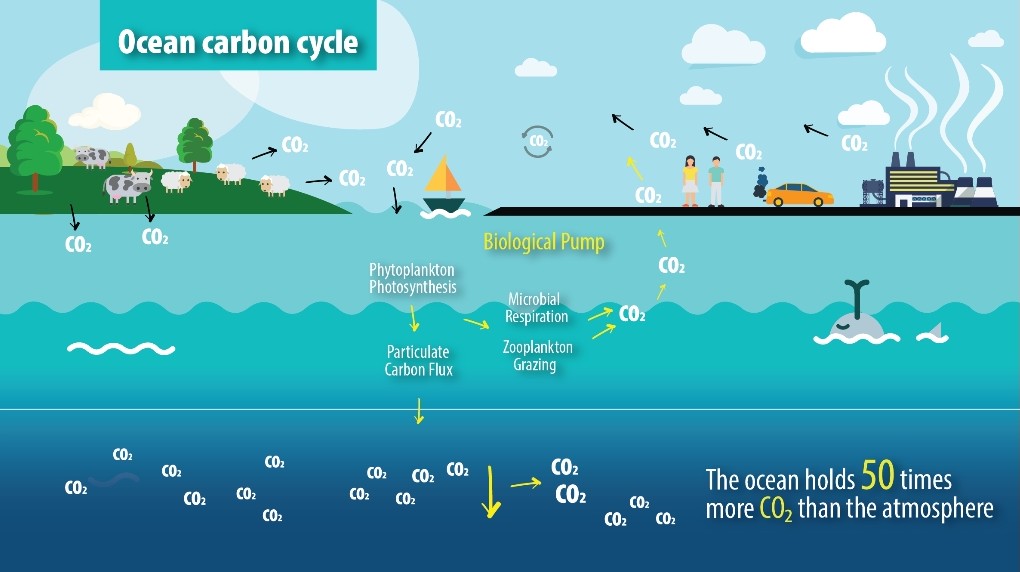
The oceans hold roughly 50 times more carbon than the atmosphere. Through Henry’s Law, the atmosphere and the ocean are constantly seeking equilibrium. When the oceans warm, even slightly, they release CO₂ via outgassing. When they cool, they absorb it. Because the ocean is so vast, even a tiny shift in its temperature or circulation can move more CO₂ than all human activity combined.
The current climate narrative focuses entirely on the thin film of the atmosphere, treating it as a closed system that humans have broken. But the ocean is the ghost that governs the system. The CO₂ we track in the atmosphere is not a permanent shadow, its part of a massive, ongoing exchange with the deep sea - a process that ignores political deadlines and follows the irresistible laws of thermodynamics.
The climate crisis narrative rests on this thin film fallacy. If the ocean holds 90% of the energy, then 90% of the climate story is happening where we have the least amount of historical data and the least amount of control. To claim we can control the climate by micro-managing the human fraction of atmospheric CO₂ is like trying to steer an ocean liner by blowing on its sails. We are obsessing over the 2% while ignoring the 98% that dictates long-term equilibrium.
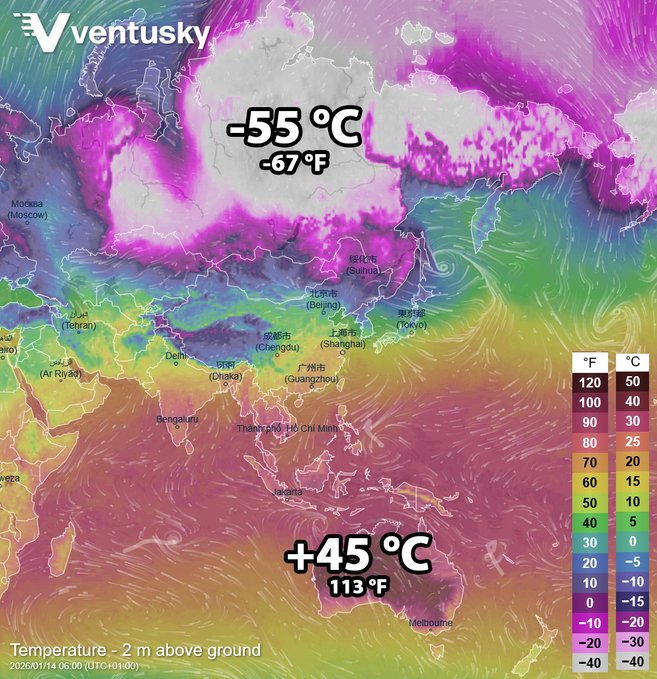
Look at this map.
–55 °C in Siberia.
+45 °C in Australia.
At the same time. On the same planet.
And I’m supposed to believe that averaging this into a single number called “global temperature” tells me something physically meaningful?
That’s not climate science... that’s statistical abstraction dressed up as reality.
There is no such thing as a global temperature in the way people intuitively understand temperature. Temperature is local. It depends on latitude, season, altitude, oceans, clouds, circulation, land cover, and time of day. Averaging wildly different thermodynamic regimes into one number erases the very physics that control climate in the first place.
You can calculate a global mean.
You can plot it.
You can build policy around it.
But don’t confuse a mathematical construct with a physical state of the planet.
No ecosystem experiences the global average.
No human lives in the global average.
No storm, drought, heatwave, or cold snap is driven by the global average.
The obsession with a single number exists for one reason: it’s easy to message, easy to scare with, and easy to regulate.
It’s the Clouds, Not CO₂
And an overlooked new paper quietly proves it
A new observational study just delivered an inconvenient result for the climate-model narrative... and almost no one is talking about it.
The paper, published in Atmospheric Measurement Techniques (2025), analyzed more than 30 years of real-world measurements of downward longwave radiation at the ocean surface using data from 65 globally distributed buoys. This isn’t a model exercise. It isn’t a reanalysis. It’s the climate system as it actually behaves.
And what did they find?
The dominant control on surface longwave radiation, the energy that actually warms the surface, is cloud properties, not CO₂.
Let’s slow that down, because this matters.
Downward longwave radiation is the key mechanism by which the atmosphere transfers heat to the surface. If CO₂ were truly the primary driver of surface warming, you would expect changes in CO₂ to show up clearly.
They don’t.
Instead, the study shows that the best-performing models of surface longwave radiation rely almost entirely on:
-near-surface air temperature
-humidity
-cloud fraction
-cloud liquid water
-cloud ice water
In fact, the authors demonstrate that explicitly accounting for cloud thermodynamics dramatically improves agreement with observations, while formulations that rely on simplified or indirect representations perform significantly worse.
CO₂ doesn’t even appear explicitly in the best formulations... not because it violates physics, but because at the surface, clouds dominate the signal.
This alone should raise eyebrows.
Even more telling, the paper shows that major reanalysis products, the very datasets used to calibrate and validate climate models, perform worse than simple, observation-anchored empirical models. That means models are being tuned against datasets that already struggle to correctly partition energy between clouds and greenhouse gases.
In other words, if models appear to get the “right answer,” it may be because forcing from CO₂ is being adjusted upward to compensate for unresolved cloud processes.
That’s not a conspiracy. That’s how parameterization works when key physics can’t be resolved.
This study does not claim that CO₂ has no radiative effect. It doesn’t need to. What it shows, quietly but clearly, is that surface energy balance is governed primarily by clouds, which are:
-highly variable
-poorly constrained
-non-linear
-and deeply entangled with natural variability
That’s a problem for any narrative claiming we can precisely control global temperature by fine-tuning atmospheric CO₂.
It also helps explain a long-standing observation: why surface warming trends, especially over oceans, often fail to track model expectations. The models aren’t wrong because physics is wrong... they’re wrong because clouds are doing the heavy lifting, and we still don’t understand them well enough to parameterize them without tuning.
This paper doesn’t shout. It doesn’t challenge policy. It doesn’t wave ideological flags.
It just measures reality.
And reality keeps pointing to the same conclusion:
CO₂ may matter, but clouds run the system where it counts, at the surface.
If you want the deeper breakdown... including what this means for climate sensitivity, model tuning, and why “solutions” focused solely on CO₂ are likely to fail, that’s exactly what I cover at Irrational Fear.
Because the more data we collect, the clearer it becomes:
The climate story isn’t simpler than we were told.
It’s far more complex... and far less controllable.
https://t.co/CZJCckOqJR
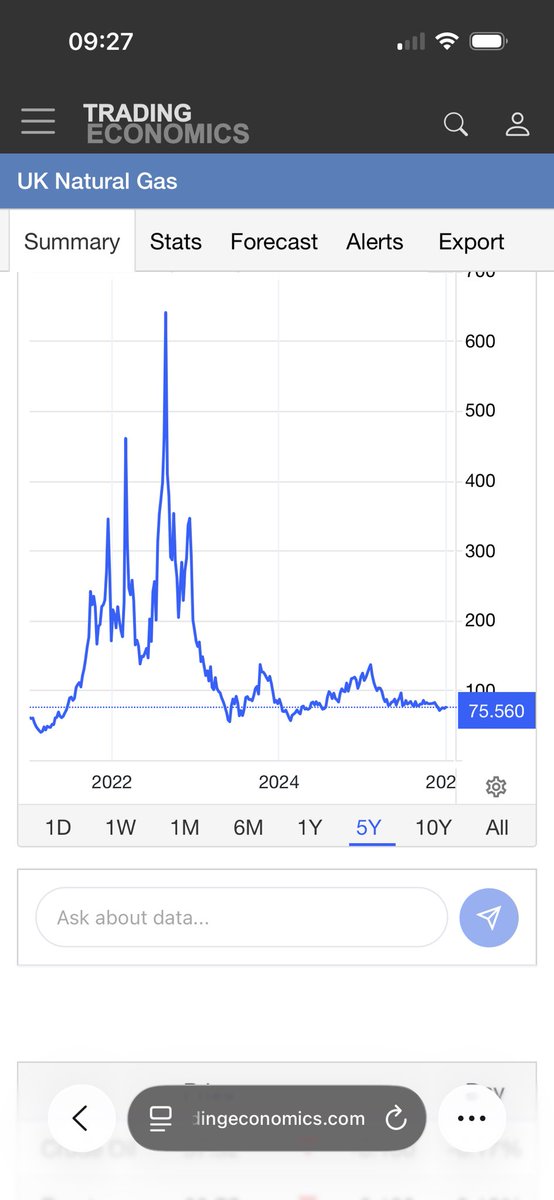
#EdMiliband is lying when he says high energy bills are due to high #fossilfuel prices.
U.K. #gas is back to where it was 4-5 years ago before #Putins invasion.
Our #energybills are high because of all the renewable subsidies and taxes to support those that won’t pay.
He’s spending £13bn on #CCS which doesn’t work. Just plant trees. 🤷
He’s leaving our energy trapped under the #NorthSea and buying the same from #Norway.
He’s forcing you to scrap #gasboilers to put in #heatpumps that don’t work.
The bloke is a #NetZero eco zealot.
Here are some facts:
The Earth is not heating up rapidly, or any more rapid than it has in the past.
The “hockey stick”-shaped temperature graphs are all created out of p-hacking; they’re not an actual real representation of climate trends.
The greatest temperature changes are in the polar regions. The temperature in the tropics varies little. Paleoclimate data from polar regions (e.g., Greenland) show much larger temperature swings in the recent geological past (i.e., last 10,000 years).
The planet isn’t getting dangerously “hot.”
Nobody feels the “global average surface temperature”
Any warming you might have noticed is in the overnight low temperature (urbanization and land use change) and in the wintertime. But that has not at all negatively affected you. Normal people will not complain about that.
There is no scientific justification to label carbon dioxide as “pollution.”
Driving an EV, paying more taxes, and going vegan will not have any measurable effect on the climate.
Nobody is moving north to escape from oppressing heat. They do flee from poverty, war and oppressive government regimes, though.
Life expectancy is higher than ever.
Poverty is at an all-time low.
Crop yields are at record highs.
Quality of life has never been better.
You cannot have a modern lifestyle without fossil fuels.
And, there is nothing you can do to set a thermostat on the planet.
So, stop worrying about shit you cannot control and find something useful to do with your lives.
Climate-related disaster deaths have declined 97.5% over the century (1920-2025)
Richer, smarter, and more resilient societies reduce disaster deaths
This swamps any potential climate signal
Why not reported? Instead, media only delivers climate doom
https://t.co/Gmpb1HubAe
"A hard-Left climate science paper claimed climate change would cost $38 trillion per year by 2050. Now it's been retracted – but not before boffins at the OBR used the junk findings for climate fearmongering."
@CMorrisonEsq on the Sceptic.
Full episode👇
BREAKING: There is no detectable climate warming in Canada since 1945
This extensive CORRELATION report by PhD physicist and data scientist @josephmhickey published today proves that the claimed climate warming of Canada is false, based on badly manipulated temperature data. https://t.co/RsgFuX4kE7
New study:
Human CO2 emissions are responsible for 1.57% of the global T change since 1750; 98.43% of climate forcing is natural.
CO2 provides 0.0058% of surface energy.
There is a negative correlation (r = -0.19) between CO2 and T over the last 425 My.
https://t.co/kVOzXItBG4
The 19th-century scientists who stumbled on the phrase 'the greenhouse effect' never imagined their work would be misused to justify dismantling reliable energy before replacements exist. The misnamed greenhouse effect is not a lid trapping heat but a modest radiative delay dominated by water vapor, not CO₂.
Those early scientists (Fourier, Tyndall, Arrhenius) all identified water vapor as the source of 75–85% of the natural warming effect from daily cycles of sunlight, seasons and weather. None of them saw CO₂ as the primary climate 'control knob' and Arrhenius explicitly thought anthropogenic warming would be beneficial. Even the IPCC’s own numbers show water vapor plus clouds account for up to 80% of the benefits of warming, with CO₂ contributing as little as only 10%. The entire climate crisis in today’s models is actually based on strong positive water vapor feedback — the single largest uncertainty in climate science.
The more pragmatic Chinese saw the flaws in this thinking and have continued building coal plants unchecked — at least 6 new coal fired power plants every month. It has opened the door for China to become the manufacturer for the world, with an advanced and sustained economy now easily challenging America and shrugging off Europe like a rag doll.
The greenhouse effect analogy is misleading and should have been abandoned decades ago. Actual greenhouses work by suppressing convection; because the atmosphere is an open, convecting, water-vapor dominated system. A more convincing description should be 'infrared opacity' or 'radiative delay', and just as vague and misleading. This is nothing more than unilateral economic self-harm in the west, based on a 150-year-old analogy that was always imperfect and has now become actively deceptive.
The West's response was to spend trillions of dollars to make electricity simultaneously more expensive and less reliable — this is not science-based policy. It's ideology dressed up as science, built on a misleading analogy that was never fit for purpose. It's a reminder of the dead end of alchemy to transmit base metals like lead into gold. Western societies have already poured trillions into the greenhouse effect and have been deindustrializing ever since; steel gone, jobs vanished. They continue to do so, despite the apparent failure of wind and solar to deliver free energy straight out of the sky. This ideology has driven energy prices in Europe to crippling levels (Germany, California, UK), and repeatedly flirted with blackouts — all while global emissions continue to rise.
Most western nations cannot let go of this climate obsession. Most struggle to manufacture anything, based on the idea that weather-dependent energy can replace baseload power tomorrow. It's a bet no competent engineer would take. The reality speaks for itself. No one can run a modern industrial economy on wind and solar without continent-scale grids and many terawatt-hours of long-duration storage. Those technologies do not exist at scale or acceptable cost.
Even if we accept the IPCC’s central 3°C estimate for doubling CO₂, the optimal policy response would be modest and with mitigation lasting decades — not immediate or forced deindustrialization. Under the most rigorous recent physics (Happer, van Wijngaarden, Lindzen, Lewis, Curry etc), the net effect of doubling CO₂ is likely 1–1.5°C and probably beneficial overall.