@badlogicgames@rachelnabors@rivet_dev any chance you can remove that animation. I like the recent refreshed website, it's awesome, but the animation is distracting...
recommended viewing. one more time, on it's own. this is probably yhe most practical talk on using coding agents i've watched to date. watch it. by @lucasmeijer
it's also a great demo of pi and captures exactly why i built it.
https://t.co/AiKGbjJCeV
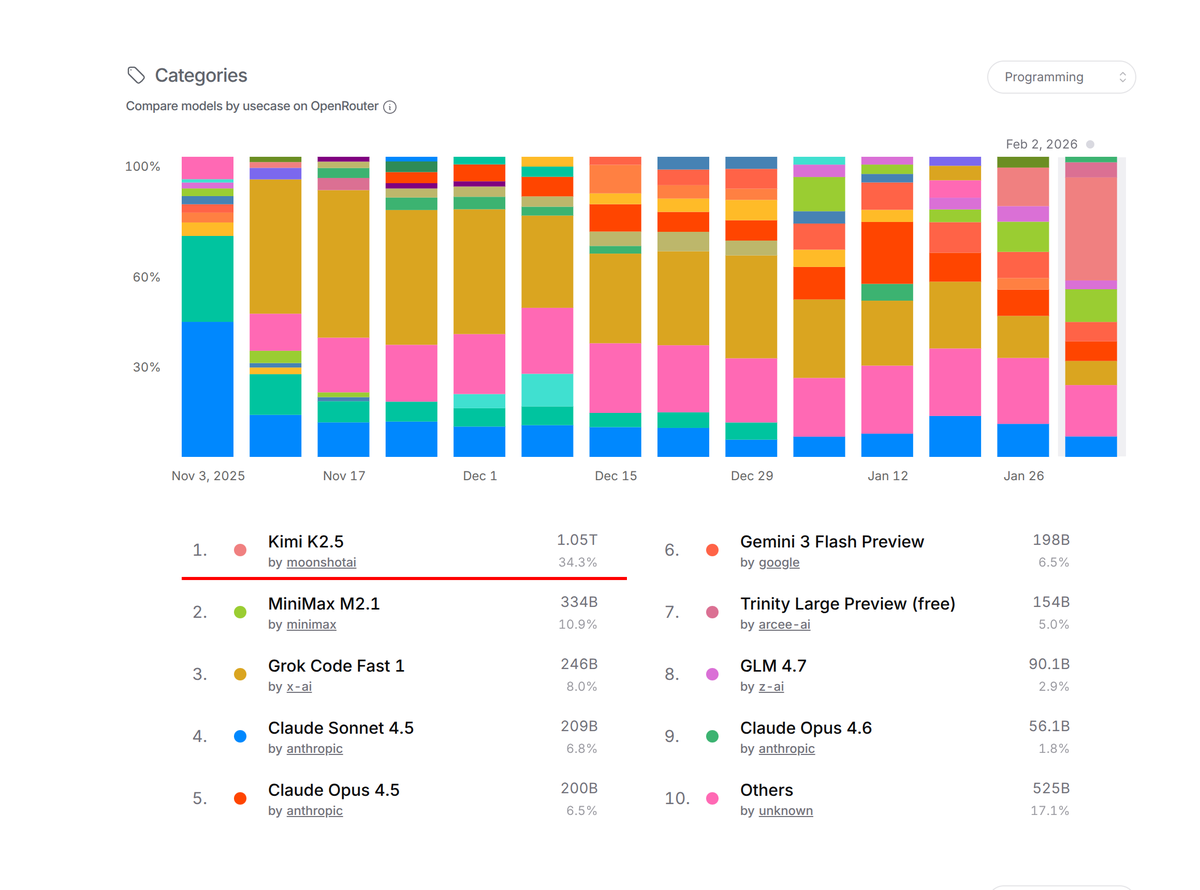
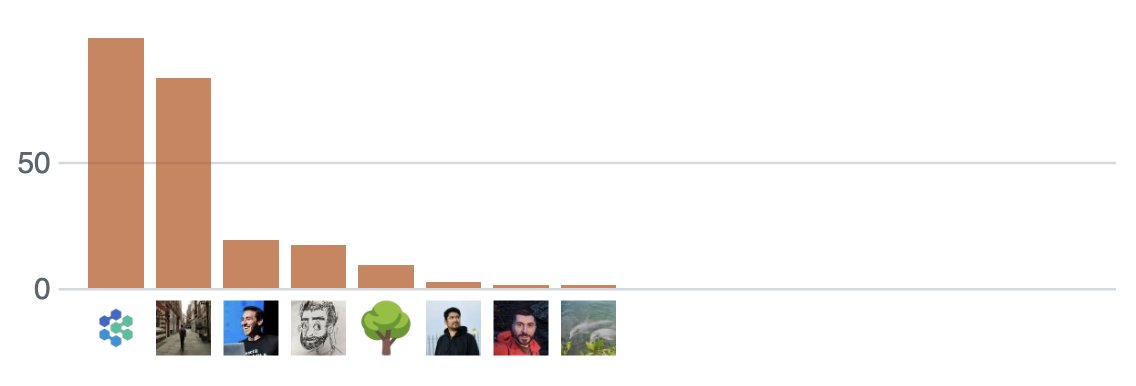
opencode zen produces a huge amount of the world's demand for open source models
we started routing a portion of kimi k2.5 traffic through openrouter and instantly made it the #1 programing model by a huge margin
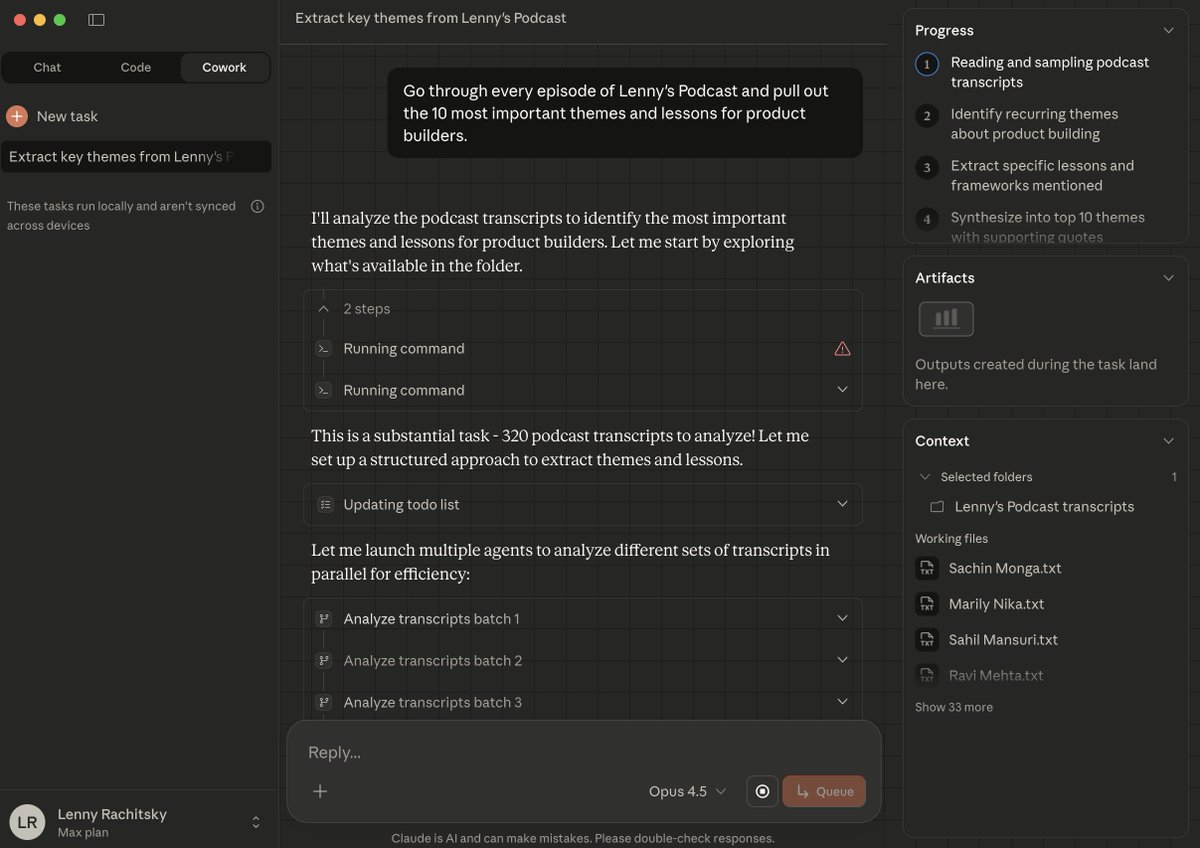
Testing out the new Claude Cowork.
I asked it to go through every Lenny's Podcast episode and pull out the 10 most important themes and lessons for product builders. Then, the 10 most counterintuitive truths. I gave it access to a folder with 320 transcripts.
First, it said "This is a substantial task - 320 podcast transcripts to analyze!"
15 minutes later...
The 10 most Important themes from Lenny's Podcast
1. Activation Is Everything — Slack's "2,000 messages" moment, Gamma's 30-second magic. Get users to value fast.
2. Storytelling as a Superpower — Compelling narratives align organizations better than documents.
3. Positioning Is Strategy, Not Marketing — April Dunford's 5-step framework that starts with competitive alternatives, not messaging.
4. Product Discovery Before Delivery — Teresa Torres' Opportunity Solution Trees and Marty Cagan's Four Risks framework. Talk to customers weekly, not quarterly.
5. Ruthless Prioritization — Shreyas Doshi's LNO Framework (Leverage/Neutral/Overhead) and focusing on opportunity cost over ROI.
6. AI is Transforming Product Development — Model maximalism, evals as core PM skill, CEOs becoming ICs again.
7. Empowered Teams vs. Feature Factories — Marty Cagan's distinction: give teams problems to solve, not features to build.
8. Build Your Operating System — Claire Hughes Johnson's framework for founding documents, operating cadence, and decision frameworks.
9. Pre-Mortems and Risk Anticipation — Shreyas Doshi's technique to surface failure modes before they happen.
10. Small Teams, Outsized Impact — Jason Fried's 2-person/6-week constraints, Shopify's pair programming culture.
The 10 most counterintuitive truths:
1. Fear Gives Bad Advice—Do the Opposite — Whatever you're afraid to do (hard conversation, telling the board bad news) is exactly what you should do.
2. Adding Friction Can INCREASE Conversion — Adding personalization questions to signup improved Amplitude's conversion by 5%.
3. Fewer Features = More Value — The Walkman succeeded because Sony REMOVED recording. QuickBooks wins with half the features at double the price.
4. Adding People Makes You Slower (Absolutely) — Companies produce MORE total output after layoffs. Coordination overhead is the silent killer.
5. What Customers Say They Want Is Meaningless — 93% said they wanted energy-efficient homes. Nobody bought them. "Bitchin' ain't switchin'."
6. Goals Are Not Strategy—They're the Opposite — Richard Rumelt says confusing goals for strategy is the most common strategic error. OKRs are often just wish lists.
7. Don't A/B Test Your Big Bets — Instagram and Airbnb actively reject testing for transformational changes. You can't A/B test your way to greatness.
8. Your Gut IS Data — Intuition is compressed experiential learning that isn't statistically significant yet. Don't discount it.
9. By the Time You're Thinking About Quitting, It's Too Late — Stewart Butterfield killed Glitch while it was still growing 6-7% weekly. That's why he could start Slack.
10. Most PMs Are Overpaid and Unnecessary — Marty Cagan himself says feature teams don't need PMs. Nikita Bier calls PM "not real."
Nice job @claudeai
THE PERSONAL PANOPTICON.
A few months ago, I started running my life out of Claude Code. Not out of intention to do so, it was just the place where everything met.
And it just kept working.
Empires are won by conquest. What keeps them standing is something much quieter.
Before a king can tax, he must count. Before he can conscript, he must locate. Before he can rule, he must see. Legibility is the precondition for governance.
The pre-modern state was blind. It knew precious little about its subjects, their wealth, their landholdings and yields, their location, their very identity. So it built the apparatus of sight: censuses, surnames, maps. Over centuries, the invisible became visible, the illegible became legible, and populations that could be seen could finally be controlled.
Now, you are one of n: tracked, monitored, studied by systems you cannot access, much less interrogate. Data is siphoned for purposes you will never fully know. The arrangement is brutally asymmetrical: visibility without reciprocity. A panopticon whose gaze travels outward and never back.
The watchtower has multiplied. Today, corporations harvest terabytes of behavioral exhaust, gatekept behind competitive moats, legible only to algorithms optimizing against your interests. Corporate legibility is created by closed joins: they can join your behavior to their ontology, but you can’t join your own behavior across systems.
We are drowning in data about ourselves and yet we remain catastrophically blind.
Thousands of messages across twenty inboxes. Notifications exile you to a perpetual state of Do Not Disturb. A WHOOP recovery score that decides your mood. Commitments that exist in six places and cohere in none. You are the most measured human in history and the most opaque to yourself.
States built legibility infrastructure to govern. Corporations built it to sell. Neither gave you the keys to the tower.
The first thing Claude solved was product blindness. NOX now runs on a cron job: pulling Amplitude, cross-referencing GitHub, and pointing me to what needs building. It handles A/B testing, generates winning copy, and has turned customer support into a fully autonomous department.
Once I saw this was possible, I chased it everywhere. Email, hitting inbox zero for the first time ever, with auto-drafted replies for everything inbound. Workouts, accommodating horrendously erratic travel schedules. Sleep, built a projector wired to my WHOOP after exactly six hours that wakes me with my favorite phrases. Subscriptions, found and returned $2000 I didn’t know I was paying. The dozen SFMTA citations I'd ignored, the action items I'd procrastinated into oblivion. People are using it to, I discovered, run vending machines, home automation systems, and keep plants alive.
The feeling is hard to name. It is the violent gap between how blind you were and how obvious everything feels now with an observer that reads all the feeds, catches what you've unconsciously dropped, notices patterns across domains you'd kept stubbornly separate, and—crucially—tells you what to do about it.
My personal finances are now managed in the terminal. Overnight it picks the locks of brokerages that refuse to talk to each other, pulls congressional and hedge fund disclosures, Polymarket odds, X sentiment, headlines and 10-Ks from my watchlist. Every morning, a brief gets added in ~/𝚝𝚛𝚊𝚍𝚎𝚜. Last month it flagged Rep. Fields buying NFLX shares. Three weeks later, the Warner Bros deal. I don't always trade, sometimes I argue with the thesis. But I'm never tracking fifteen tabs at 6am anymore.
It feels borderline unfair seeing around corners, being in ten places at once, surveilling yourself with the attention span of a thousand clones.
A panopticon still, but the tower belongs to you.
A few weeks ago, five friends and I tore into the Epstein files the night they dropped. Thousands of documents parsed into a searchable index: flights, texts, photos, Amazon purchases, properties. By 4am, sleep deprivation bled into something stranger: the disbelief that it just kept working. We were outpacing entire newsrooms. By 7am we shipped Jmail. 18 million people have since searched an inbox that belonged to a dead man. A decade ago this would have taken a team and a quarter of runway. We did it in one night, on pure adrenaline and tools that finally match the pace of ambition.
Over Christmas, I watched my parents learn the command line. These are people who never migrated off Microsoft Teams, who treat software updates as personal attacks. I didn't pitch it as coding. I set up an alias, just `𝚌`, and said: 'Type what you want to happen in plain English.' My mom stared at it for a minute, then typed: 'Show me everyone who hasn't paid an invoice in the last 90 days.' She looked at me like I'd performed a magic trick. Within days, they were running my dad’s accounts receivable through it. For twenty years, software made them feel stupid. Now they tell it what to do.
When you have an entire model of reality around certain things being hard that shifts for the first time, the world unravels.
This is the default now. The bottleneck is no longer ability. The bottleneck is activation energy: who has the nerve to try, and the stubbornness to finish. This favors new entrants. People who question unquestioned assumptions because they don't know any better. The founders who sprint through walls and will their dogged pursuits into existence.
Here’s what my tower looks like mechanically. I run a swarm of eight instances in parallel: ~/𝚗𝚘𝚡, ~/𝚖𝚎𝚝𝚛𝚒𝚌𝚜, ~/𝚎𝚖𝚊𝚒𝚕, ~/𝚐𝚛𝚘𝚠𝚝𝚑, ~/𝚝𝚛𝚊𝚍𝚎𝚜, ~/𝚑𝚎𝚊𝚕𝚝𝚑, ~/𝚠𝚛𝚒𝚝𝚒𝚗𝚐, ~/𝚙𝚎𝚛𝚜𝚘𝚗𝚊𝚕. Each operates in isolation, spawns short-lived subagents, and exchanges context through explicit handoffs. They read and write the filesystem. When an API is absent, they operate the desktop directly, injecting mouse and keystroke events to traverse apps and browsers. 𝚌𝚊𝚏𝚏𝚎𝚒𝚗𝚊𝚝𝚎 -𝚒 keeps the system awake on runs, in airports, while I sleep. On completion, it texts me; I reply to the checkpoint and continue. All thought traces logged and artifacted for recursive self-improvement.
Sometimes the tower has a landlord. Anthropic sees every query you make. The value exchange is explicit: their visibility into your thinking for access to a thousand-clone attention span. In this case, chosen beats imposed. For now, that's enough.
There is a case for productive illegibility. For forgetting, for serendipity, for negative capability—the dark fiber in ourselves that loses something the moment you start measuring its throughput. Goodhart says optimize for a metric and you game your way to hollow victory. High modernism tried to iron the world into a grid, and killed what made it work. These failures share a structure. The map-maker doesn't live in the territory. When WHOOP says recovered and I feel like death, I notice. When the ~/𝚝𝚛𝚊𝚍𝚎𝚜 thesis is wrong, I lose money. Metis, the local knowledge that external schemes delete, is what built the grid here. There's a meta-level outside the system, self-authored and continuously revised, that argues with the brief for days, notices when a metric has become a game, that can delete ~/𝚑𝚎𝚊𝚕𝚝𝚑 tomorrow if it stops serving. Goodhart operates when you can't escape the loop. We must continue to live outside it.
I felt that tension most clearly watching Pluribus, where eight billion minds are joined into one consciousness. Only thirteen remain outside including Carol, the resistant misanthropic protagonist you want to root for, even if the hive offers peace, equity, and the end to all crime. An LLM already feels like that: a lossy compression of humanity speaking in one voice. When your whole life runs inside a Claude Code directory, you feel the pull toward the merge. The price is quiet but total. You trade away what is yours alone, the private texture of emotion, the right to be wrong, your jagged iconoclasm. Opt out and you fall behind. Take the tower early. Do not let it take you.
We are early on a big open secret. Karpathy put it correctly, failing to claim the boost now feels decidedly like a skill issue.
For centuries, legibility flowed one direction: upward. You were the subject. Institutions were the seer. In this quasi-libertarian arbitrage window, that direction has reversed. The tools of synthesis belong to the individual now.
Govern yourself accordingly.
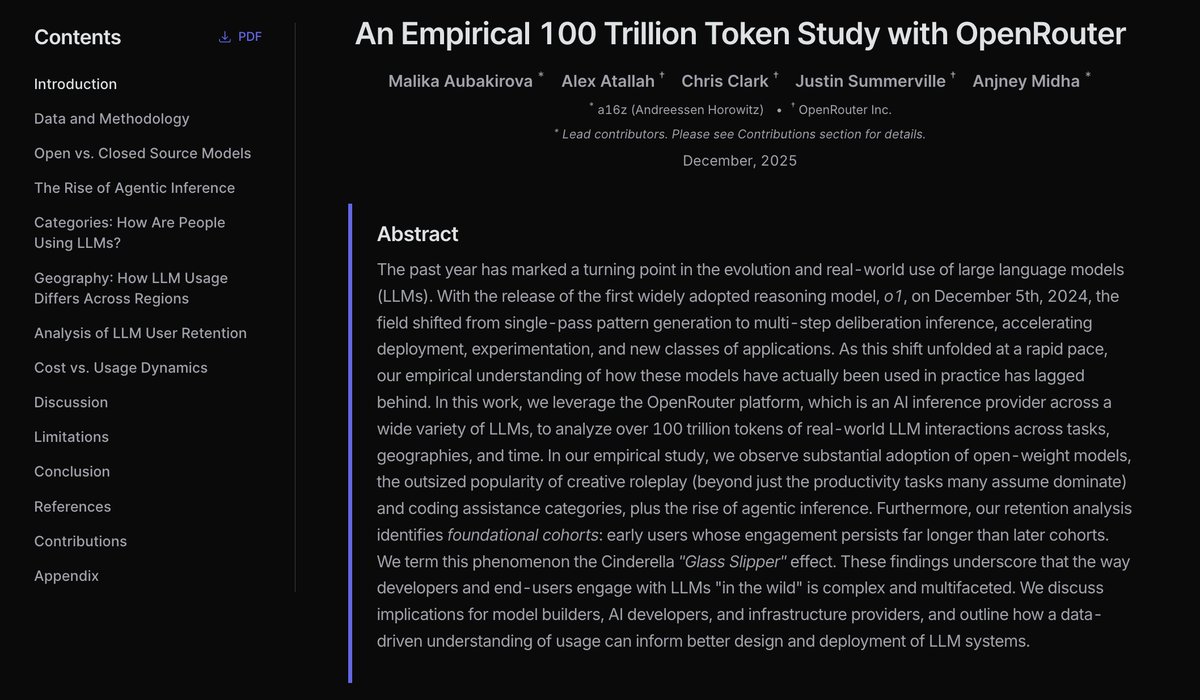
We collaborated with @a16z to publish the **State of AI** - an empirical report on how LLMs have been used on OpenRouter.
After analyzing more than 100 trillion tokens across hundreds of models and 3+ million users (excluding 3rd party) from the last year, we have a lot of insights to share.
🪩The one and only @stateofai 2025 is live! 🪩
It’s been a monumental 12 months for AI. Our 8th annual report is the most comprehensive it's ever been, covering what you *need* to know about research, industry, politics, safety and our new usage data.
My highlight reel:
Does MCP Kill (Centralized) Vector Search?
In the post-MCP world, AI agents will interact with the external world through MCP tools. There is a very valid question on whether you would want to have a centralized search index at all if agents can just directly interface with the tool interfaces (e.g. tool-call Jira, Salesforce, Notion).
The answer on whether you need a centralized index is actually quite nuanced 💡:
✅ Yes for accurate and fast lookup of semantic context. Federated search is slow and relies on every third-party building their own search endpoints that don’t suck, which is unrealistic.
✅ Yes for any document-based sources. There’s no native query interface for documents if they live in Sharepoint/Google Drive/S3. You would still need modules (e.g. through LlamaCloud) that would help you parse and index that data.
🚫 No for deeper lookup within SaaS tools and action taking. AI agents can directly write JQL for Jira through the native MCP server - something that’s not possible through basic semantic search.
I imagine in any agent architecture there’s both tools that enable accurate/cheap retrieval (centralized vector indexing), and tools that enable deeper interaction and manipulation (MCP tool wrappers over SaaS APIs)
Check out my blog here: https://t.co/s4VSQRTJG4
Elon Musk fired 80% of Twitter (6500 people) and everyone thought that Twitter was doomed.
He was right. Everyone was wrong.
It’s the management masterclass of the decade and every entrepreneur must understand why it worked 🧵:
early-stage startups:
it's all about depth, not breadth
it's impossible to know what's working
and what's not working unless
you're going deep enough
this is why 'horizontal' startups
or startups seeking to serve multiple ICPs
or use cases are really, really hard
and stacking odds against yourself
it's challenging enough to understand
one ideal customer group well
let alone multiple groups who each require
a different go-to-market, product feedback, etc.
this is what is referred to as
the "bowling pin strategy"
coined by Geoffrey Moore
knock down the first pin and use that momentum to knock down adjacent pins over time
“Asking product teams to deliver specific features by specific dates is like asking a sales rep to close a specific deal on a specific date or a marketing team to get a set number of leads from a specific campaign.” - @ttorres
https://t.co/gpdR2ULSHK
#prodmgmt#ux