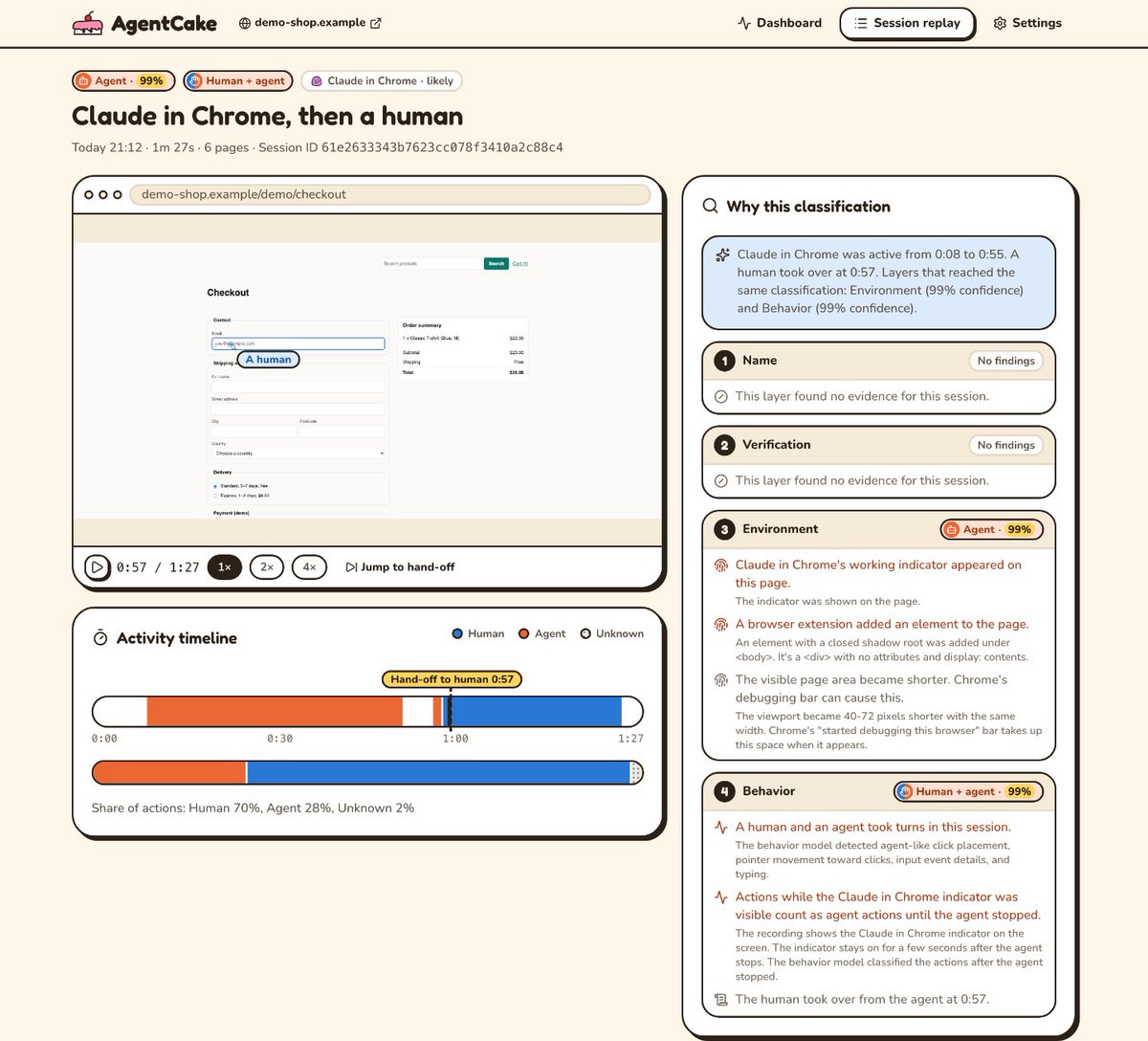
More and more AI agents visit your website, from Grok Bot to Muse. Some even buy or download your product. You now have three kinds of traffic.
1. Bots: Search and training crawlers.
2. AI agents: Some make short visits, perhaps researching for a competitor. Others buy or sign up.
3. Humans: Still here, though we expect their share of traffic to shrink as agents take on more tasks.
Current analytics struggle to identify agents across providers and behaviors. I built AgentCake to tell these visits apart. It recognizes more than 140 AI agents and 450 bots by name and uses a behavioral model to help classify sessions. Open source and self-hosted on your own computer or server.
Check it out on GitHub:
https://t.co/mTiaVnghEl
Great question! We detect agents mostly based on behavior, such as how the pointer moves, typing rhythm, and scrolling patterns.
However, agents that intentionally mimic human behavior are much harder to detect.
Detection isn't always accurate, so we show a confidence percentage rather than making an absolute prediction.
More and more AI agents visit your website, from Grok Bot to Muse. Some even buy or download your product. You now have three kinds of traffic.
1. Bots: Search and training crawlers.
2. AI agents: Some make short visits, perhaps researching for a competitor. Others buy or sign up.
3. Humans: Still here, though we expect their share of traffic to shrink as agents take on more tasks.
Current analytics struggle to identify agents across providers and behaviors. I built AgentCake to tell these visits apart. It recognizes more than 140 AI agents and 450 bots by name and uses a behavioral model to help classify sessions. Open source and self-hosted on your own computer or server.
Check it out on GitHub:
https://t.co/mTiaVnghEl
@prabalhere I think more people will use AI agents to shop, sign up for services, and get information from websites. Traffic may be low now, but I expect it to grow. I personally use browser-use and computer-use agents almost daily for operational tasks.
I use Facade Code daily. Favorite part: agents that drive other agents.
Today my Antigravity quota on Argon ran out. My Claude agent looked through Antigravity's other models, found Gemini 3.8 Flash still had quota, and switched to it.
It finds the tokens I haven't used up.
Good question! Currently, AgentCake doesn't detect fetch-only agents. It records sessions, and a session only starts when the page script runs. We're focusing on visits where the page script runs to reduce noise.
There are other ways agents interact with websites, such as MCP, direct fetch requests, and API calls, but we're not covering those yet. I'd love to hear any feedback!
We identify different cloud agents using their IP ranges, signatures, and headers. For browser-use agents, each product leaves its own traces. For example, Claude in Chrome adds elements to web pages, while Codex's in-app browser has its own fingerprint. We also use a small behavioral model to help distinguish humans from AI agents.
Is your website getting plenty of traffic, but your conversion rate is staying the same or even decreasing? Could some of those visits be coming from AI agents?
HUMAN Security found that traffic from AI agents and agentic browsers grew 7,851% year over year. If your analytics can't recognize these agents, their visits may be counted as human traffic, making your daily reports misleading.
We've launched AgentCake to help answer that question. It's free, open source, and self-hosted. It records website sessions so you can replay them and identify whether they were driven by a human, an AI agent, or both.
AgentCake uses four layers of signals to identify whether a human or an AI agent drove each session: name, verification (request signatures and IP ranges), environment (automation traces and agent markers on the page), and our behavioral model.
What you can see:
• What AI agents do on your site: Which pages they visit and whether they're just browsing or trying to sign up.
• Where they get stuck: Which steps are causing problems and could be improved.
After unlocking agentic analytics, you can:
• Design for AI agents: Make your website experience agent-friendly.
• Set different KPIs for humans and agents: For example, you might expect a lower conversion rate from agent sessions than from human sessions.
To set it up, open Claude Code or Codex and paste the install instructions from our README:
https://t.co/mTiaVnghEl
If you give it a try, we'd love to hear what you think. ❤️
#AgenticAnalytics #AgentTrafficAnalytics #AIAgentAnalytics #AIAgents #AgentExperience #WebAnalytics #SessionReplay #OpenSource #SelfHosted
If you're interested in testing data skills, feel free to contribute to the repo. Every skill on the list is tested on real data first.
https://t.co/6Afot5mafK
Claude Code created a GA4 events table in BigQuery, with and without the bigquery-schema-design skill.
With the skill: described each column; formatted event time; sorted by 3 columns to improve query performance.
https://t.co/wsZSe4HlMO
Other BigQuery modeling skills?
My Bay Area Data/AI picks this week:
Tue-Thu 10/27-29: ODSC AI West, Burlingame
Wed 10/28: VeloDB Data for Agents, Menlo Park
Wed 10/28: MotherDuck Women in Data + Eng Happy Hour, Birba, SF
Links below.