Model misspecification is one of the trickier challenges in SBI: what happens when your simulator doesn’t capture the observed data?
I wrote an overview of the problem and methods to detect and handle it, now out in the ICLR 2026 blog post track: https://t.co/PuTbZgQKPq
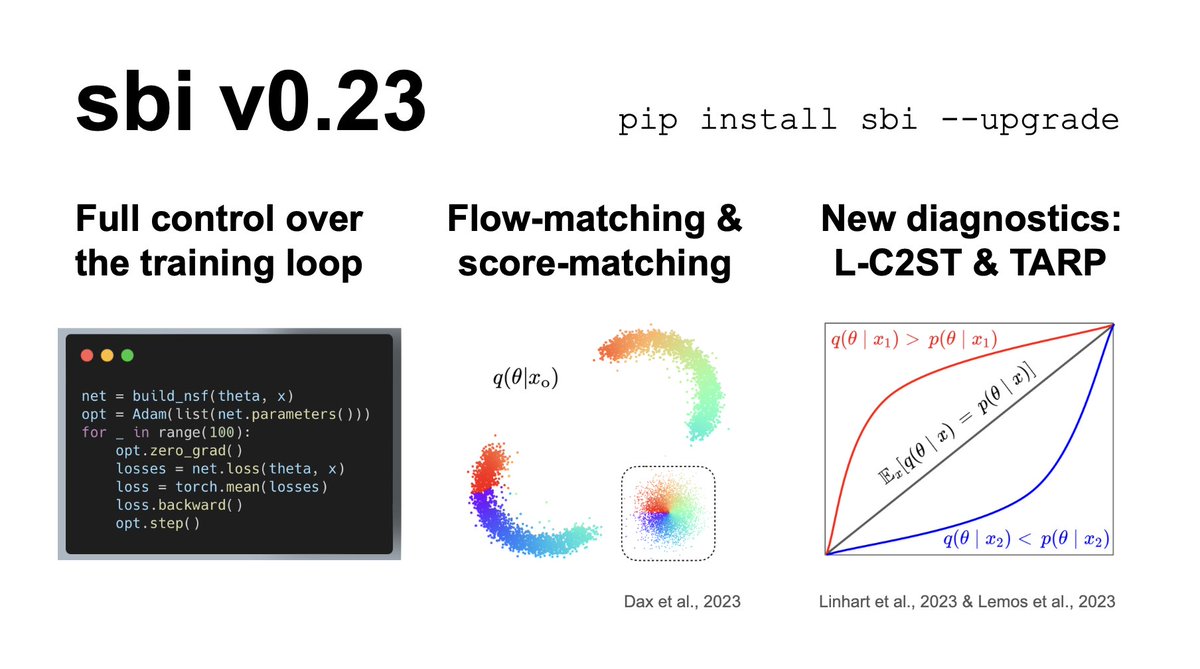
From hackathon to release: sbi v0.25 is here! 🎉
What happens when dozens of SBI researchers and practitioners collaborate for a week? New inference methods, new documentation, new embedding networks, a bridge to pyro and a bridge between flow matching and score-based methods 🤯
For everyone working with trial-based i.i.d. data and varying experimental conditions - we have you covered now!
You can train NLE once and then run MCMC with multiple subjects, trials and conditions, etc.
Example: https://t.co/t2AujhvQz2
Reach out on GitHub for questions 🙋♂️
🎉 Just in time for the end of the year, we’ve released a new version of sbi!
📦 v0.23.3 comes with exciting features, bug fixes, and docs updates to make SBI smoother and more robust. Check it out! 👇
🔗 Full changelog: https://t.co/bn4qICJMcU
The sbi package is growing into a community project 🌎 To reflect this and the algorithms, neural nets, and diagnostics that have been added since its initial release, we have written a new software paper. Reach out if you want to get involved: https://t.co/IKRLTONnbj
We have an exciting talk coming up tomorrow at 4pm CEST in the TransferLab seminar! Join us for an introduction to Reduced Order Modeling and how surrogate models can accelerate large-scale engineering workflows. More details below and here: https://t.co/R5a3m8mJPT
Looking for some physics-enhanced machine learning insights this Thursday afternoon? 🧠
Join us for the upcoming TransferLab talk on "generalized quadratic embeddings for nonlinear dynamics".
Make sure to check out the fresh look of our docs website: https://t.co/9j2hgEg6Yx🎨
Big thanks to @tomamoral for the incredible help and kudos to https://t.co/pwzFuMfC9y, making docs version switching so seamless.
So excited to see the new SBI release out just in time for today’s talk at #EuroSciPy2024! 🎉 A big shoutout to all the new contributors who made this possible. Thank you all! 🙏 Names are here: https://t.co/ZjWIk55AiF
We just released a new version of `sbi`, and this one has _a ton_ of new features! Many of these features are thanks to more than 30 (mostly new) contributors. We are very excited about the growing community and the new release! 🧵 1/8
Excited to present the SBI toolkit at #EuroSciPy2024 next week! 🎉 I’ll introduce SBI and show how @sbi_devs gives user-friendly access to the latest methods for Bayesian parameter inference on scientific simulators. See you there! #OpenSource#Python
We’re excited to share that the SBI package is now officially @NumFOCUS affiliated and growing into a community project. A lot of upcoming release originated from a hackathon earlier this year, and there are more events planned soon. Stay tuned for details! #opensource#hackathon
🚆 Heading to #icml2024? Need a good read for the journey? Check out the paper summaries I wrote at https://t.co/KjO4KfMNd6! 📚
📝 "All-in-One SBI", outstanding work by Gloeckler et al. (oral) @mackelab
📝 "Position: Leverage LLMs for BBO" by the amazing @RobertTLange et al.
Neural networks are highly sensitive to tiny adversarial perturbations. Can we trust them to reliably perform Bayesian inference?
We investigated the brittleness of inference networks & possible solutions. By @gloecklermanuel@deismic_@jakhmack, accepted at ICML. 🧵1/5
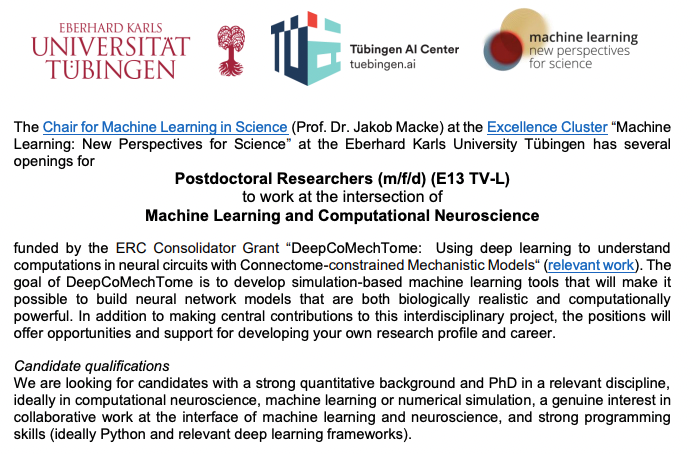
We are hiring postdocs!
If you're interested in working at the intersection of machine learning and neuroscience, join us in Tübingen @uni_tue to build biologically realistic and task-performing deep neural networks.
Check out the full job ad here: https://t.co/anNlccgonU
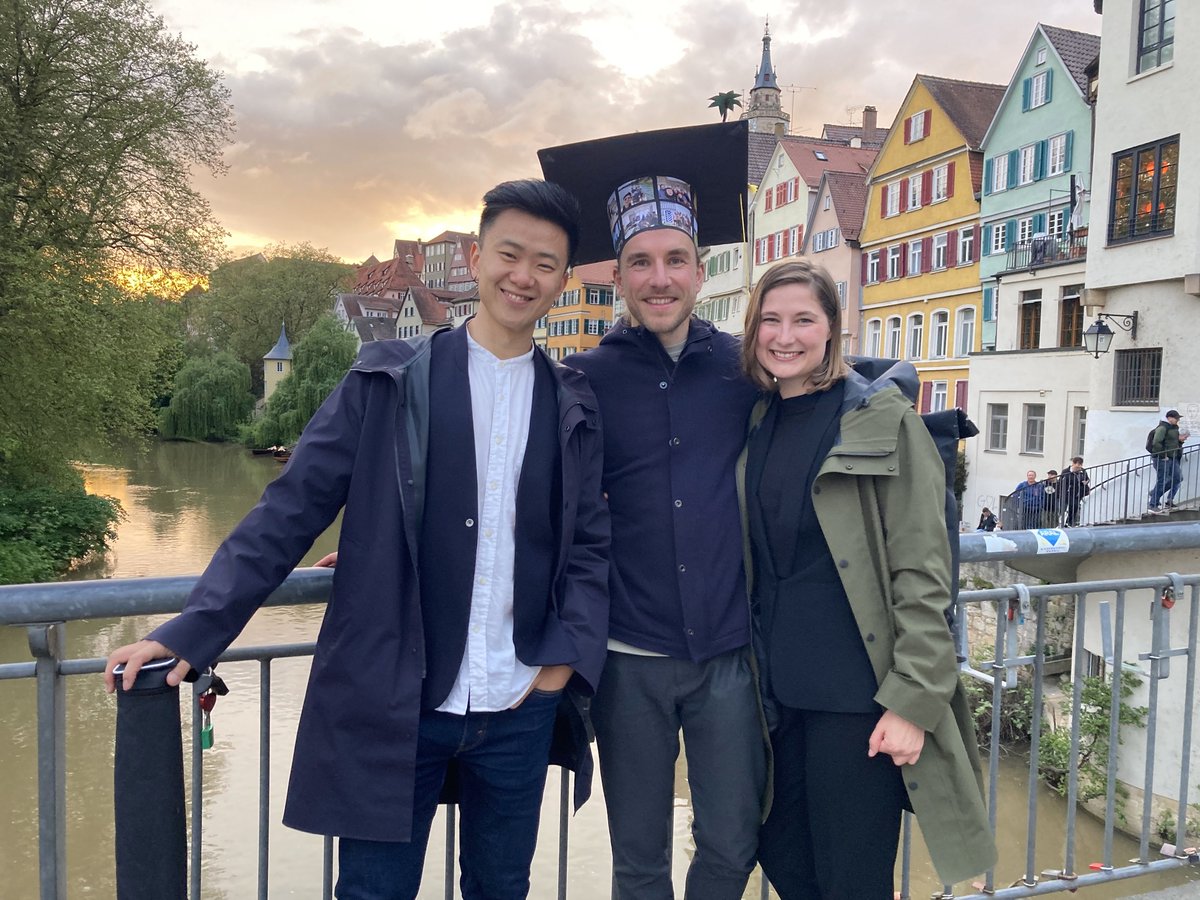
New Doctor in the house!
Dr. Jan Boelts @janfiete successfully defended his PhD last week, talking about a fantastic set of works on developing and applying simulation-based inference methods in neuroscience and cognitive science.
Many congratulations for making it to the top!
Neural oscillations are abundant! But what is their role? Oscillations could serve as a clock signal for phase-coding information.
In: https://t.co/qxWgSPfPtJ, we studied the dynamical systems underlying this kind of coding. With @matthijs_pals, @jakhmack and Omri Barak [1/5]