Finally, a big "thank you" for funding and support to Uni Tübingen, the Tübingen AI center, the excellence cluster ML4Science, @dfg_public, @ERC_Research, the Carl Zeiss Stiftung, MPI-IS, NERF, VIB, and Hertie-AI!
Our work on training biophysical models with Jaxley is now out in @naturemethods. Led by @deismic_, with Philipp Berens, Pedro Gonçalves & @jakhmack et al.
https://t.co/dXzqjR4Oct
Finally, a big "thank you" for funding and support to Uni Tübingen, the Tübingen AI center, the excellence cluster ML4Science, @dfg_public, @ERC_Research, the Carl Zeiss Stiftung, MPI-IS, NERF, VIB, and Hertie-AI!
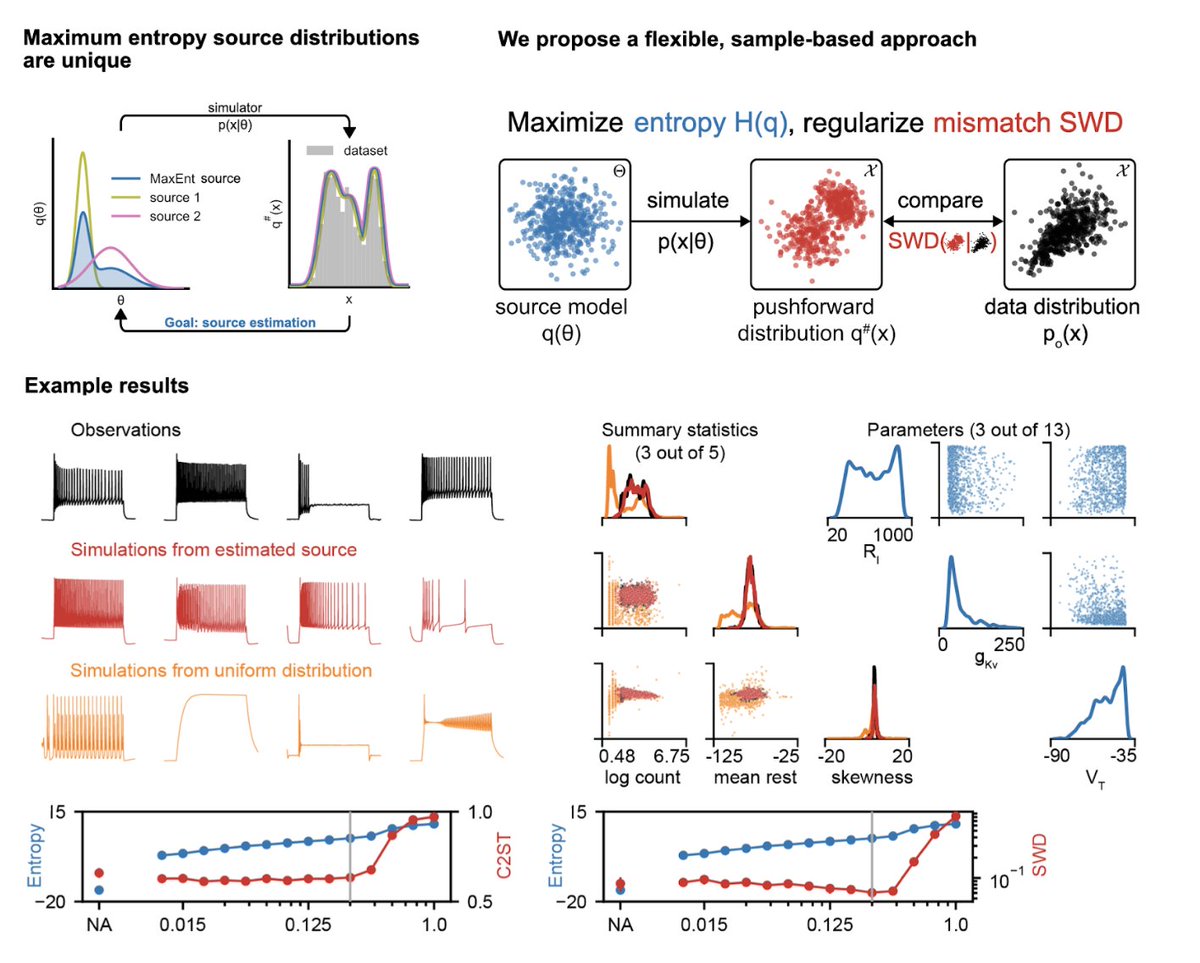
Julius Vetter (on Bluesky) and I are excited to present our work at #Neurips2024! We present Sourcerer: a maximum-entropy, sample-based solution to source distribution estimation.
Paper: https://t.co/HUYgz8ySCw
Code: https://t.co/WBPD3uVQUm
(1/8)
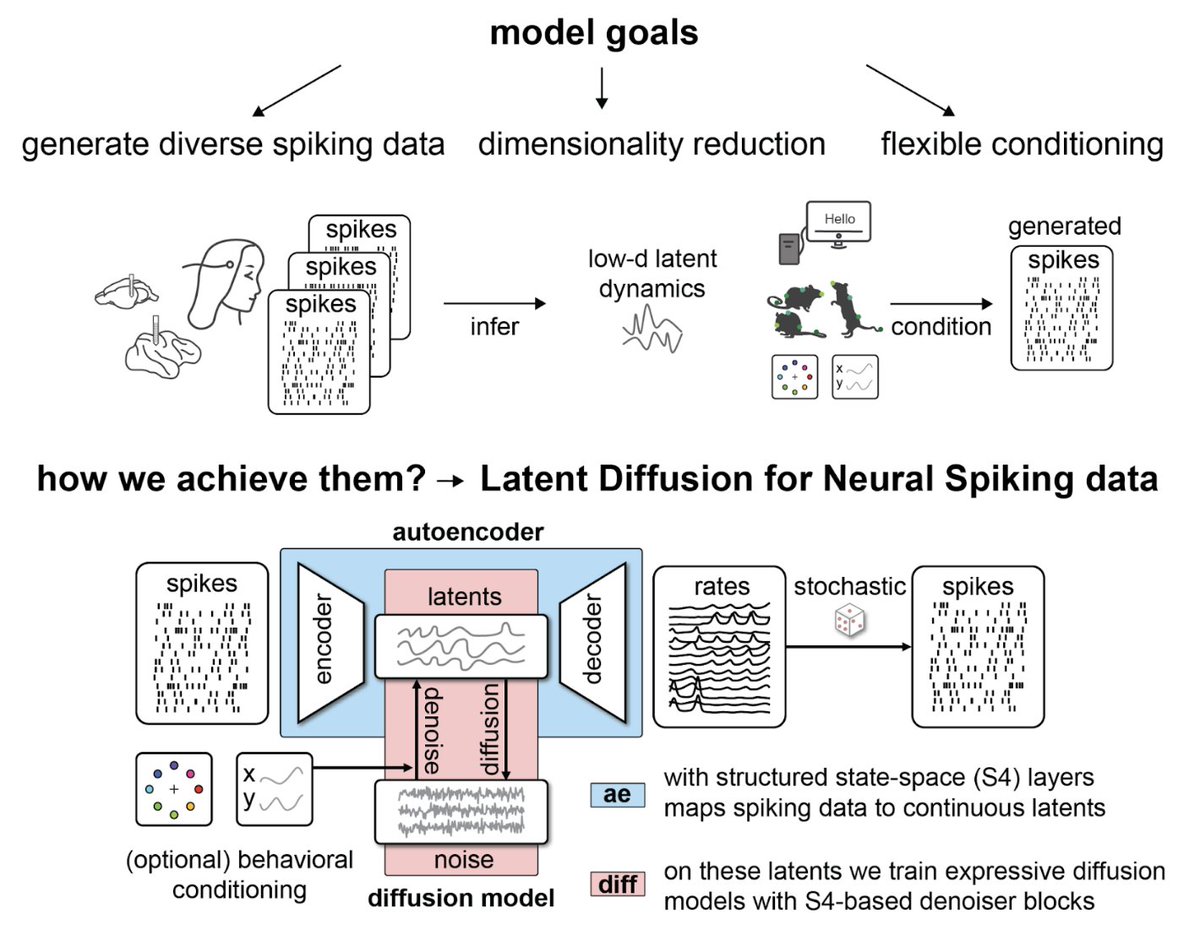
1) With our @NeurIPSConf poster happening tomorrow, it's about time to introduce our Spotlight paper 🔦, co-lead with @_Jaivardhan_ :
Latent Diffusion for Neural Spiking data (LDNS), a latent variable model (LVM) which addresses 3 goals simultaneously:
How to find all fixed points in piece-wise linear recurrent neural networks (RNNs)?
A short thread 🧵
In RNNs with N units with ReLU(x-b) activations the phase space is partioned in 2^N regions by hyperplanes at x=b 1/7
We introduce a new maximum-entropy, sample-based approach to solve the source distribution estimation problem. Poster #4006 (East; Fri 13 Dec 11:00 PT). By Julius Vetter, @guymoss13, ➡️https://t.co/sKtS35cj9F 4/4
Thrilled to announce we have three #NeurIPS2024 papers! Interested in simulating realistic neural data with diffusion models or recurrent neural networks, or in source distribution sorcery? Have a look 👇 1/4
@_Jaivardhan_ and @SchulzAuguste introduce LDNS, a diffusion-based latent variable model to generate diverse neural spiking data flexibly conditioned on external variables. Poster #4010 (East; Wed 11 Dec 11:00 PT) ➡️https://t.co/SphWV7FTlT 3/4
Welcome Daniel (@danigedon) to our lab!
In his PhD he focussed on time series and low-dimensional representations, and now he will work on model discovery for time series.
Outside the lab he's active from biking, to hiking or yoga-ing. Glad to have you join!
Recently I defended my PhD thesis 🤓
While my face barely hides my thoughts on some questions, we had a blast celebrating later 🥳🎉
Now I am enjoying Swedish summer ☀️🇸🇪 and in September, I will join @mackelab at @uni_tue as PostDoc to continue with more fun research! 🇩🇪
We are looking to hire multiple PhD students on (1) deep learning for mechanistic models of neural computation, (2) simulation-based Bayesian inference, (3) ML for clinical neuroscience. Reach out if you are excited about these topics! Details here: https://t.co/oNwIeQ2IiX
there is still time for you to make some really good-looking—and state-dependent!—fake LFP or EEG data to up the chances for your Cosyne submission! *
* that was (obviously) a joke: Cosyne does not condone the use of LFP or EEG data.
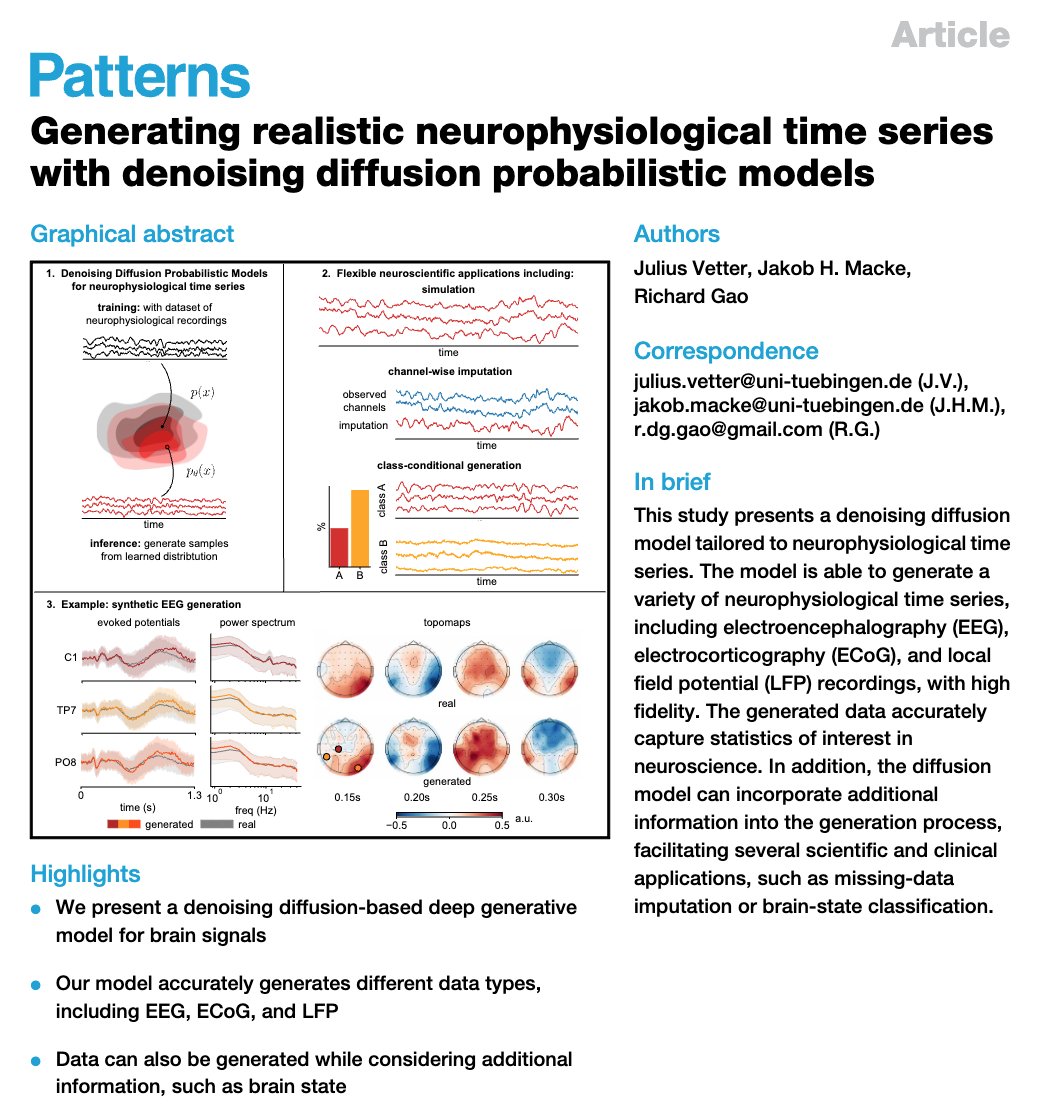
Want a tool that uses ML to generate REALLY good fake brain recordings?
You're getting one. Julius' paper on diffusion models for brain data is published!
Works with all kinds of densely sampled, multichannel continuous signals (LFP, EEG, etc.)
https://t.co/CG7aD3uLAu