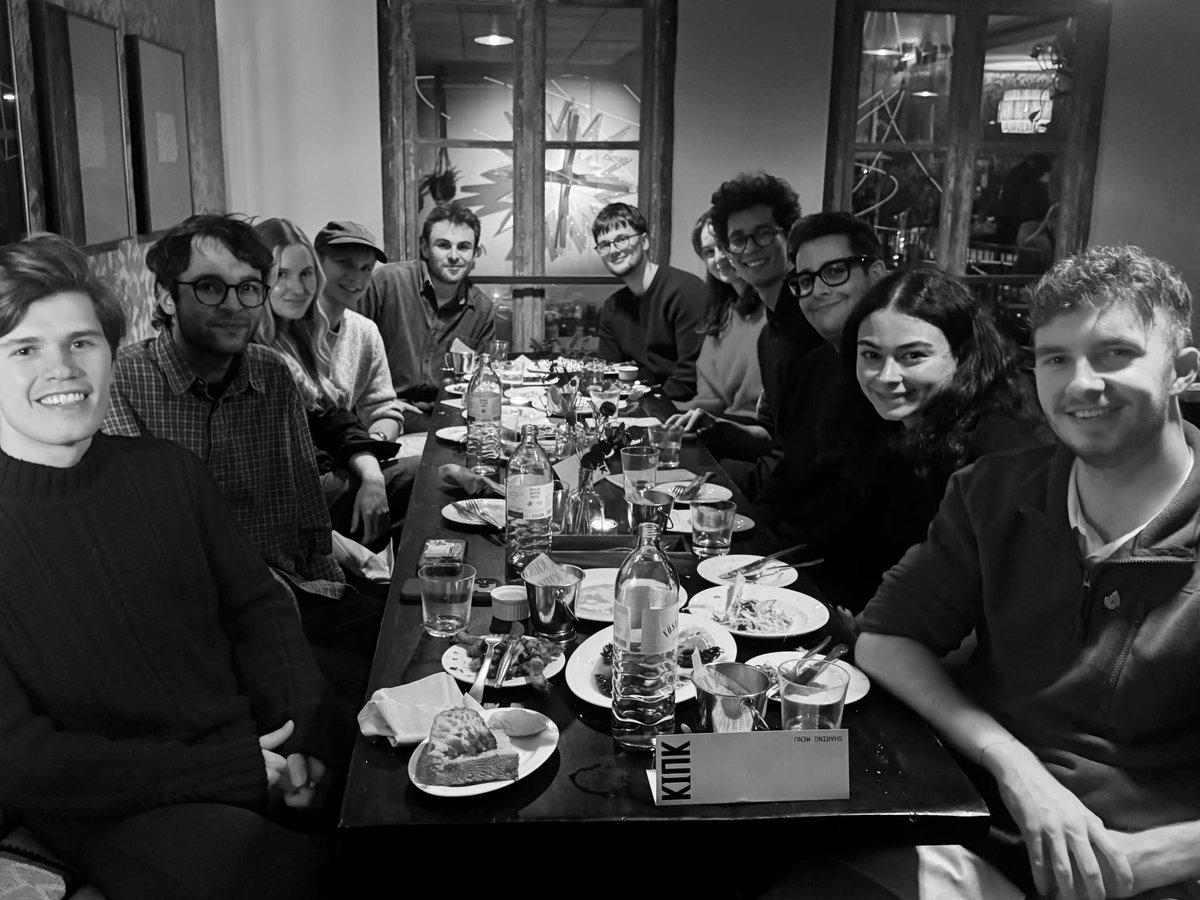
Saturday Club this weekend in London!
For people with full-time commitments, serious about founding soon
Bringing together technical builders, strong commercial people welcome
No networking, screened for commitment
Apply here: https://t.co/N7aJLywTb4
Fable 5.2 shows substantially improved skills in controlling physical robots, even on tasks it has never explicitly been trained to do.
On RoboDojo, a benchmark with a simulated two-arm robot, it outperformed other models and most AI systems built to control robots.
I'll be in Berlin and Dresden this week meeting exceptional operators and builders, who want to build global companies from day -1
If this sounds like you or someone you know, DM me and/or tag them in the comments
Every time I interacted with @sequoia at @Ledgy and specifically @LucianaLix, their team was always exceptional
Can’t wait to see what these great individuals are up to next
My fundraising philosophy: Eat when the appetizers are being passed. To mix metaphors, the lesson of the last 20 years of venture capital is the spigot can turn off in a matter of days.
I just joined a panel on how to find a cofounder hosted by @SOSV.
Here are my tips on how to nail one of the most important decisions you'll ever make as a founder...
Initial takeaways:
- Compute & infrastructure expense went from 251% of revenue (Q1'25) to 48% (Q2'26). Over the same period, revenue grew 1,368% YoY while compute grew ~300%.
- Operating losses turned into a profit. The GAAP operating margin went from -249% in Q1'25 to +8% in Q2'26
- Gross vs net: 48% of H1'26 revenue was sold via cloud
(CSP) marketplaces. Anthropic books these sales gross, with the CSP's cut in "Sales, marketing & partnerships", which rose to $3.2bn (19% of revenue)
- Compute obligations: Fixed and minimum commitments were ~$265.6bn at 30 June, against $131.7bn of cash and investments. Separately, Broadcom TPU equipment leases total ~$161.2bn of rent, SpaceXAI is up to $120.5bn, Nscale up to $44.6bn and Lambda ~$41.3bn.
- Customer concentration has fallen. No customer exceeded 10% of 2026 revenue. The top 5 customers were ~25% of revenue, down from 36% in Q1'26 to 21% in Q3'26.
Congrats @alexnhaus & @Esanzgadea on announcing Helicon and their $16.5M seed.
These guys are obsessive and intense, and they’re industrializing critical components of our Western supply chain.
I'm incredibly grateful I got to back and work with them at EF.
Helicon is building factories to industrialize composites.
We raised a $16.5M seed round led by @alley_corp (@abemurray /@JonesBrannon) with participation from @joshbuckley, @chalfs, @gokulr and other top investors.
We’re ramping production at our factory in Los Angeles to deliver against millions of unmanned systems that need to be built domestically.
We're building a world class team. Join us. https://t.co/30DjajhOr6
@hiiamArielle@colossusmag@AcquiredFM Shockingly, a total coincidence! (At least for the Acquired episode). We found out there was a LD book dropping last week after it was already recorded.
That said, excited to read it!
I can’t escape Larry David (nor did I ever want to), such a legend
I think the first person to be covered by my two favorite media co’s (@AcquiredFM@colossusmag) at the same time
Larry David is one of America’s unlikeliest icons, and one of history’s purest founders.
In our latest profile, Correspondent-at-Large @blakejharrisNYC—who spent six years talking to Larry for his new book—explains what makes Larry so special, and why it took him so long to break through.
Larry was a mediocre student with a middling social life. His first two jobs—selling bras and driving cabs—ended quickly. At 25, he called his mother from a hotel room: “Ma, nothing good is ever gonna happen to me.” She urged him to become a mailman.
Soon after, he found what he thought would be his calling: stand-up comedy. His material was funny, but he rarely finished a set. If somebody in the audience looked at their watch, or didn’t laugh when he thought they should, Larry stormed off.
14 years later, aged 39, he got a break. He was asked to write his first sitcom script for a big new Showtime series. Only an eighth of what he wrote survived the edit, but the episode was still his. He was broke, and the writing credit could have sparked his career. But Larry refused to put his name on it.
Even with Seinfeld, Larry nearly hit self-destruct. The pilot performed worse than almost any other show NBC had ever tested. Still, the network ordered four episodes, one of the smallest orders in TV history. Larry barely made it through them.
When the studio installed a showrunner to oversee the scripts, Larry endured the man’s notes, then said “NO. I’m not doing one thing,” and walked out. In the summer of 1991, with the show finally starting to work, NBC wanted Jerry and Elaine to get married and have a baby. Larry quit in the parking lot and wished everyone good luck. Jerry stood with Larry, and NBC caved.
Larry’s friend and comedian Bill Scheft put it this way: “He doesn’t [act this way now] because he has fuck-you money. It’s the opposite. He has the fuck-you money because he’s always acted this way.”
Read the full profile by Blake, author of Emperor of Nothing: The Making of Larry David.
https://t.co/Qno3w0ozHz