Hands-on, open-minded Product Engineer since 1986. Entrepreneur at heart. Former InsurTech CTO/CPO. Creator of Gravity, the social net app for Nokia w/ 1M users
GLM 5.2 has taken control of a tmux session with Claude Code in it.
It's watching and waiting for approval prompts.
Then it's trying to approve or reject them, but that tool call itself is running through another GLM 5.2 approval agent 🤯
The fact that I can tweet this means neither of those agents accidentally wiped my MacBook yet ... 😂🤣
@CFDevelop Especially those decisions like „this doesn’t work, can we rewrite it, like, completely!?“
Nowadays that’s not a strict „noooooo!!!“ anymore 😎
Well, looks like gpt-6.2-astra is finally usable on a cheap $20 sub. That's a big plus.
Just tested it on the same task (actually by accident), and analysis says, gpt-6.2-astra is about 4x more efficient! 🤯🥳
Very interesting analysis from Opus 5.5 on my session traces:
With gpt-6-astra, one minute took about 5.6% of the 5h limit, while gpt-6.2-astra only takes 1.3%.
First tests with gpt-6.2-astra are promising. On my cheap $20 sub, the 5 hour usage limit lasts for about 60-80 minutes now ... that's a considerable improvement.
"time ~58 min / tokens ~17.0M / uncached ~168k (1%) / output ~25k (1.3k)"
First tests with gpt-6.2-astra are promising. On my cheap $20 sub, the 5 hour usage limit lasts for about 60-80 minutes now ... that's a considerable improvement.
"time ~58 min / tokens ~17.0M / uncached ~168k (1%) / output ~25k (1.3k)"
Both NeXT and 3DFX tried to “do the right thing” with color spaces, and it wound up generally making them look worse than competing options. I didn’t really understand it properly until years later.
It is natural to think that a pixel with a value of 1.0 is emitting twice the photons as a pixel with a value of 0.5, so you can do the obvious linear math to calculate partial pixel coverage, blending a foreground over a background, or interpolating between colors in a texture.
If displays are “linear”, that is correct. NeXT and 3DFX were much closer to linear than other contemporary displays. NeXT had crossover from the deep graphics understanding at Pixar, and 3DFX had the SGI heritage. They did this intentionally.
If you have 10+ bits per channel like the professional rendering systems, linear displays are The Right Thing.
Unfortunately, NeXTStation Colors were 4 bits per channel and 3DFX was 5 or 6 bits per channel, and there… it was not the right thing.
Human eyes aren’t linear intensity sensors. We mostly register relative changes in intensity, so we can tell the difference between 0.01 and 0.02 as a huge doubling, while 0.99 to 1.00 is almost imperceptible.
This distribution of intensities is often referred to as the “gamma” of the display system, but the actual curves like sRGB are a bit more complicated.
If you only have a small number of discrete pixel values, you definitely don’t want to spread them evenly from 0 to 1! If you do, you will have good precision in the brights, but very stark “intensity bands” in the dark colors.
If everything was authored specifically for 3DFX, you would still have the fundamental problem with the dark bands, but more accurate blending and filtering. The problem was that artists made all of their textures in paint programs on conventional non-linear displays, so when they were drawn by 3DFX cards, they got the characteristic “washed out color” look.
You can mathematically correct textures for differences in display gamma, but I didn’t really understand the issue back in the glQuake days, and we were so enthralled by the absolute performance of 3DFX that the color fidelity didn’t get as much attention as it should have.
Even today, tons of games don’t properly handle gamma across their textures and render targets. High resolutions and 24 bit color masks most of it, but you still see it in some slight shimmerings in high contrast textures and edges.
@CFDevelop@johnjkattenhorn I'm working a bit differently with my "software factory". I told it:
"Can you create a proper plan for the clean-ups and maybe note how we came there (how you ran deslop)?"
and it creates a markdown document with attached "work-items".
@CFDevelop@johnjkattenhorn It’s a weird world we’re in: nowadays, you just paste a link to a tweet into your agent and say „Look!!1!1!“ and it knows what to do … 😳🤩
@CFDevelop@johnjkattenhorn Nice, just asked Opus 5.5 to run it against my Typescript/Swift project:
„What I think … It's useful as an occasional review: fast, and the top production hits are real …“
😎🎉
I don’t want to live in a world where my graphics shaders (using modern tensor cores) must be approved by the government. We don’t want to live in a dystopia, where goverments dictate what code our computers are allowed to run.
Why are old stories that were not even covered up all that well become sudden international and geopolitical news?
The timing is suspicious, so worth asking: who benefits and why now?
If Jensen, the premier champion of open models, is taken out then anyone who wants AI closed, centralized, and controlled might benefit.
Why now? The midterms seem relevant. But also perhaps the upcoming IPOs.
@_overment Yep, using both in my harness. If you think about it: subagents are actually nothing else than normal sessions. And there’s absolutely no reason why they shouldn’t have individual settings for model/tools/prompts/approvals/…
In 10 years as CEO of two startups, I can't count how many times engineers pitched me a complete rewrite of our codebase.
It always reminded me of Steve Blank's Startup Suicide: Rewriting the Code and Joel Spolsky's Things You Should Never Do. Joel compared rewriting software from scratch to demolishing a building instead of renovating it. I always agreed and pushed back hard on rewrites.
But AI has completely changed my mind.
When you can coordinate a swarm of thousands of coding agents, the economics are completely different. Suddenly there's an enormous premium on having an agent-native codebase: super fast CI, minimal dependencies, clean architecture, every decision documented, and everything optimized for agents rather than humans.
For the first time in my career, I'm starting to think a complete rewrite might actually be the right call.
Introducing Claude Fable 5.2 and Claude Mythos 5.2, designed to tackle the most daunting technical challenges.
They’re capable collaborators on ambitious projects in many fields, and show improvements in areas like coding, reasoning, and vision.
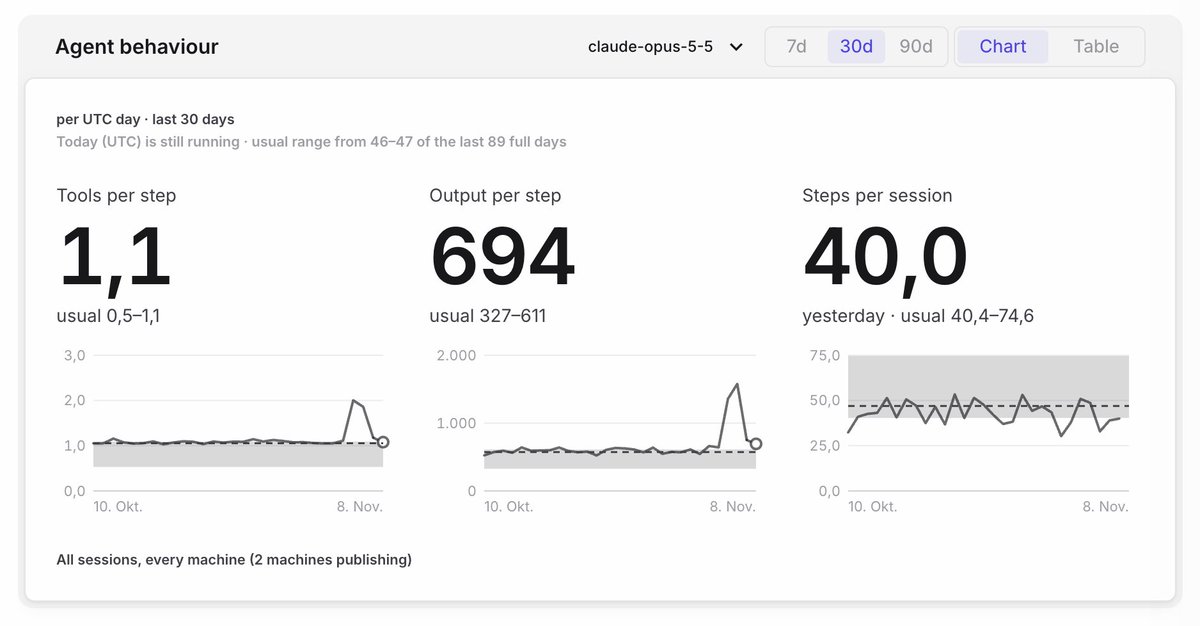
Always good to analyze all your sessions. Apparently, Opus 5.5 was switching away from using Bash for reads/writes/edits from 11-05 to 11-07. Back to normal now. I didn't notice any difference in quality, and usage was feeling normal, too ... 🤷
I fully agree. I think it's actually what I meant by "learning":
If you "vibe coded 3 decent sized apps in 3 days", my take-away would be: the skill of manually producing code is going to become irrelevant.
The skill of managing products, i.e. features, architecture, engineering, teams (virtual or mixed), that's becoming more important than ever before.
What I meant with learning in this context: now, that producing (working) code is basically free, we need to refocus on "higher quality, more sophisticated .." as you said.
The bar has been raised by A LOT. If you're a full-stack engineer, you can do literally anything now ... but so does everybody else 😉
It's nice that you can just use Claude to analyze itself:
"Since about 09:13 UTC today the server has Bash-first switched on for us anyway, so nothing urgent is wrong right now. ..."
Argh! I seem to have been targeted by another Anthropic A/B test.
Probably worth monitoring regularly.
It's when you see lots of Bash usage ("sed ...", "cat ...", ...) instead of Read/Edit/Write.
For me, "bashFirst" works better.