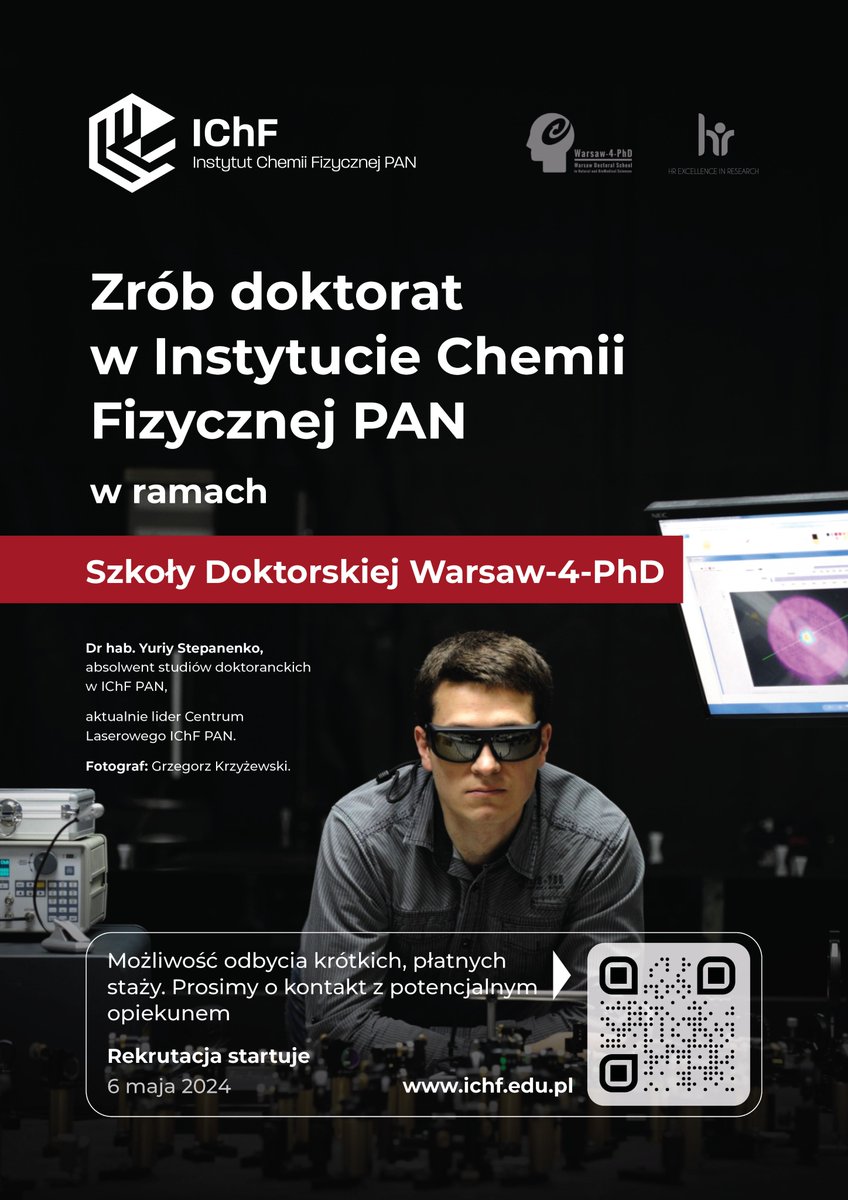
🎓Jesteś absolwentem kierunków ścisłych i zastanawiasz się nad kolejnym krokiem w swojej karierze? Sprawdź, dlaczego warto zrobić doktorat w naszym Instytucie w ramach Szkoły #Warsaw4PhD. Rekrutacja startuje 6 maja: https://t.co/9Xl29zQw0a
#IChF#ChemiaFizyczna#Doktorat#Nabór
My recent article in Nanoscale Advances has been highlighted as a Popular Advance! Read my article and see the full collection at https://t.co/Joj2s6I8HJ.
Exciting opportunity alert! Join the "Living Materials" team at IChF PAN. We're seeking:
- Doctoral candidate (starting Oct) with a monthly scholarship of 5,000 PLN.
- 2 Postdoctoral fellows (start date negotiable) 8,000 - 9,000 PLN/month gross.
https://t.co/6l9g3YUDca
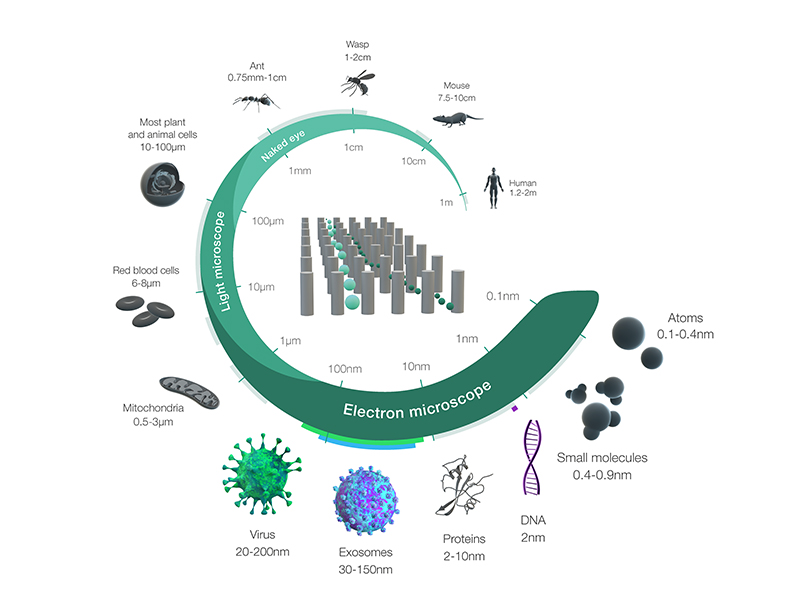
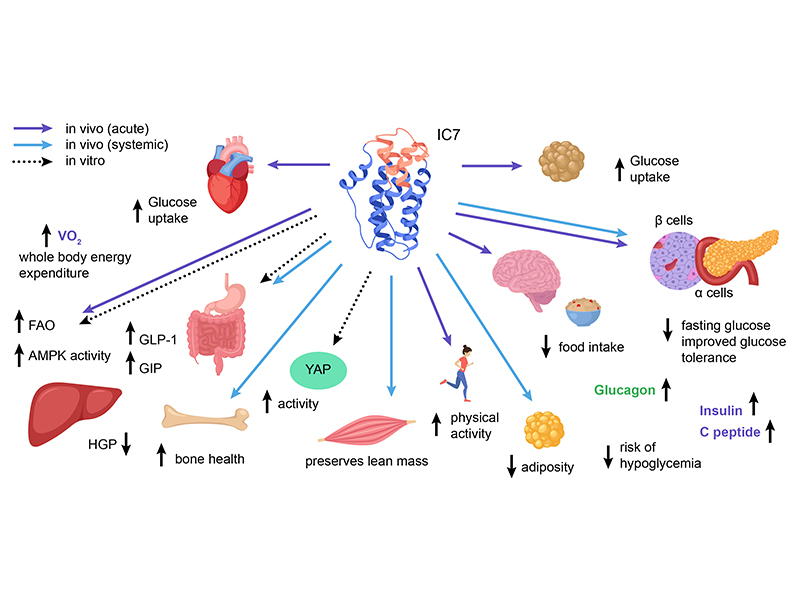
Tips for designing figures for your manuscript! #sciart
1) Keep it simple: The figure should clearly and concisely convey the information you are trying to present. Avoid clutter and unnecessary detail that can distract from the main message.
2) Use appropriate software: Choose software that is suitable for your type of figure. For example, use vector graphics software like Adobe Illustrator for creating diagrams and line drawings, and use graphing software like Excel or Origin for creating graphs.
3) Label everything: Ensure that all labels, axes, and other text are clear and easy to read. Use a font size that is appropriate for the size of the figure, and avoid using too many colors or fonts that are difficult to read.
4) Choose appropriate colors: Use colors that are easy on the eyes and that are easily distinguishable from each other. Consider color-blindness and choose colors that are accessible to all readers.
5) Use high-quality images: Use high-quality images with a high resolution. This will ensure that the details of the image are clear and crisp.
6) Get feedback: Share your figures with colleagues and ask for feedback. This can help identify potential issues or areas for improvement that you may have missed.
7) Follow journal guidelines: Follow the guidelines of the journal you are submitting to regarding figure format, size, and resolution. This will ensure that your figures are presented in the best possible way and meet the requirements of the journal.
8) Keep a record of your figures: Keep a record of all the figures you create, including any changes you make during the editing process. This will help you keep track of the different versions of your figures and ensure that you use the correct version when submitting your manuscript.
9) Be consistent: Ensure that all figures are consistent in terms of style, font, and size. This will help to create a cohesive and professional-looking manuscript.
📌 Adaptive #2D and Pseudo-2D Systems: #Molecular, #Polymeric, and #Colloidal Building Blocks for Tailored Complexity
🔗 Read the full #openaccess publication: https://t.co/gGVJdHNjLT
(image is prepared via Midjourney)
Check out our latest work on the fabrication of 1D particle structures outside liquid environment using electric and capillary interactions: https://t.co/K4svje6fR2
Book chapter on phage-based sensing authored by Jan Paczesny @jan.paczesny , Mateusz Wdowiak, and Enkhlin Ochirbat @enkhlin37 is now online! Book "Nanotechnology for Infectious Diseases" was published by Springer. https://t.co/PnKld0AHvJ
Well... it is official. Bacteriophages make you smarter 😎
A hugely exciting and complex paper out this week in @cellhostmicrobe by Jordi Mayneris-Perxachs (not on Twitter?) showing phages are associated with increased cognitive function & memory
https://t.co/idkl4sjEMK
Our paper on "Adsorption of bacteriophages on polypropylene labware affects the reproducibility of phage research" was listed in 7th place among chemistry papers published in Scientific Reports in 2021 (among >1300 papers) with res…https://t.co/t2BMo54d6n https://t.co/8ec3Wxhxu8
National Science Center, the main research funding body in Poland, allowed for hiring Ukrainian researchers within ongoing grants. As the "Living Materials" team we invite up to 3 researchers from Ukraine to join us! There are some opportunities within So…https://t.co/gVK0xWkAEZ
@SteveGayder@JeremyJBarr The effect of mixing is in the timescale of hours, whereas the effect of just storing in RT is visible after weeks. The time required for sample prep for the dilution series and plaque assay was much shorter.