Gut microbiome screens could identify risk of Parkinson’s disease years before symptoms appear
A healthy diet was inversely associated with these alterations and might mitigate disease risk
@NatureMedicine
https://t.co/lY5eWZ1w7B
Natural polyphenols in the treatment of inflammatory bowel disease (IBD): pathological intervention activities & delivery system constructions
✅️ Natural polyphenols are bioactive compounds derived from plants, which have shown great potential in the treatment of IBD due to their powerful anti-inflammatory, antioxidant, & immunomodulatory properties.
Highlights:
▶️ Introduces the pathological intervention activities of natural polyphenols in the treatment of IBD.
▶️ Elaborates the applications of natural polyphenols in constructing innovative therapeutic systems for treating IBD.
▶️ Presents the challenges faced by natural polyphenols in drug delivery systems for treating IBD & summarizes the corresponding countermeasures.
https://t.co/YUTxnC04JW @HealthyFellow@_INPST@_atanas_@DHPSP@drfherediaz@DrGrimaldesJ@LoriShemek@tatiann69922625@NutrioSci@UsNdHealth
Human gut microbiome composition shows life stage-specific trends, but develops along distinct trajectories influenced by multiple factors across the life course
This review updates implications for human physiology via @FEBS_Letters:
https://t.co/A1O0eqhWKm
Exercise and the Gut Microbiome: From Mechanisms to Clinical Applications
✅️ Exercise can modify gut microbiota composition and function independently of diet.
✅️ Exercise effects are intensity-dependent, transient, and reversible. Moderate-intensity continuous training reliably increases microbial diversity, enriches health-associated taxa (Akkermansia, Faecalibacterium, Roseburia), and enhances intestinal barrier function. High-intensity interval training acutely perturbs the ecosystem but, following adaptation, stimulates butyrate production through lactate cross-feeding.
https://t.co/LwAnjSGxIG @HealthyFellow@tatiann69922625@Mangan150@_atanas_
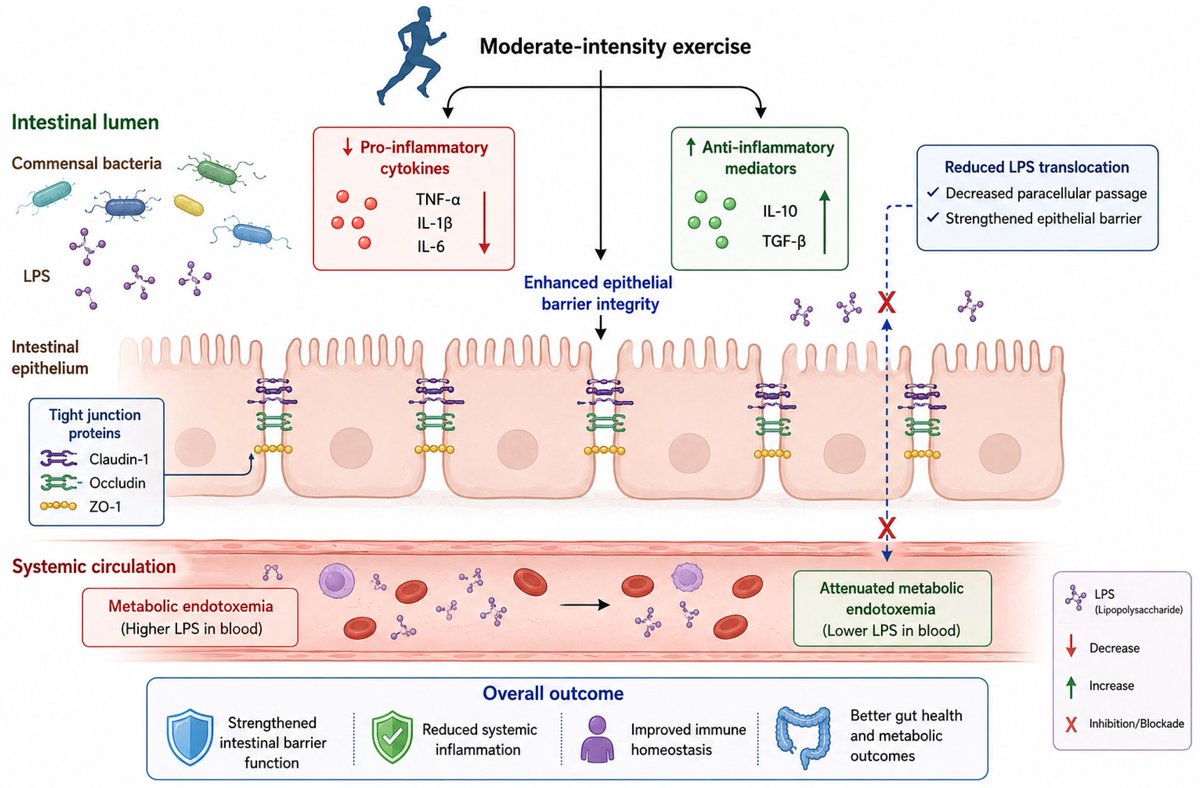
Schematic representation of exercise-induced immunomodulation of the intestinal barrier.
Moderate-intensity exercise upregulates tight junction proteins (claudin-1, occludin, ZO-1), reduces pro-inflammatory cytokine expression (TNF-α, IL-1β, IL-6), & increases anti-inflammatory mediators (IL-10, TGF-β). These adaptations limit bacterial lipopolysaccharide (LPS) translocation & attenuate systemic metabolic endotoxemia.
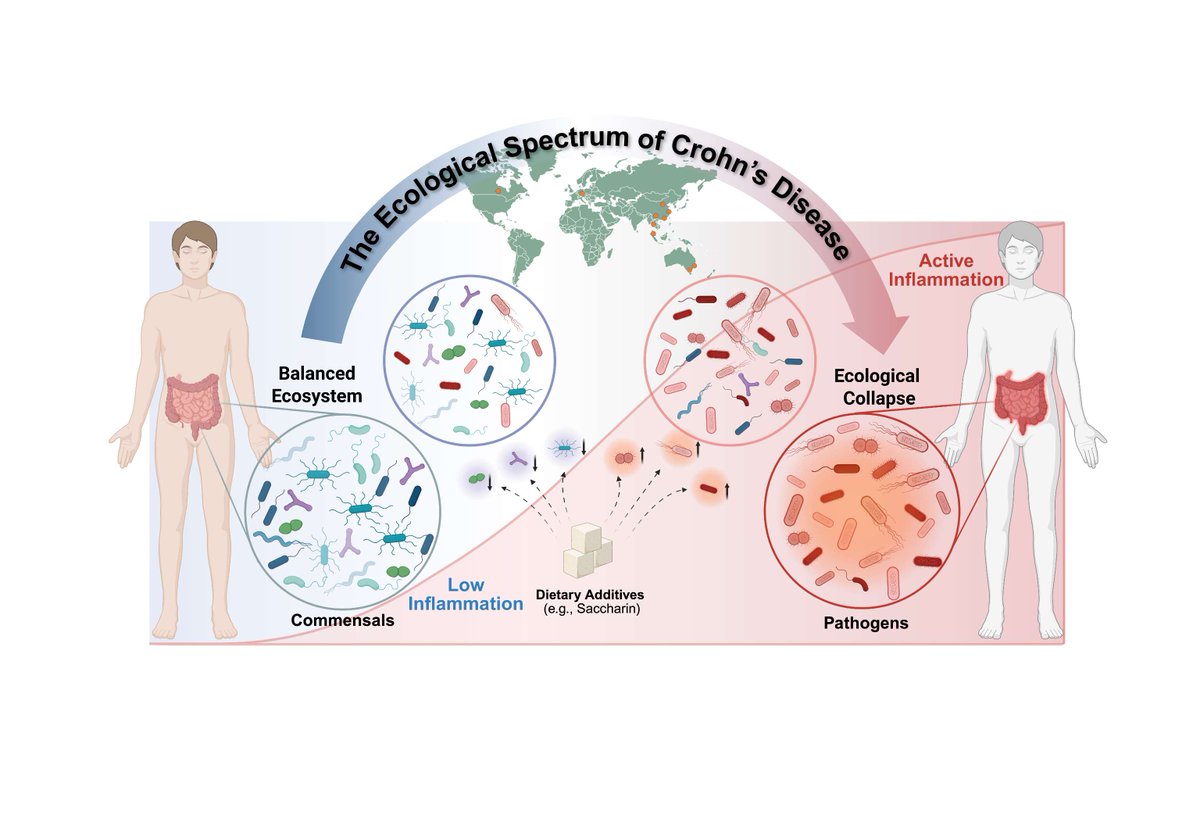
Can diet influence Crohn’s disease patterns? 🔬🍬
Research presented at #DDW2026 analyzed a nearly 500 people across Australia and Asia and found that sweeteners - the key food additives studied - such as saccharin, were linked to gut bacteria changes associated with Crohn’s disease. @CUHKofficial
Impact of Bifidobacterium infantis supplementation on growth, health outcomes, and gut microbiome features in underweight infants from Pakistan.
Great collaboration between Gates Medical Research Institute, Al Shifa Research Centre, and CMbio 🦠🧬
https://t.co/v2BIHLvgG1
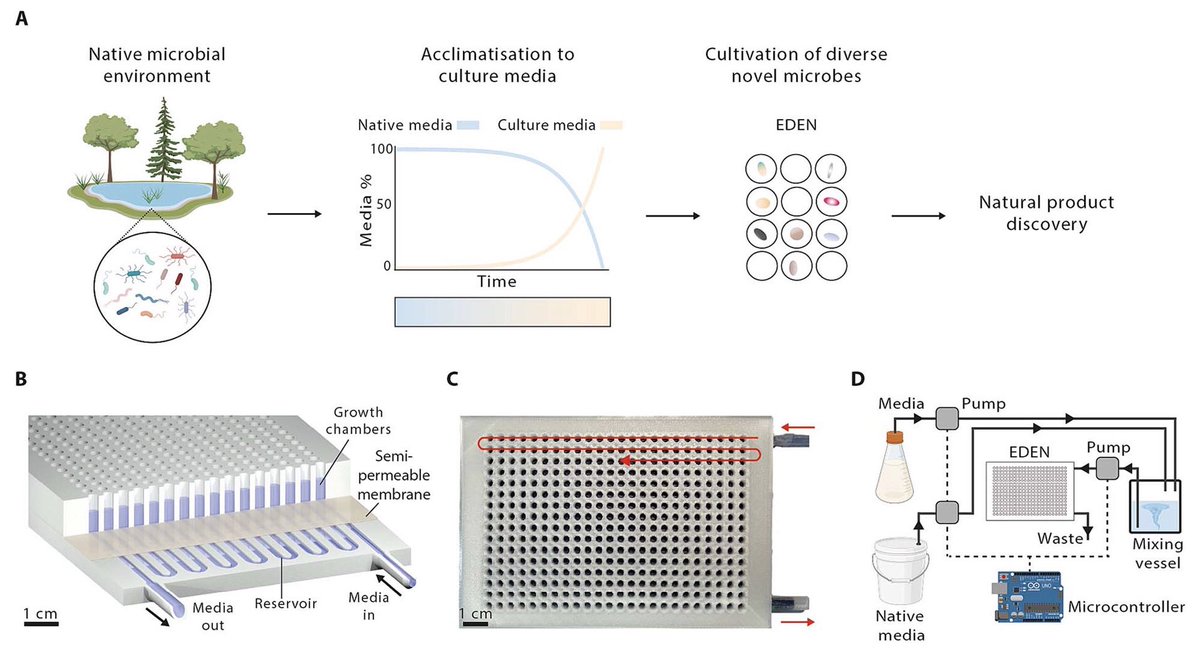
Most bacteria remain uncultured and don’t grow in the lab.. to address this am excited to share EDEN - an enhanced domestication method to grow uncultured bacteria & new diversity. Using EDEN we isolate a new species active against MDR pathogens..
https://t.co/LZ9F4B2aIZ
Microbes as architects of colonic patterning
Highlight of @CellCellPress paper discovering regionalization of colonic epithelium depends on microbes, with proximal identity regulated by microbial nicotinic acid-induced PPARα activation in the epithelium.
https://t.co/AX4sPHgVw0
Engraftment of essential functions through multiple fecal microbiota transplants in chronic antibiotic-resistant pouchitis—a case study using metatranscriptomics https://t.co/Koq3toCadr
In #Microbiome
🚨Uncommon bacteria may be a new source of treatments for drug-resistant infection
🔍Employing enrichment cultivation to access antimicrobial peptides encoded by low-abundance bacteria within a marine biofilm community
👉https://t.co/TGvXqol506
(7/7) If you want to hear about the messy reality and the "Aha!" moments behind the work, read our Behind the Paper story https://t.co/NJjkaHraoR
#Parasitology#RNAbiology
Weekend read: Catalog of human oral microbiome
Human reference oral microbiome (HROM) comprises 72,641 genomes from 3,426 species, including 2,019 novel species. HROM reveals disease-assoc. species & ectopic oral species in gut predictive of disease
https://t.co/c7YXg3hnhz
Meet the ultimate gatekeeper of the nucleus. This molecular machine determines what compounds are welcome inside and which shall not pass. The mechanism behind its selectivity remains a mystery. https://t.co/NOfp9O5Aiu
We’re hiring a PDRA and a research technician!
If you’re passionate about #parasites#genomes#condensates then this project is for you! Help us decode the role of nuclear architecture in gene expression regulation in #Leishmania alongside the Mottram Lab @YBRI_UoY@UniOfYork
I think this paper will become a game-changer for studying the microbiome. Matthew Schmitt and I found that a simple neural network, when trained on paired sequencing and functional data, can infer functional group structure directly from data. Preprint -> https://t.co/5gWEO0eKJC
🧬 A major data reanalysis in December's most-read Genetics paper uncovers thousands of previously hidden protein-coding regions in human and mouse genomes: https://t.co/CiRw4bRmPN