1999 was an everything bubble. Earnings were stretched. So were the multiples investors paid for them.
2026 looks similar on the surface. A new technology is driving a capex and earnings boom. The difference is sentiment. https://t.co/z8IX8L2oVs
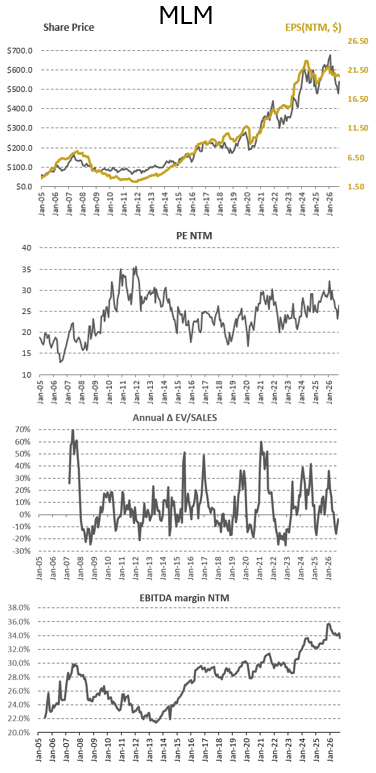
$MLM is a US rate sensitive stock with pricing power.
Resi construction is the third largest segment which account for 22% of aggregates shipped. However, its the most cyclical given its link to the housing cycle.
The price rises over the last few years has resulted in higher EBITDA margins as operating leverage kicks in when sales surge.
A sustained fall in rates will start a housing boom. Combined with price rises $MLM will likely have higher margins in the future.
Billionaire Chris Hohn's hedge fund TCI, which made about $18.9B in gains last year, owns stakes in US aggregates suppliers Vulcan Materials and Martin Marietta
The two firms are among the largest US suppliers of crushed stone, sand and gravel. Their average price per ton has risen every year since 2017, up 68% at Vulcan and 73% at Martin Marietta.
TCI's latest 13F filings value each stake at more than $700M.
Falling interest rates will certainly benefit rate sensitive stocks.
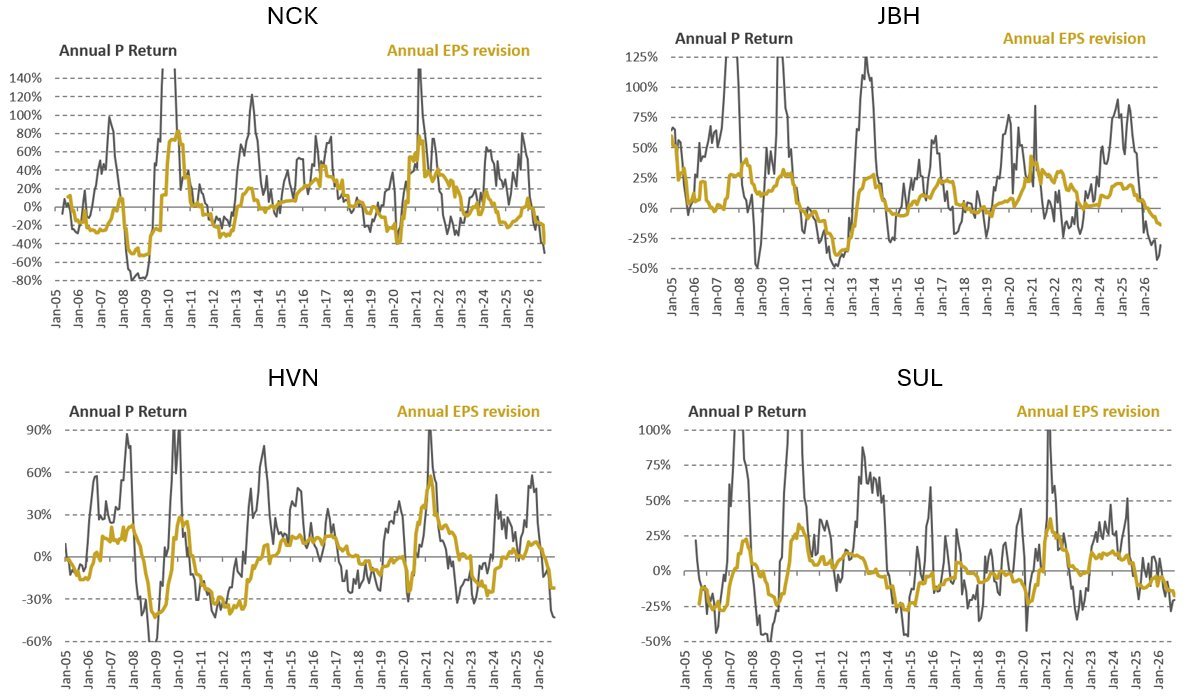
They range from low beta plays such as REITs/infrastructure (with less earnings risk) to higher beta plays such as retailers/homebuilders (with more earnings risk).
Falling rates help sentiment, but earnings will be the anchor. Given their recent price falls and if retailers stop downgrading the foundation is set for a huge rally in a falling interest rate environment (PE expansion with the eventual positive EPS revision).
The million dollar question is the duration and depth of the economic slowdown before the RBA cut rates. The RBA has most likely paused their rate hikes given last week's spike in unemployment rate. But if there is a long period to cut rates there could be more earnings downgrades to come.
$NCK $JBH $HVN $SUL
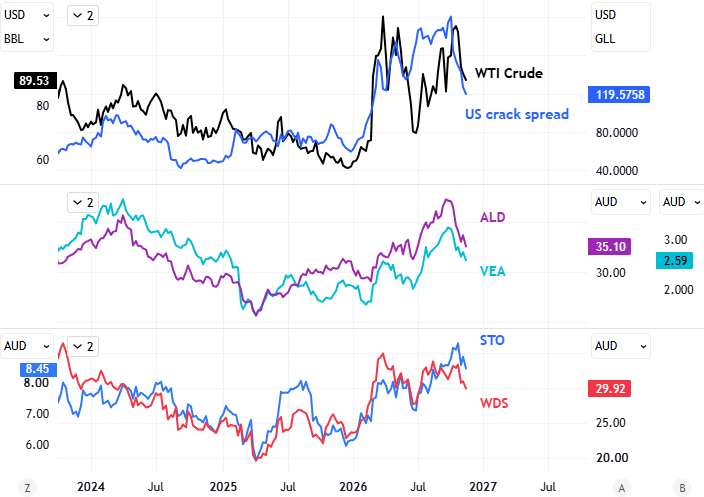
Geopolitical oil shocks are temporary. The Hormuz crisis is no different.
Crude flows are making its way through the Strait. Crude and refining margins are both falling as the geopolitical premium fades.
That's a headwind for the stocks that rallied on the shock: refiners $ALD.AX and $VEA.AX, and producers $WDS.AX and $STO.AX
Lower fuel prices should pull headline inflation down over the coming months, though a weaker AUD will offset part of it.
#ausbiz #oilprice #Hormuz
@trade4a_livin@bowtiedstocks US markets don't trade over the weekend, so the next best proxy for sentiment is bitcoin:native.
bitcoin:native like the Nasdaq was in freefall on Friday, but has stabilised over the weekend.
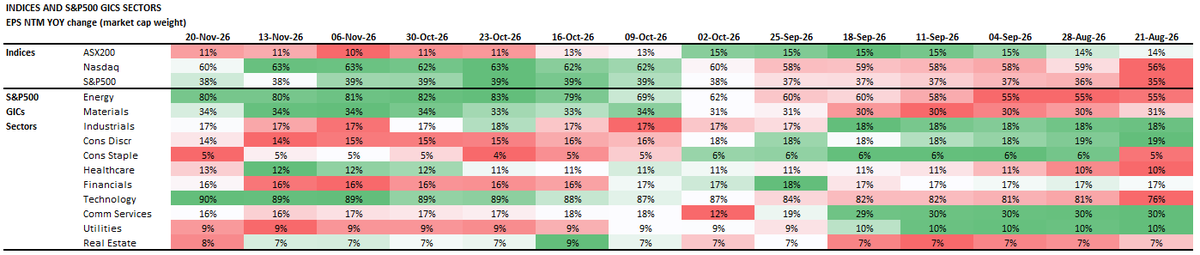
INDICES AND S&P500 GICS SECTORS
EPS NTM YOY change (market cap weight)
The S&P500 and Nasdaq earnings growth has decelerated slightly from its 23 October 2026 peak. However, the S&P500 Technology sector has exhibited no deceleration
#macro $SPY $QQQ
Elon is a canary (with a loud voice) in the coal mine.
Credit will fall further in value if Elon's predition becomes true next year. The AI wobbles will create a huge headache for the private credit industry.
If you thought private credit had it tough this year, it could get worse next year.
$MOT.AX $MRE.AX $MXT.AX #privatecredit #ausbiz
Getting this amount of compute turned on, cooled and working reliably is incredibly hard.
The cash shortage is also going to be nuts next year. Even cumulative industry delays of a few months between paying for compute and getting it reliable enough to generate revenue will mean hundreds of billions of incremental dollars just for working capital. Where will that come from?
The surge in grid-scale battery installations has led to Australia being ranked as the third-largest utility-scale battery market in the world behind China and the United States.
At 7pm 21 Nov 2026, grid-scale batteries represented 17% of electricition generation. Its share will likely more than double in the next couple of years as there is 30 GWh under construction versus current energy storage capacity ~23 GWh.
In the US, $LLY looks interesting after its bubble valuation popped from 2024. Fundamentals remain strong with strong sales combined with operating leverage.
In Australia, $CSL.AX is not priced like a turnaround anymore. Nothing wrong with the IG industry, but competition has eaten its share of pie. If competition backs off, then profits should rebound - this is a harder call.
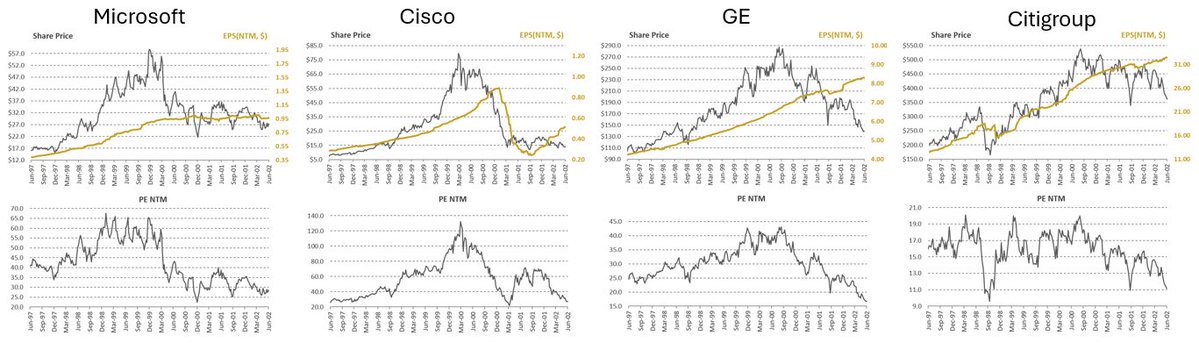
The Nasdaq peaked in March 2000 at the height of the TMT boom. As the bust was unfloding there was significant market rotation:
$MSFT peaked in Dec 1999
$CSCO peaked in Mar 2000
$GE and $C peaked in Sep 2000
First stage: market rotated out of tech leaders (e.g. $MSFT, $CSCO) as their extreme PEs unwound. Capital then flowed to non-tech stocks (e.g. $GE and $C)
Second stage: entire market could not escape economic gravity as it became clear that the economy was slowing from late 2000. US entered into a recession in March 2001 and the Nasdaq bottomed in Sep 2002.
In the current AI boom, we are in the first stage of the market rotating out of AI related stocks into non-tech stocks. It has not entered the second stage as there's little sign of slowing economic growth in the US yet.
@ryu_tay Flow will hit the riskiest stocks first, which are typically small caps or stocks with earnings risk. The next stage of flow will then hit more defensive stocks as they become funding sources for redemptions and/or beaten down stocks. We are not at the second stage yet.
If there is a cash crunch the cost of credit is going to soar.
Hyperscalers are fine but neoclouds could go bust. If this occured it will have flow on effects to the private credit industry. There could be a lot of private credit funds gated next year from client redemptions. Equities will likely be impacted as well as the risk premium on stocks increase.
High yield credit spreads have begun to rise and showing signs of stress already.
#macro #private #credit #SPY $ausbiz
JUST IN: Elon Musk warns the AI industry could face a massive cash shortage next year, potentially requiring hundreds of billions of dollars in additional financing.
Market rotation and the 2000 TMT boom/bust
Nasdaq bubble burst from March 2000, but the market rotation away from tech stocks kept the S&P500 elevated. S&P500 traded sideways for another 6 months and began its market correction from September 2000.
$SPY $QQQ
The Nasdaq peaked in March 2000 at the height of the TMT boom. As the bust was unfloding there was significant market rotation:
$MSFT peaked in Dec 1999
$CSCO peaked in Mar 2000
$GE and $C peaked in Sep 2000
First stage: market rotated out of tech leaders (e.g. $MSFT, $CSCO) as their extreme PEs unwound. Capital then flowed to non-tech stocks (e.g. $GE and $C)
Second stage: entire market could not escape economic gravity as it became clear that the economy was slowing from late 2000. US entered into a recession in March 2001 and the Nasdaq bottomed in Sep 2002.
In the current AI boom, we are in the first stage of the market rotating out of AI related stocks into non-tech stocks. It has not entered the second stage as there's little sign of slowing economic growth in the US yet.
Attacking probabilistic forecasts by saying “the model said 20% and it happened, so it was unfalsifiable,” is doing what @AnnieDuke calls 'resulting'.
Resulting is judging a decision or forecast by the outcome that occurred, while ignoring the probabilities that were assigned and the quality of the reasoning process at the time.
You cannot properly evaluate decisions or forecasts this way. A good process with a bad outcome is still a good process; a bad process with a good outcome is still a bad process. A 20% forecast is not refuted just because the 20% event happens. The outcome is being treated as proof the reasoning was wrong.
Ganz correctly notes that individual probability estimates cannot be strictly falsified by a single outcome. Treating that limitation as a fatal flaw in the whole approach, however, is itself a form of resulting. It prioritises one realised outcome over the quality of the process and how well the model performs across many forecasts.
They aren't falsifiable. If you make a good prediction you say, "Yep our model is right," if not, you say, "Well we did say it had 20 percent or so chance." That's the definition of being unfalsifiable. What would falsify the entire model?