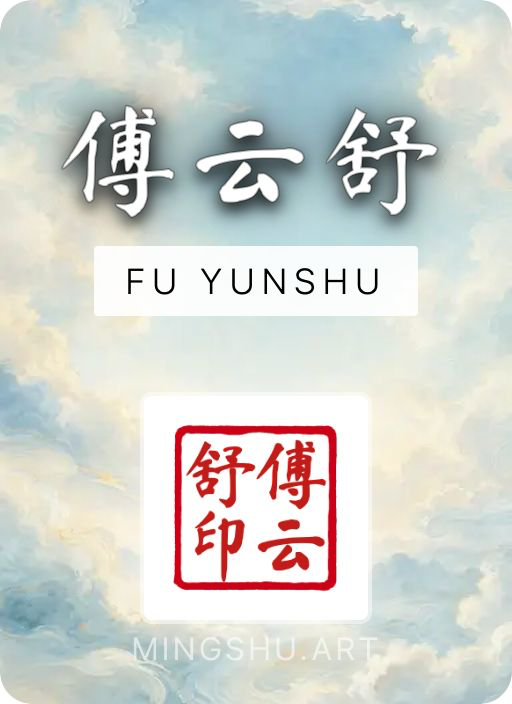
A Chinese name can hold a whole sky.
傅云舒 — Fù Yúnshū
云 is “cloud”; 舒 is “to unfold.” Together, Yúnshū evokes clouds slowly opening across the sky: spacious, composed, and free.
MingShu sample identity, completed with its own seal.
Create yours: https://t.co/YXD1vzr5Of
Worth slowing down in the calligraphy and painting galleries and reading the red seals along the edges — on Jiangnan scrolls those are usually collector marks added over centuries, not the artist's. The signature line at the end is the artist's; the crowd of stamps around it is the ownership history.
赞比亚 is a nice example of how country names get transliterated — the characters are picked mostly for sound, but 赞 (praise) and 亚 are deliberately chosen over homophone characters with sour meanings. Same instinct applies when someone picks a Chinese personal name: sound first, then check what the characters actually say.
Agreed. Chinese given names usually carry their meaning in the characters themselves, so a swapped English name drops the whole layer — you lose the pun, the allusion, and often the foreshadowing the writers built in. Keeping the name and glossing it once in-game costs almost nothing.
Congratulations! One practical thing: ask your husband's family what the generational character is, if their line still keeps one — many families have a fixed middle character per generation, and using it makes the name land immediately with relatives. Then you only need to choose the last character.
The dialect mismatch is the giveaway — a Cantonese romanized surname like Ng or Lau next to a Mandarin pinyin given name reads instantly as two different systems stapled together. Even within Mandarin, most real given names pair characters that balance in tone and stroke weight, not just meaning.
@eric_yuehanxun@W_T_Han The difference may be phonology rather than Confucianism. Korean and Japanese can render a foreign name in hangul or katakana and have it still function as a name; Mandarin has to spend real characters that carry meaning, so the borrowed name never sits quietly.
@W_T_Han There's a mechanical reason too: Chinese can't absorb a foreign name gracefully. Transliteration eats three or four characters and still reads as noise, so a separate name per script beats one name spelled differently — which is what Europeans do with Johann/John.
@BorahaeArts@WrightJuwe A Korean-script seal is a nice thing to already own — hangul in a seal square is genuinely harder to compose than 漢字, since the blocks don't fill the field the same way. Worth checking whether yours was cut 陽 (red characters) or 陰; the two read very differently on paper.
@WrightJuwe@BorahaeArts Seal-carving classes live or die on the instructor, because the hard part isn't the knife — it's laying out characters inside a square so the white space carries weight. A good teacher makes you draw the 印稿 in reverse before you ever touch stone.
@DullClayCutter Raking light is the closest thing to a proof before you ink. The other trick from that same logic: 印泥 fills the low ground unevenly, so a stroke that looks clean under raking light can still print thin if the shoulder of the cut is sloped rather than vertical.
@JakabfiK@W_T_Han 康明智 is a better job than most university-assigned names get — 康 is a real surname that echoes Károly's K, and 明智 reads as an adult's name rather than a textbook label. Most classroom names fail exactly there: they're phonetic and no Chinese parent would have chosen them.
The 小名 doing the daily work while the 大名 sits on documents is exactly how 字 used to function — the formal name was almost never spoken aloud by family. So it isn't that the tradition was lost, just that the layer that survived is the intimate one instead of the scholarly one.
The Pinyin problem is real and it's usually not the characters' fault — Singaporean romanization often froze a dialect reading, so a name that's dignified in 汉字 comes out clunky in Latin letters. Keeping the characters and letting the spelling be the compromise is the right way round.
A Chinese painting without a seal looks unfinished.
The brushwork can be perfect. The composition can be quiet and complete. But the inscription and the red marks are not decoration. They are the artist putting a name on the work — the last sentence, not a sticker.
Same painting. One version unsigned. One version inscribed and sealed. You can see the difference before you can explain it.
That is what a personal seal is for. Not a logo. A name you can press.
The next step is to give a confirmed name a form you can actually carry.
MingShu’s Seal Maker lets you preview 1–4 Han characters as a personal seal for profiles, artwork, stationery, and creative projects.
Preview: https://t.co/k6zwlZ8nBh
“Chinamaxxing” is the internet’s playful name for going deep on Chinese everyday culture: food, travel, dramas, language, wellness, and the small routines that make a place feel real.
But a meme is only the beginning. 🧵
#Chinamaxxing#ChineseName
A Chinese name should be more than a translation-app result.
Choose characters you can explain. Check the sound and the full-name meaning. Confirm Simplified or Traditional form. Then keep the name consistent wherever you use it.
@gengargeous Register is the hardest part of a Chinese name — 华安 is perfectly fine on paper but carries an older, film-reference feel to mainland ears. When one character is locked by the family, the usual fix is swapping the second character to move the tone, not touching the surname.