If you're a 7-8 figure ecom founder, your time is easily worth $500-$1,000/hour.
The founders who break past 8 figures aren't the ones working the most hours. They're the ones who ruthlessly protect where their hours are spent.
@adriantheboz Agree with each of these. Would only add that it's important to keep track each of these per monthly cohort, to get CAC and first-order ROAS targets in place
Most businesses pay invoices too early.
When you know exactly when each supplier invoice is due, you can pay right up to the due date instead of early.
This frees up operational cash without needing to renegotiate any terms.
You can hit your ROAS target and still lose money.
If your contribution margin doesn't cover fixed costs, the ROAS number doesn't matter. Track CM vs. fixed costs, not a ROAS target in isolation.
"Record revenue month" and "profitable month" are not always the same.
A large inflow of new customers can spike top-line revenue, while margins decline.
More customers means more shipping charges, more paid ads, more disputes and refunds.
If you only look at revenue it's easy to lose sight of what's downstream.
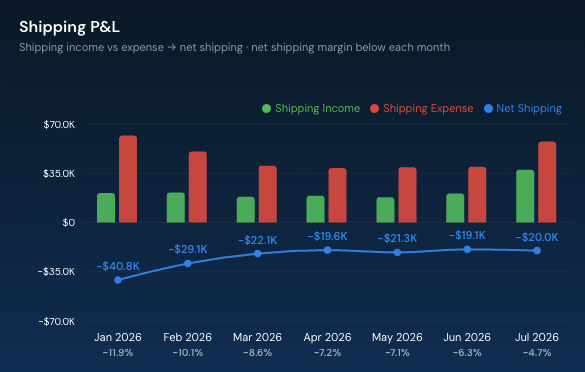
A brand was losing 10-12% of revenue on shipping.
All we did was raise the free-shipping threshold from $40 to $60.
Shipping % of revenue dropped to 4-5%.
The best thing is that conversion didn't move at all.
No shipping partner negotiations, no price increases, just a minor policy change.
I'm ruthless about cutting subscription costs.
My favorite habit: cancel a subscription on purpose, then resubscribe when the "we miss you" discount email lands.
Costs a few minutes. I've seen founders save thousands a year just doing this.
How do you minimize software spend?
Most ecom founders ignore sales tax until it's too late.
Had a client who scaled fast, hit economic nexus in 42 states, and received a tax notice from Australia.
Sales tax isn't optional past a certain revenue point.
If you're doing >$100k a year across multiple states, worth checking your nexus exposure now.
@IstvanicMarin Agreed it's not a failure in dollar terms. But the number I'd want to see is the incremental margin: $25K / $500K new revenue = 5%.
That's a substantial drop in profitability. After another 500k and their margin would be just 8.3%, tighter than what i'd like to see.
@CarlWeische RPV is useful, but contribution margin per visitor is the real number.
CM/visitor shows what the visitor is actually worth after COGS, shipping, refunds and fees
Having options in Ecom is underrated.
See brands all the time all-in on 1 ad platform, 1 supplier, no back-up plan at all.
Then one algorithm update or vendor issue and the whole business is in crisis.
Diversify when things are going good, not when it's too late.
@FedotOff90 Acquired customers you can't retain is really just 100% churn. One meta CPC hike, or ads underperforming and the whole business falls apart.
Meta's Q2 Earnings Release explains why your CAC will always keep rising.
Cuz they had another record quarter with $61 billion in revenue.
But what's important for you is that 97.6% of that comes from Advertising Revenue (= Ad impressions x Price per Impression).
Which is why it's crazy to see that they earned more in Q2 than they did in Q4 last year ($60.8B vs $59.9B).
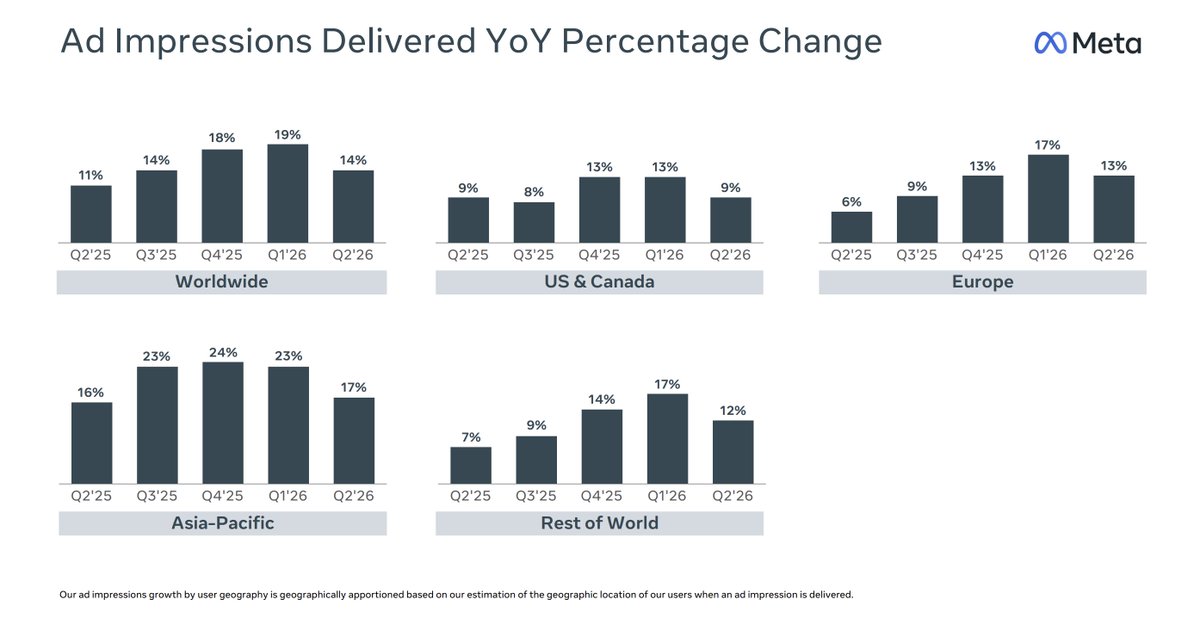
Especially as Total Impressions only grew by 9% yoy in Q2 vs 13% in Q4 in the US & Canada.
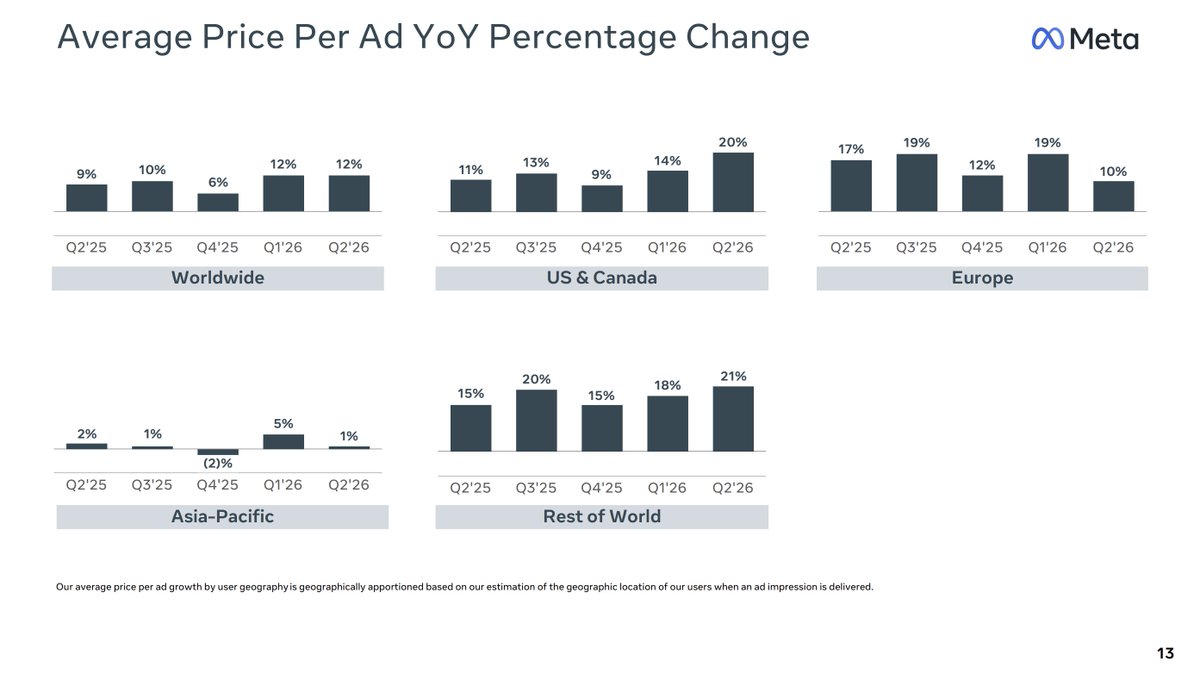
Reason is simple: Average Price per Ad has been going up HARD.
They increased price per ad by 20%(!) yoy in Q2 in the US, record increase by far. Price only increased by 9% yoy in Q4.
So there's like this constant and rising inflation on your impressions.
Meta will always keep pushing the price per ad as much as they can.
Which is why your CAC will keep rising by default.
Your only answer to this is to:
• Keep increasing your prices where you can
• Keep negotiation your COGS and keep OPEX as low as you can
• Keep working on you retention and reorder rate
Only good thing is that all your competitors also pay more per ad.
Got to outcompete them on your financials.
@ecom_rickx Exactly why a 13-week cash flow forecast beats a bank balance check every time. Map payout timing against supplier due dates and you'll see exactly how aggressively you can scale without going in the red.
@nicktheriot_ Under $50 AOV isn't automatically dead, it's dead without a repeat mechanism behind it. The real question is CAC payback, how long it takes for the product to pay back it's CAC. This tells you whether AOV is health and whether it's a product worth selling.
High refund rate and none of your other margins matter, I see founders all the time trying to optimize their ROAS, or their contribution margin, when fixing their refund rate is the single biggest lever. You've already paid to acquire and fulfill that customer. A refund just burns these costs.
Ecom founders are scaling based on the wrong metrics.
Most 7-figure Ecom founders know their LTV by heart. On paper, it usually looks healthy.
Here's an example of what that usually looks like:
Lifetime LTV: $171 (the number Shopify tells you)
Blended CAC: $56
First order value: $42
6 month LTV: $91
LTV to CAC looks great. Almost 3.1x. Your marketing agency would say that's a green light to scale.
But look closer. First order value is $42 against a CAC of $56. You're losing $14 the moment someone buys. 6 months later, you're up $35...
... but that's before product cost, fees, and fulfillment costs.
LTV alone doesn't tell you if a customer is profitable. You need to know how much of that revenue you actually keep, and how long it takes you to breakeven on every new customer you acquire.
The result? The ratio says scale. The bank account says something else entirely.
Here's the 5 things I look at before ever increasing ad-spend:
1. CAC vs first order value. If you lose money on every first order, we must be clear on how many new customers we can afford to acquire per month.
2. Contribution margin by SKU. Usually 2-3 products are carrying the whole business and 2-3 are quietly killing it.
3. LTV at 90 days, not 12 months. You can't wait a year to find out if a customer was worth acquiring. You need the early read.
4. Repeat rate by channel. Some channels look great on the surface but are unprofitable once you dig deeper.
5. Cash conversion cycle. How many days sit between paying for inventory and that cash actually landing back in your account.
Most founders at this stage don't have insight into a single one of these.
Not carelessness, just that nobody has the bandwidth to track all five and run a business as the same time.
The data exists. It's just never been presented in the right order.