बहुत लोगों को आरक्षण हटाओ नाम से समस्या है। इसे अव्यावहारिक और मूर्खतापूर्ण भी कहा गया। लेकिन किसी भी आंदोलन की शुरुआत बड़े लक्ष्य से होती है। हमारा उद्देश्य तत्काल आरक्षण समाप्त करना नहीं, बल्कि वर्तमान स्वरूप की आरक्षण व्यवस्था पर राष्ट्रीय चर्चा शुरू करना है।
मैं स्वयं कई बार कह चुका हूँ कि मौजूदा परिस्थितियों में आरक्षण हटाना संभव नहीं है। फिर भी इस आंदोलन का समर्थन इसलिए है कि जब तक समाज इस विषय पर खुलकर बात नहीं करेगा, तब तक कोई राजनीतिक दल भी इसे मुद्दा नहीं बनाएगा। यदि लाखों लोग अपने परिवार और समाज में इस पर चर्चा शुरू करें, तो संसद और विधानसभाओं तक भी यह विषय पहुँच सकता है।
पहला कदम यही है कि आँकड़ों और तथ्यों पर चर्चा हो। क्या आरक्षण का सबसे बड़ा लाभ कुछ ही प्रभावशाली जातियों तक सीमित रह गया है? पिछले 70 वर्षों में वास्तविक लाभ किसे मिला? जिन समुदायों की सामाजिक-आर्थिक स्थिति बदल चुकी है, उनकी समीक्षा क्यों नहीं होती? इन प्रश्नों पर बात होना आवश्यक है।
यदि “आरक्षण हटाओ” शब्द से आपत्ति है, तो इसे “Reservation Reforms” या “वर्तमान स्वरूप की आरक्षण व्यवस्था में सुधार” भी कहा जा सकता है। हमारा उद्देश्य व्यवस्था की समीक्षा और सुधार है।
इसी तरह जाति हटाओ का अर्थ यह नहीं कि जाति एक दिन में समाप्त हो जाएगी। लेकिन जातिवाद पर चर्चा तो होनी ही चाहिए। अपनी पहचान पर गर्व अलग बात है, लेकिन उसी के आधार पर दूसरों को हीन समझना जातिवाद है।
EWS को पूर्ण समाधान नहीं माना जा सकता। यदि आर्थिक रूप से कमजोर छात्र को पढ़ाई के लिए कर्ज लेना पड़े और वर्षों तक उसे चुकाना पड़े, तो व्यवस्था की प्रभावशीलता पर सवाल उठना स्वाभाविक है।
हमारा मत है कि प्राथमिक शिक्षा तक वंचित वर्गों को पूरा सहयोग मिले। लेकिन उच्च शिक्षा और प्रतिस्पर्धी चयन की व्यवस्था में वर्तमान आरक्षण मॉडल की समीक्षा होनी चाहिए। यदि सहायता दी जाए, तो उसका आधार वास्तविक आर्थिक और सामाजिक वंचना हो, न कि केवल जाति।
Default on farm loan, State will waive it. Burn rice stubble, State will ignore it. Steal electricity, State will subsidise it. Attack police, State will allow it. Eke an honest salary, State will tax it.
State will reward defaulters, polluters, and rioters, not honest citizens.
एक बेईमान नेता हटेगा दूसरा बेईमान उसकी जगह आएगा, एक बेईमान पार्टी हटेगी दूसरी बेईमान पार्टी उसकी जगह आएगी, एक का हटना दूसरे का आना कोई हल है ही नहीं,
●जहां भाजपा सरकार है वहाँ विपक्षी पार्टियां लोकतंत्र की दुहाई देते हुए छाती पीटती हैं,
●जहां विपक्षी पार्टियों की सरकार है वहाँ भाजपा लोकतंत्र की दुहाई देते हुए छाती पीटती हैं,
ऐसा एक राज्य बताइये जहां बेरोजगारी, महंगाई और पेपर लीक जैसी समस्याएं नहीं हैं? ऐसा राज्य बताइये जहां स्वास्थ्य और शिक्षा व्यवस्थायें दुरुस्त हैं? राज्यों को आपस में कमपेयर करने पर आपको कुछ बेहतर उदाहरण मिल सकते हैं लेकिन जैसे ही आप उनको चीन, अमेरिका और यूरोपीय देशों से तुलना करेंगे आप शत प्रतिशत निराश होंगे,
जो पार्टी सत्ता में आती है दमनकारी नीतियां अपनाती है, किस पार्टी में अनपढ़, गुंडे, माफिया, अपराधी नहीं भरे हुए हैं? किस पार्टी में भाई भतीजा वाद नहीं है? किस पार्टी ने भ्रष्टाचार की नई परिभाषाएं नहीं लिखी हैं?
इन सभी का हल सिस्टम को ट्रांसपैरेंट और अकाउंटेबल बना कर होगा, जब तक सिस्टम के मूलभूत ढांचों में सिस्टेमिक बदलाव नहीं होंगे तब तक भ्रष्टाचार जैसी समस्याओं से हमें निजात मिलना असंभव है,
•सिस्टम में समस्याओं के टेक बेस्ड हल,
•पॉवरफुल ट्रांसपैरेरेंसी टूल्स का निर्माण और एग्जिस्टिंग टूल्स को मजबूत करना
•नीचे से ऊपर तक की जवाबदेही फिक्स करने के रिफॉर्म
•स्ट्रॉन्ग, ट्रांसपेरेंट , इफेक्टिव , एक्सेसिबल और अफोर्डेबल ग्रीवैंस रीड्रेसल मैकेनिज्म
•कम्यूनिटी पार्टीसीपेशन ,
•जूडिशल रिफॉर्म
•पुलिस रिफॉर्म
•स्टॉप क्रिमिनलाईजेशन ऑफ पालिटिक्स
•स्ट्रॉन्ग विशिलब्लोअर कानून
•नौकरशाही और प्रशासनिक सेटअप में बदलाव
देश में आंदोलन होते रहे हैं और होते रहेंगे, लेकिन हर एक आंदोलन का लक्ष्य सत्ता परिवर्तन होता है, हमारे सामने हमारे देश के ही कई राष्ट्रीय और राज्य स्तरीय उदाहरण हैं, उसके बाद क्या बदलाव आए?
आंदोलन तब प्रभावशाली और ऑर्गेनिक होता है जब उसका नेतृत्व समझदार , लक्ष्य पर केंद्रित, अन्य पोलिटिकल पार्टीज से स्टेज साझा न करना, बेवकूफ़ी भरे नारों से दूरी बनाना और आगे की रणनीति समझदारी से बनाने पर होता है,
देश में आंदोलन आगे भी होते रहेंगे, लेकिन जब तक हम मूलभूत ढांचों के बदलावों पर चर्चा नहीं करेंगे तब तक देश में कोई भी बदलाव सम्भव नहीं है
चूँकि मेरे दिए गए समाधान न तो जनवरी में माने गए, न फ़रवरी में (नीचे कमेंट में), और आज पुनः हम उसी मोड़ पर हैं जहाँ भाँग खाने वाले सलाहकारों और पे-रोल पर पलने वाले चापलूस 'कीप काम एंड ट्रस्ट मोदी' का जाप कर रहे हैं, मैं फिर भी पतितों की तरह कुछ समाधान बिंदु लिख रहा हूँ।
यह मैं इसलिए नहीं करता कि कोई इसे पढ़ कर अपनी अंतरात्मा जगा लेगा या सरकार मेरी बात मान लेगी, ये मैं केवल डॉक्यूमेंटेशन के लिए लिखता हूँ कि मैं केवल समस्या बताने वालों में से नहीं था, बल्कि मैं समाधान भी दे रहा था।
1. PM को सामने आ कर विद्यार्थियों, उनके परिजनों से सीधे बात करनी चाहिए। वहाँ स्वीकारिए कि यह समस्या है और सरकार उसे अभी तक केवल आंशिक रूप से सही कर पायी है, वृहद समाधान में समय लगेगा, और आप तत्परता से उस पर कार्य कर रहे हैं। क्या कर रहे हैं, उसकी एक झलक भी दिखाएँ/बताएँ।
2. अब धर्मेंद्र प्रधान को हटाना उचित नहीं लगता क्योंकि यदि अभी ऐसा होता है तो 'जो सबसे लंबा अनशन करेगा, उसके हिसाब से मंत्री हटाए जाएँगे' की एक परिपाटी बनेगी। वो हटे, पर अभी तो बिल्कुल नहीं। बात यह नहीं है कि कॉकरोच की डिमांड क्या है, बात यह है कि 28 करोड़ लोगों के द्वारा चुनी सरकार को अराजकतावादियों के हिसाब से मंत्री नहीं बदलना चाहिए। समर्थकों के कहने पर नहीं हटाया तो इन पर तो बिल्कुल नहीं।
3. चाहे NEET हो, SSC हो या अन्य परीक्षा, इसे ऑब्जेक्टिव तक ही सीमित ना रख कर इसका एक-दो चरण ऐसा हो कि केवल MCQ ही उनका भविष्य तय ना करे। बोर्ड तक उसकी सतत समझ की क्षमता के साथ साक्षात्कार आदि को भी डाला जाए या IIT की तरह उसे भी बड़ा बनाया जाए। यदि यह संभव ना हो तो आप IIT या UPSC से सीखें कि उनकी परीक्षा के प्रश्न लीक क्यों नहीं होते।
4. हर कोचिंग संस्थान, विद्यालयों और महाविद्यालयों में विद्यार्थियों के मानसिक स्वास्थ्य का ध्यान रखने के लिए मनोवैज्ञानिक परामर्शदाता की नियुक्ति अनिवार्य की जाए ताकि हर 40 मिनट में एक विद्यार्थी आत्महत्या ना करते रहें।
5. हर विभाग का परीक्षा कैलेंडर (हर चरण का दिन पूर्व निर्धारित) हर वर्ष निकले और परीक्षा केंद्र छात्रों की सहजता के हिसाब से हो ना कि रैंडम। अभी ऐसी स्थिति है कि सेंटर अनावश्यक रूप से 4-500 किलोमीटर दूर तक दे दिए जाते हैं। इसका कोई तर्क नहीं होता।
6. पेपर लीक से जुड़ी फर्म ही नहीं, उनसे जुड़े व्यक्ति और उनके परिजन तक ब्लैकलिस्टेड होने चाहिए कि ये लोग इसी व्यवसाय में पुनः कहीं से भी नहीं आ सकते। यदि कोई सरकारी व्यक्ति पैसा खा कर ऐसा कुछ भी करता है, उन्हें कोई टेंडर आदि दे देता है तो उस पर देशद्रोह का केस चले और न्यूनतम 20 वर्ष का दंड हो।
7. ऐसे अपराध से जो जुड़े हों, उन्हें शिक्षा मंत्रालय का अपना ट्रिब्यूनल हैंडल करे और ऐसी सुनवाई 'इन कैमरा' होने के स्थान पर 'ऑन कैमरा' सार्वजनिक रूप से हो। इसे एक तय समयसीमा में निपटाने की बाध्यता हो। यदि यह सार्वजनिक नहीं होता तो फिर से हर चीज मैनेज हो जाएगी और इसका कोई महत्व नहीं रहेगा।
8. इस नौटंकी आंदोलन में जो भी हैं, एक-एक को चिह्नित कर, उनका उदाहरण बनाया जाए। हाँ, कुछ वास्तविक विद्यार्थी भी होंगे, तो उन्हें काउंसलिंग के साथ छोड़ दिया जाए, परंतु अराजक तत्वों को, यदि वो किसी पार्टी से हैं, 18 वर्ष से ऊपर के हैं, तो उन्हें जेल में डाला जाए, उन्हें जीवन में कोई नौकरी ना मिले यह सुनिश्चित किया जाए और यह हर हिंसक आंदोलनकारी को बताया जाए कि प्रदर्शन का अधिकार है, आगजनी और हिंसा का नहीं।
--
और भी कुछ सुझाव होंगे, परंतु अभी इतना ही। सरकार ऐसा कुछ नहीं करेगी पर 'दिल के ख़ुश रखने को 'ग़ालिब' ये ख़याल अच्छा है' के लिए मैं यह लिख रहा हूँ।
ORBIT ACHIEVED. 🚀
Vikram-1 Test Flight-1 has reached orbit. India's first privately developed orbital rocket has completed its final burn and injected its payloads into a ~450 km orbit, making India the third country in the world with private orbital launch capability.
History is made. 🇮🇳
#Vikram1 #JourneyToOrbit #SkyrootAerospace
To love India, we have to shift our cognitive lens away from the simple, clean eqns of Euclidean Geometry (where everything fits into neat straight lines) & upgrade to the complex eqns of Fractals (where patterns emerge out of infinite, self-repeating chaos).
China built a beautifully engineered machine. India is a self-evolving, organic jungle. A machine is orderly until it breaks; a jungle is chaotic, but it never stops living.
Ancient India's strength was its modular decentralization. The central king (Chakravartin) rarely interfered with the local governance laws (Shreni-Dharma of merchant guilds/Grama-Sabhas of villages). Every community had its own unique operating system.
When Nooyi says "the beauty of India is in its chaos," she is instinctively recognizing that India's survival mechanism for 5000 yrs has been its ability to absorb, metabolize & integrate turbulence, rather than trying to sanitize it through forced, top-down uniformity.
In the Western mindset, "chaos" implies a total lack of structure/failure of a system. But in physics & mathematics, Chaos Theory proves that complex, seemingly random systems actually have deep, underlying patterns & feedback loops that are highly adaptive.
Ancient Indian thought, specifically Sankhya Darshana, formalized this exact reality through the interplay of 2 cosmic entities: Purusha & Prakriti.
China’s model is built on artificial Purusha: absolute, rigid, uniform order. India’s model is rooted in Prakriti: a living, breathing, non-linear ecosystem where 1000s of variables (languages, sub-cultures, independent decentralized units) interact simultaneously.
Prakriti looks chaotic from the outside, but it is highly resilient because a collapse in 1 node does not crash the entire network. Rigidly uniform systems are efficient in the short term, but they suffer from brittleness under unexpected systemic shocks.
Order requires single-variable compliance, whereas India operates on multivariable coexistence.
In ancient Indian epistemology, the Jain school perfected a highly sophisticated logical framework called Anekantavada (the doctrine of non-absolutism/manyness of reality). It states that reality is infinitely complex & has multiple facets (Ananta-dharmatmakam vastu). No single perspective can claim absolute monopoly over the entire system.
A homogenous society (like China) operates like a single-threaded software program. It executes commands seamlessly & cleanly because there are no competing logic loops. India operates like an massive, multi-threaded, open-source asynchronous protocol. It looks messy, it looks confusing & it lacks standard symmetry, but it allows completely contradictory truths, lifestyles & economic layers to occupy the exact same physical space w/o destroying 1 another. 🙏🙏
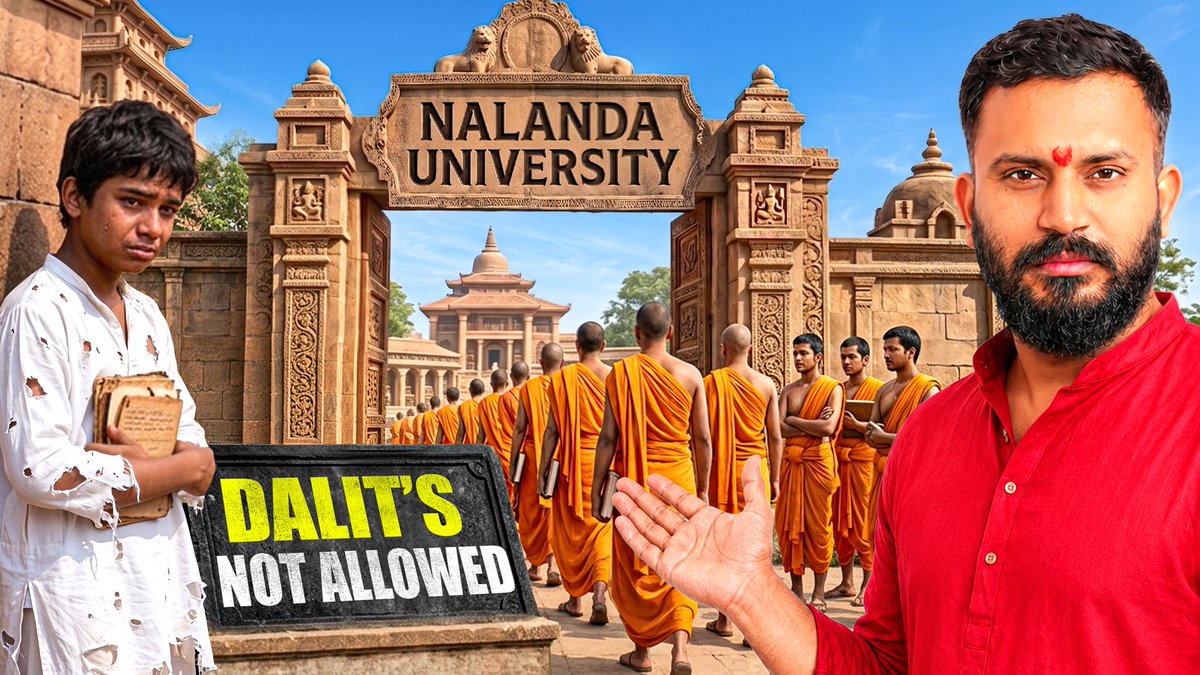
'For 3,000 years, 10% of Brahmins enjoyed a 100% reservation in education. Similarly, Vaishyas monopolised trade and business. Yet no one questioned their monopoly. Now that efforts are being made to create a more equal society, why has everyone suddenly become so restless?' says the so-called Indian educator and author Vikas Divyakirti.
From Dr Bhimrao Ambedkar to Periyar and Jyotirao Phule, all have made similar claims.
The Dossier examined the British East India Company's administrative records, the India Office Records preserved at the British Library in London, reports by British collectors, minutes of government meetings, and survey reports prepared by British officials - all contemporary primary sources.
What we found was intriguing: none of those claims, whether made by Divyakirti, Phule, or others, stood up to scrutiny.
Watch the Full Investigation video Here.
Video Link:- https://t.co/vOp13bCQvQ
1 crore manuscripts documented and mapped as part of the Gyan Bharatam National Survey of Manuscripts!
A landmark achievement in preserving Bharat’s civilisational knowledge heritage, this milestone reflects the strength of Jan Bhagidari in documenting and safeguarding centuries of intellectual, literary, scientific, and cultural traditions for generations to come and for the benefit of the world.
#12YearsOfVikasBhiVirasatBhi #GyanBharatam #GyanBharatamSurvey #CultureUnitesAll
Why do modern paper-leak cartels flourish? Because anyone with money can buy their way into an exam hall, regardless of character/ethical stability.
The ancient system had a rigorous pre-qualification protocol based on Ethical Auditing before a student was even allowed near advanced data. According to the Dharmasutras, education began with the Upanayana ceremony, which was not a religious ritual, but a binding psychological contract. The student had to take a strict, lifelong vow of Satya (Absolute Truth) & Asteya (Non-stealing/Non-cheating).
If a student showed even a minor trace of deceit/plagiarism/intellectual dishonesty during their basic schooling, the Acharya exercised the right of Varjana (expulsion/blacklisting). They were permanently barred from higher education because the ancients believed that giving advanced knowledge to an unethical mind is like putting a sword in the hands of a monkey.
Mainstream historians marvel at how the vast libraries of Vedic knowledge, mathematics, astronomy & grammar survived for 1000s of yrs w/o a single typo/textual corruption, despite massive foreign invasions that burnt physical libraries to ashes. They did it using the ultimate decentralized network architecture:
The Patha System. To prevent anyone from modifying/falsifying/leaking the sacred data, the ancients invented complex mnemonic mathematical algos for oral recitation:
Jata-Patha (जटापाठ)
Shikha-Patha (शिखापाठ)
Gana-Patha (घनपाठ)
In Gana-Patha, the words of a text were memorized & recited back & forth in a strict mathematical sequence (1-2-2-1-1-2-3-3-2-1-1-2-3). If a corrupt scholar tried to insert a fake line/change a word to favor a student, the mathematical grid of the sound frequency would immediately break, acting like a self-triggering software alert. It was the world's 1st biological blockchain.
When Macaulay introduced the English Education Act of 1835, his explicit goal was to destroy this decentralized, character-driven oral evaluation system. The colonial state needed cheap, compliant clerks who could fill out uniform paper registers. They replaced the deep, individual-focused Guru-Shishya assessment with the Mass Written Exam.
- We swapped real-time intelligence for static memory.
- We swapped character filters for competitive paranoia.
We created a centralized single point of failure (the paper vault), which naturally gave birth to the billionaire coaching & paper-leak mafias we see today.
This 4,500-year-old terracotta dice from the Indus-Saraswati Civilization is a powerful reminder of India’s living heritage. Dicing is also mentioned as a popular game in Rig and Atharva Vedas (two of the four sacred Vedic scriptures).
From symbols and craftsmanship to rituals, yogic practices, and collective memory, numerous elements of ancient Indian civilization continue to thrive in the daily social and religious life of Indian society across regions and communities.
Civilizational inheritance is not just about geography or ruins, it is defined by living customs, symbols, rituals, and unbroken cultural consciousness. India is the enduring living continuity of the Indus-Saraswati Civilization.
#IndusSaraswatiCivilization #AncientIndianHeritage
राष्ट्र की स्वतंत्रता हेतु कठोरतम अमानवीय यातनाएं सहकर अपना जीवन मातृभूमि के चरणों में अर्पित करने वाले माँ भारती के अमर सपूत, महान स्वतंत्रता सेनानी ‘स्वातंत्र्यवीर’ विनायक दामोदर सावरकर की जयंती पर सादर नमन।
उनकी क्रांतिकारी चेतना और संघर्षपूर्ण जीवन हमें सदैव राष्ट्रहित में समर्पण, साहस और अटूट संकल्प का अमूल्य संदेश देता रहेगा।
Today, it almost sounds like fiction when we state an obvious truth: that Sardar Vallabhbhai Patel was a Congressman and that he felt no compulsion to display an Yajnopavitam over his shirt.
https://t.co/BR82KmBHjD