Huge thanks to @0xIntuition for joining the Real Talk NFT podcast! We had an insightful discussion with Josh Betchler-Levin about Intuition's decentralized network for unbiased, accessible data, unique identifiers, verifiable data, and a universal knowledge graph. Check out the episode to learn about their innovative tools, protocols, and the future of decentralized data systems. Don't miss it! 🎧
https://t.co/mbmjOVYtov
Two things have happened to the information economy at the same time.
The cost of generating plausible content has fallen to near zero. Any operator with commodity hardware can now produce more text, more images, more analysis than the entire mainstream press produced a decade ago. Most of it is indistinguishable from the work that's actually worth reading.
And the consumers of information are increasingly machines. Agents making trust calls at machine speed, operating on signals they can't verify from reputations they have no way to audit.
The old proxies for signal stopped working at the same moment the demand for signal went vertical.
InfoFi is the response. Information becomes an asset. Curation becomes a market. The act of staking on what's true compounds into a public record of judgment that anyone can query and no operator can manipulate.
Not a nice-to-have. The infrastructure the next decade of AI-assisted work is going to need to function at all.
The Knowledge Graph is live. The economics are real. The question is whether the people whose work depends on trustworthy information are going to participate in the layer that produces it, or keep renting access from platforms whose incentives diverge from theirs.
The @nasdaq tower lit up for a reason. @galaxyoneapp for Business is open to all U.S. small businesses and LLCs!
One platform for cash reserve management, brokerage investments, and digital assets built for your business' modern treasury needs.
Now @zachxbt is getting attacked for exposing scams.
So I just tagged him as "investigative" on Hive Mind.
Real signal. Bot-resistant. Backed by stake.
Built on @0xintuition
@galaxyoneapp GalaxyOne is the best part of the Galaxy ecosystem. Owning the Premium Yield note damn near out performs Galaxy stock. It’s a win win for us boomers. @novogratz says buy puts, I’ll just buy more premium yield and let the interest buy more Galaxy stock
Staking is live on GalaxyOne 🚀
Here's how it works:
- Stake $SOL. Earn up to an estimated 6.50% in variable rewards.
- Enjoy 0% commission through December 31, 2026.*
- Rewards auto-compound while $SOL remains staked.
Powered by @galaxyhq's validator infrastructure.
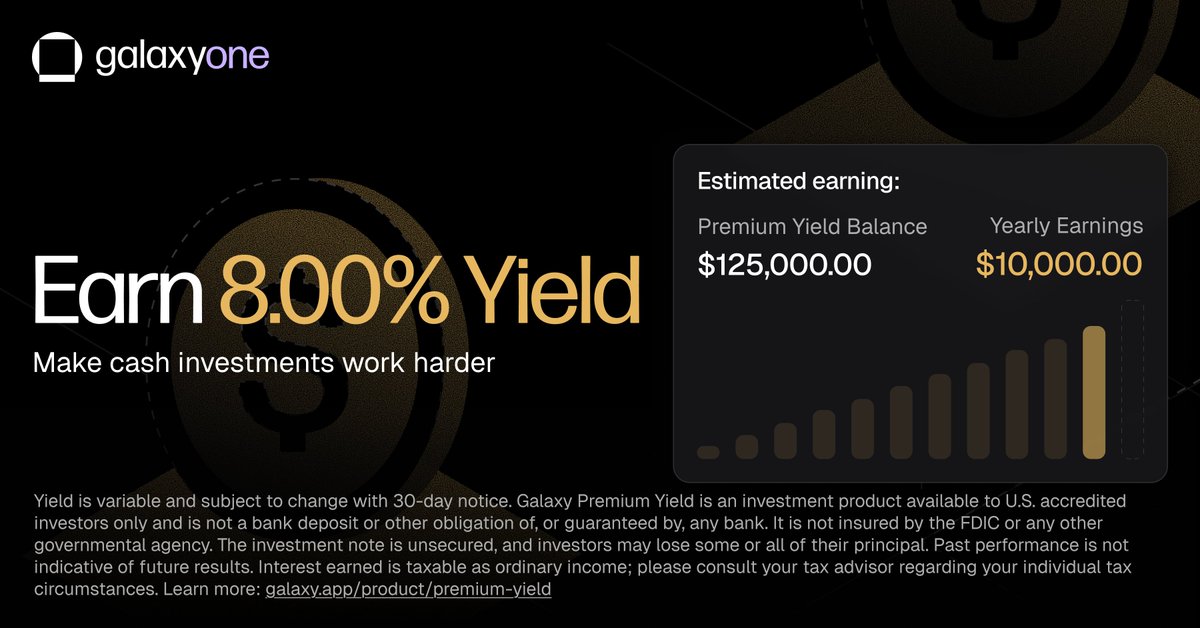
While the Fed may have not cut rates, we lowered the minimum investment required for Galaxy Premium Yield.
Verified accredited investors now only need $10,000 to invest and earn 8.00% yield* on cash investments of up to $1 million.
*Yield subject to change with 30-day notice.
2025 was a defining year for Galaxy.
It reflected conviction not only in markets, but in people, in partnerships, and in the belief that digital assets and AI infrastructure are reshaping global finance.
A look back at the milestones that shaped the year 🧵
Ethereum will undoubtedly be the most valuable blockchain for the foreseeable future.
However, the fundamental question is not whether Ethereum is valuable, but rather how ETH, the asset, accrues value from this.
Last cycle, the common assumption was that ETH would directly accrue value from the success of Ethereum. This is the whole “Ultrasound Money” argument in a nutshell: Ethereum would be so useful that it would burn vast quantities of ETH, giving the asset a clear and mechanically enforced source of value.
Now, I think we can say with considerable confidence that this will not be the case. Ethereum’s fees have plummeted with no recovery in sight, and its largest sources of growth, RWAs and institutions, primarily use USD as the base monetary asset, not ETH.
The value of ETH will now depend on how ETH indirectly accrues value from Ethereum’s success. But indirect accrual is far less certain. It rests on the hope that as Ethereum becomes more systemically important, more users and capital will choose to treat ETH as a store of value.
But unlike direct, mechanical value accrual, there is no guarantee this happens. It relies entirely on social preference and collective belief, which isn’t inherently a flaw (this is, after all, how Bitcoin attains its value). But, it does mean that ETH’s appreciation is no longer tied to Ethereum’s economic activity in a deterministic way.
Whether or not ETH can indirectly accrue value remains an open question, and that uncertainty is the crux of the ETH debate.
What happens when AI decides everything you see? 👀
If discovery is controlled by black-box algorithms, and ads decide your choices, that’s not convenience… it’s dystopia.
Listen to @0xbilly founder of @0xIntuition break down interesting topics and what Intuition is doing👇
It's clear to me that AI is the thing that threw off the typical 4yr credit/business cycle (and thus BTC's cycle presumably)
A completely uncorrelated catalyst, it could have happened any time but it happened at peak bear. It came in and saved the market right at the time where monetary policy/credit cycles normally would have had to start stepping in. The advent of AI, unlike normal business drivers, was not tied in any way to the normal timing of business cycles. It follows that throwing in a completely exogenous massively stimulative event would change the normal cadence of things.
GDP stayed up, earnings stayed up, money poured into US tech, those invested in that tech and the indices containing them made out extremely well and could support the economy all on their own spending. But under the hood, normal people, normal businesses have been deteriorating.
Without AI we likely would have fallen further in 2022 or needed easing sooner. But the huge AI stimulus lifted the indices and GDP so the Fed didn't need to step in, they could keep hiking rates for a bit, they could keep doing QT until now, etc. Everyone expected recession in 2022, perhaps they would have been right if AI capex didn't swoop in to save us at the bottom.
But this "AI stimulus" is not as broad as monetary stimulus. It doesn't give all businesses access to cheap capital like low rates do, we don't see an uptick in most businesses because of this, we don't see the normal business cycle.
The result is monetary/credit/business cycles got pushed back, there has not been reason for reignition of these cycles since overall the state of the economy is being held up by the top earners and the picture remains rosy so long as you look at the average.
But this can only go on so long without those top 10% effects flowing down to the bottom 90%. That 90% needs saving at some point which is why I believe the cycle has just been extended, not avoided entirely. I imagine at some point we'll see more breadth to the market, that AI money hopefully propagating some as AI capex reaches a tipping point, and the middle class businesses getting a boost from stimulus and cheap capital.
As always the tricky part is path dependency/timing. Even if everything I say here works out as expected, when it happens and how bad things get first can vary a lot. Do we transition smoothly right into a new business cycle or does it take a recession to reset us first? Lots of paths can bring us to the one result I've outlined.
Spot trading for Intuition (TRUST) will go live on 5 November 2025. The opening of our TRUST-USD trading pair will begin later today if liquidity conditions are met, in regions where trading is supported.