In his magnum opus Chronicles of Peru (written between 1540 and 1550), the Castilian chronicler Pedro Cieza de León provides information about the populations of the northern division of the Inca Empire—the Chinchaysuyo—who were contemporary with the Incas, rather than about the Moche culture. It is unlikely that he had any knowledge of the Moche, as this culture became extinct around the 8th century AD following its annexation by the Wari Empire. Furthermore, 'Moche' is actually a modern historiographical designation applied to a group of northern lordships sharing a common culture, whose first scientific discovery was made between 1899 and 1901 by the German archaeologist Max Uhle, who named them 'Proto-Chimú.' The term Moche or Mochica was formally coined by Julio C. Tello in reference to the native language Muchik, spoken by the ancient inhabitants of Peru's northern coast; however, we do not actually know what they called themselves.
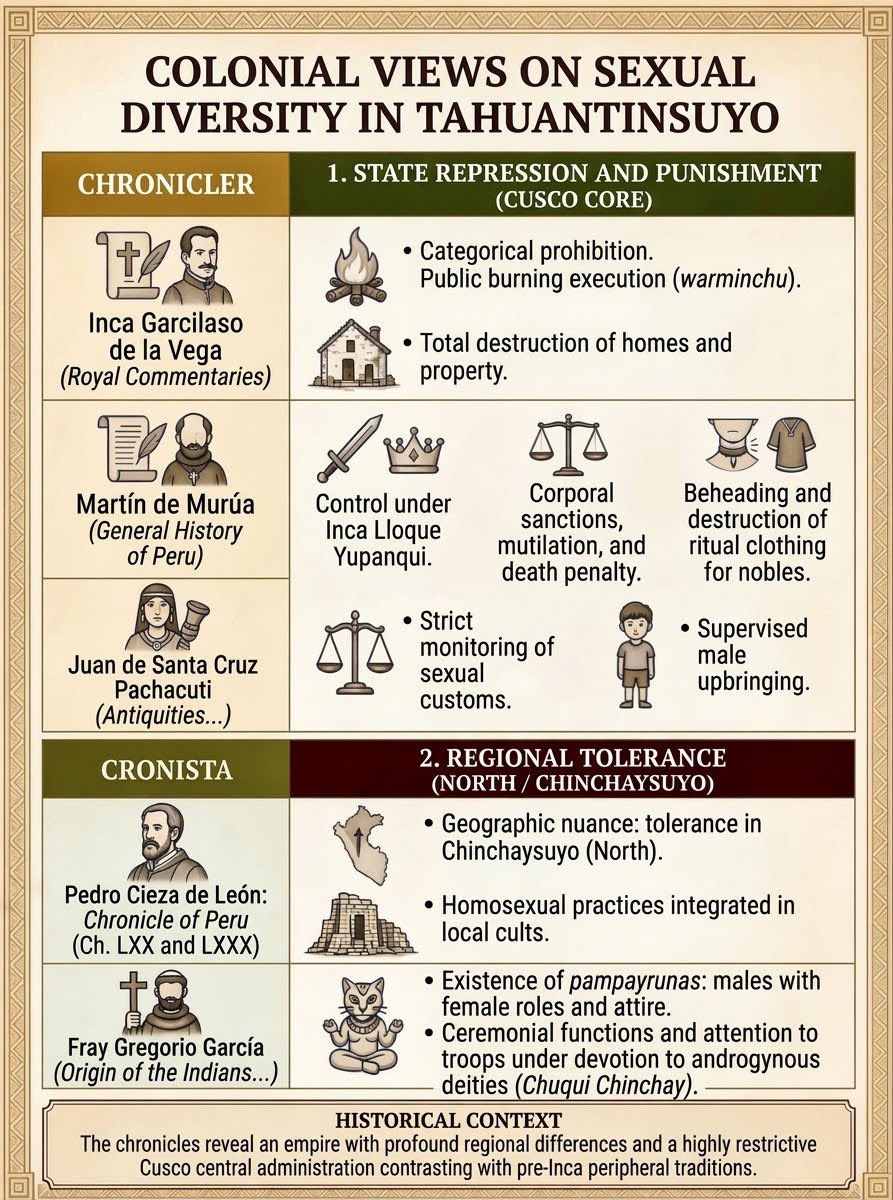
Pedro Cieza de León's work provides data on a form of religious or ritual homosexuality, noting that 'each principal temple or shrine has one, two, or more men, depending on the idol, who walk about dressed as women, and with whom the lords and principal men have carnal union almost as a matter of sanctity and religion.' The description details how, during major religious festivals, only the most illustrious and respected men were allowed to engage in these sexual relations, in a blend of religious observance and social recognition.
However, these isolated references in the chronicles of Pedro Cieza de León and Fray Gregorio García—who recorded specific cases in the far north of the Chinchaysuyo that stood out precisely due to their exceptional nature—should not be extrapolated into a general dynamic for the largest empire in pre-Columbian America, which spanned between 1.7 and 2.5 million square kilometers with an estimated population of 10 to 12 million inhabitants. This narrative systematically omits the testimonies of chroniclers such as Inca Garcilaso de la Vega, Martín de Murúa, and Juan de Santa Cruz Pachacuti, whose works document, on the contrary, that the central government in Cusco actively enforced a severe state-level repression of homosexuality with explicit punitive sanctions.
@GianlucaAL27 Así es toda la responsabilidad en @FlavioBolsonaro, tan igual que aquí con @rlopezaliaga1, experiencia para tropezarse en el último tramo de una campaña presidencial.
Beatificados en Ibiza en una multitudinaria y emotiva ceremonia los 20 sacerdotes mártires asesinados en la Guerra Civil por anarquistas: https://t.co/mh9eyKcJc5
Según Luis Icochea, pueden convertir las calles de tierra de Chiclayo en lodo.
El Congreso debate facultades frente a El Niño. El drenaje no aparece expresamente.
Mi columna en Expreso: https://t.co/JfK6C7BWW0 🧵
Chiclayo tendría drenaje en 2031. Trujillo, en 2035.
Las facultades pueden acelerar la respuesta. No pueden sustituir las obras pendientes.
Cada facultad necesita una meta, un responsable y control público.
¿Quién responderá en enero por lo que no se hizo en octubre?
#ElNiño #GestiónDelRiesgo
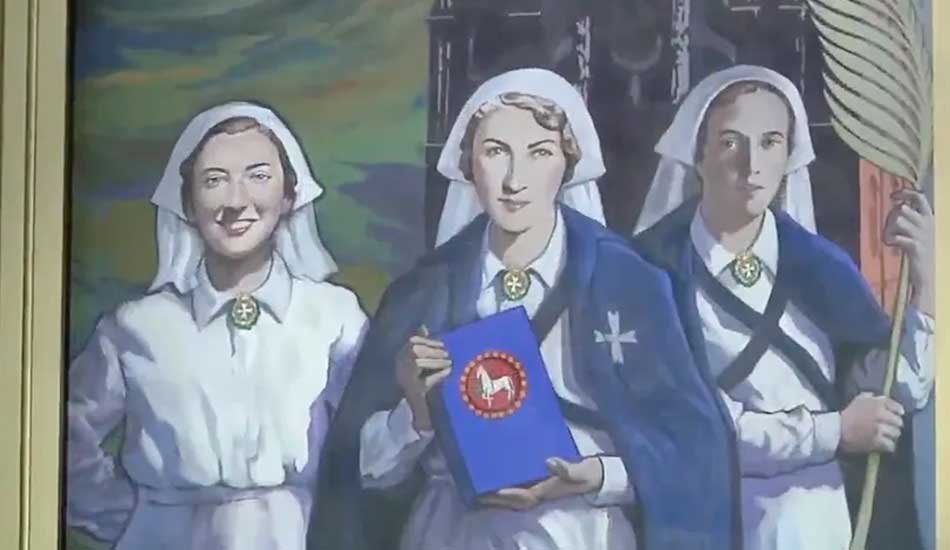
@JaneCampbell15@CauseSanti Las Enfermeras Mártires de Astorga fueron 3 voluntarias de la Cruz Roja que prestaron servicio en un hospital de sangre del bando sublevado durante la guerra civil española, fueron fusiladas el 28.10.1936 en la localidad de Pola de Somiedo. El 29.5.2021 fueron beatificadas.