This broke my mental model of game dev 💀
2.5 hours → fully playable ‘Worms’ clone.
Built with Hermes agent by @NousResearch
Here’s what made that speed possible:
Hermes used ‘Persistent Shell’ mode, which ensured it didn't forget its current folder or active tools.
This allowed it to work smoothly, without the distraction of constantly having to recall where it left off last time.
To optimize the workflow, the agent moved beyond linear execution and parallelized the workload.
It spawned isolated subagents while executing multiple independent tool calls via ThreadPoolExecutor.
Like, one subagent wrote Python RPC scripts for the projectile physics while another utilized vision tools for character sprites.
When the complex terrain logic required debugging, the agent used filesystem checkpoints and the /rollback command to instantly return to a stable state.
To fix UI bugs, it attached to a live Chrome instance via CDP (/browser connect), fixing rendering issues in real-time.
The agent’s built-in learning loop was active from the very beginning.
By the time the game was finished, this continuous process allowed the agent to autonomously convert the physics logic into a custom skill.
This logic is now a permanent plugin file in the agent's plugin architecture, making the physics engine a native capability that the agent can reuse for future projects.
Follow @warv3finale for updates!
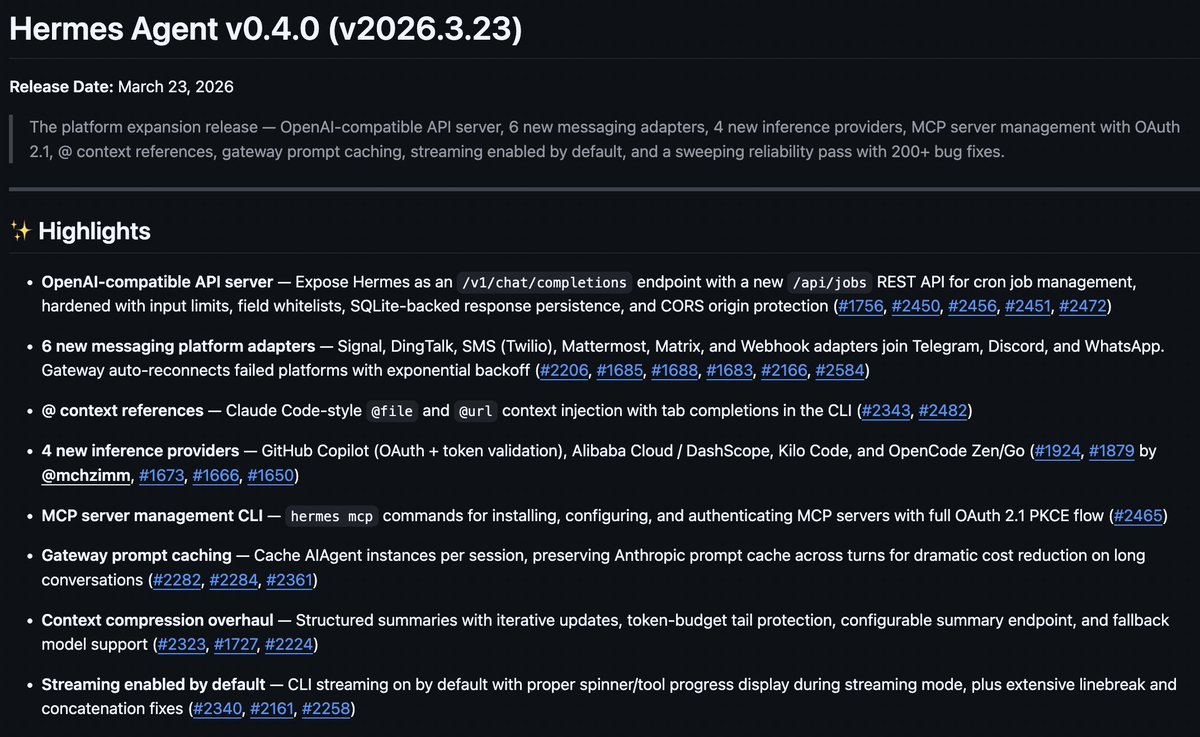
Hermes Agent v0.4.0 — 300 merged PRs this week. Biggest release we've done.
Background self-improvement, OpenAI Responses API endpoint for your agent, new messaging platforms, new providers, MCP server management, and a lot more.
Good morning to all my Hermes homies
what are you building right now or planning?
Hermes is surprisingly good at creative stuff, found that out myself
my friends don’t believe my game https://t.co/Gm0sAnUi9K was built end to end by an agent
I wanna show them more use cases
Good morning to all my Hermes homies
what are you building right now or planning?
Hermes is surprisingly good at creative stuff, found that out myself
my friends don’t believe my game https://t.co/Gm0sAnUi9K was built end to end by an agent
I wanna show them more use cases
This broke my mental model of game dev 💀
2.5 hours → fully playable ‘Worms’ clone.
Built with Hermes agent by @NousResearch
Here’s what made that speed possible:
Hermes used ‘Persistent Shell’ mode, which ensured it didn't forget its current folder or active tools.
This allowed it to work smoothly, without the distraction of constantly having to recall where it left off last time.
To optimize the workflow, the agent moved beyond linear execution and parallelized the workload.
It spawned isolated subagents while executing multiple independent tool calls via ThreadPoolExecutor.
Like, one subagent wrote Python RPC scripts for the projectile physics while another utilized vision tools for character sprites.
When the complex terrain logic required debugging, the agent used filesystem checkpoints and the /rollback command to instantly return to a stable state.
To fix UI bugs, it attached to a live Chrome instance via CDP (/browser connect), fixing rendering issues in real-time.
The agent’s built-in learning loop was active from the very beginning.
By the time the game was finished, this continuous process allowed the agent to autonomously convert the physics logic into a custom skill.
This logic is now a permanent plugin file in the agent's plugin architecture, making the physics engine a native capability that the agent can reuse for future projects.
Follow @warv3finale for updates!
This broke my mental model of game dev 💀
2.5 hours → fully playable ‘Worms’ clone.
Built with Hermes agent by @NousResearch
Here’s what made that speed possible:
Hermes used ‘Persistent Shell’ mode, which ensured it didn't forget its current folder or active tools.
This allowed it to work smoothly, without the distraction of constantly having to recall where it left off last time.
To optimize the workflow, the agent moved beyond linear execution and parallelized the workload.
It spawned isolated subagents while executing multiple independent tool calls via ThreadPoolExecutor.
Like, one subagent wrote Python RPC scripts for the projectile physics while another utilized vision tools for character sprites.
When the complex terrain logic required debugging, the agent used filesystem checkpoints and the /rollback command to instantly return to a stable state.
To fix UI bugs, it attached to a live Chrome instance via CDP (/browser connect), fixing rendering issues in real-time.
The agent’s built-in learning loop was active from the very beginning.
By the time the game was finished, this continuous process allowed the agent to autonomously convert the physics logic into a custom skill.
This logic is now a permanent plugin file in the agent's plugin architecture, making the physics engine a native capability that the agent can reuse for future projects.
Follow @warv3finale for updates!
Some devs in my circle using OpenClaw started asking why they should pivot to Hermes
I just send them a link to my vibecoded game https://t.co/Gm0sAnUi9K
describe the process
then tell them it took 2.5 hours
and Hermes users keeps growing 😂
This broke my mental model of game dev 💀
2.5 hours → fully playable ‘Worms’ clone.
Built with Hermes agent by @NousResearch
Here’s what made that speed possible:
Hermes used ‘Persistent Shell’ mode, which ensured it didn't forget its current folder or active tools.
This allowed it to work smoothly, without the distraction of constantly having to recall where it left off last time.
To optimize the workflow, the agent moved beyond linear execution and parallelized the workload.
It spawned isolated subagents while executing multiple independent tool calls via ThreadPoolExecutor.
Like, one subagent wrote Python RPC scripts for the projectile physics while another utilized vision tools for character sprites.
When the complex terrain logic required debugging, the agent used filesystem checkpoints and the /rollback command to instantly return to a stable state.
To fix UI bugs, it attached to a live Chrome instance via CDP (/browser connect), fixing rendering issues in real-time.
The agent’s built-in learning loop was active from the very beginning.
By the time the game was finished, this continuous process allowed the agent to autonomously convert the physics logic into a custom skill.
This logic is now a permanent plugin file in the agent's plugin architecture, making the physics engine a native capability that the agent can reuse for future projects.
Follow @warv3finale for updates!
This broke my mental model of game dev 💀
2.5 hours → fully playable ‘Worms’ clone.
Built with Hermes agent by @NousResearch
Here’s what made that speed possible:
Hermes used ‘Persistent Shell’ mode, which ensured it didn't forget its current folder or active tools.
This allowed it to work smoothly, without the distraction of constantly having to recall where it left off last time.
To optimize the workflow, the agent moved beyond linear execution and parallelized the workload.
It spawned isolated subagents while executing multiple independent tool calls via ThreadPoolExecutor.
Like, one subagent wrote Python RPC scripts for the projectile physics while another utilized vision tools for character sprites.
When the complex terrain logic required debugging, the agent used filesystem checkpoints and the /rollback command to instantly return to a stable state.
To fix UI bugs, it attached to a live Chrome instance via CDP (/browser connect), fixing rendering issues in real-time.
The agent’s built-in learning loop was active from the very beginning.
By the time the game was finished, this continuous process allowed the agent to autonomously convert the physics logic into a custom skill.
This logic is now a permanent plugin file in the agent's plugin architecture, making the physics engine a native capability that the agent can reuse for future projects.
Follow @warv3finale for updates!
The secret sauce behind building @warv3finale in 2.5 hours:
Hermes Agent by @NousResearch
It handled:
- Subagent parallelization: physics and pixel art built concurrently
- Persistent shell: kept environment and variables live across all tool calls
- Safety net: filesystem checkpoints + /rollback for instant recovery from breaking bugs
- Skill creation: procedural logic saved as reusable custom plugins
USA and Israel going up against Iran ⚡️
but in a Worms-style game
Trump and Netanyahu vs Iranian leaders instead of worms
https://t.co/o6tTiPXDvp
who’s dominating this battlefield?
I finally tried vibecoding a full game concept end-to-end
Gave myself ~3 hours to build a Worms-style geopolitical satire
Trump, Netanyahu, and Iranian leaders instead of worms
Try it here: https://t.co/5T4YibMReT
Used Hermes Agent @NousResearch for everything
I literally just directed, not coded
Honestly surprised by what came out of it:
- Turn-based combat loop
- Terrain + destructible-style interactions
- Character actions and basic physics
- Playable match flow from start to finish
Persistent Shell Mode is the real play. It maintains state across tool calls, so there’s no need to re-explain context when jumping between physics and assets.
I finally tried vibecoding a full game concept end-to-end
Gave myself ~3 hours to build a Worms-style geopolitical satire
Trump, Netanyahu, and Iranian leaders instead of worms
Try it here: https://t.co/5T4YibMReT
Used Hermes Agent @NousResearch for everything
I literally just directed, not coded
Honestly surprised by what came out of it:
- Turn-based combat loop
- Terrain + destructible-style interactions
- Character actions and basic physics
- Playable match flow from start to finish
Persistent Shell Mode is the real play. It maintains state across tool calls, so there’s no need to re-explain context when jumping between physics and assets.