César Nombela Research Fellow at @IPP_CSIC. Before: @EuropeAtHarvard, @IBEI, @UniKonstanz. Studying political representation, party politics & legislatures.
I am very happy to announce that this piece with @taniaverge is now published at @cps_journal (in open access!).
We look at how interpersonal resources favor men's promotion within political parties, but they are far less relevant for women. A short 🧵👇
https://t.co/za9nybxcIk
Si tienes interés (o conoces alguien que lo pueda tener) en una plaza de profesor/a ayudante doctor/a en Ciencia Política, en la UNED se ofrece una. ¡Queda solo 19 días hábiles para presentarse!
📈Presentació
"L'ascens de la dreta radical a Catalunya. Una anàlisi de VOX i Aliança Catalana" amb Javier Martínez Cantó @javiermcanto, investigador de l'@IPP_CSIC i coautor del Quadern; i Lucía Medina, investigadora de l'ICPS.
🗓️10/06/2026 - 17:30
➡️https://t.co/3vuh7ka2Zx
📢 Quins factors expliquen l'ascens de la dreta radical a Catalunya? Qui la vota? Quins discursos connecten amb una part creixent de la ciutadania? El 10 de juny presentaré a l'ICPS el quadern que he coescrit amb Julià Tudó.
Inscripcions: https://t.co/VEWsXDZYm2...
Germany's Chancellor Merz:
People tell me: "Why don't you work together with the AfD? They agree with you on many issues. You would have a majority in the German Bundestag."
I will not do that. And there is a very simple reason. This party wants to take Germany back to the time before Adenauer.
With Adenauer, we left the age of nationalism behind us in Germany. And I will not lead the Federal Republic of Germany—and I will not lead my party—back behind the era of Adenauer.
🚀 Busquem professor/a a @UOCedcp!
Obrim una nova plaça de Ciència Política per incorporar personal docent a la UOC.
Més enllà del projecte acadèmic, tenim la sort de comptar amb un equip humà espectacular i un entorn de treball que val molt la pena.
https://t.co/CAkmzZkIZJ
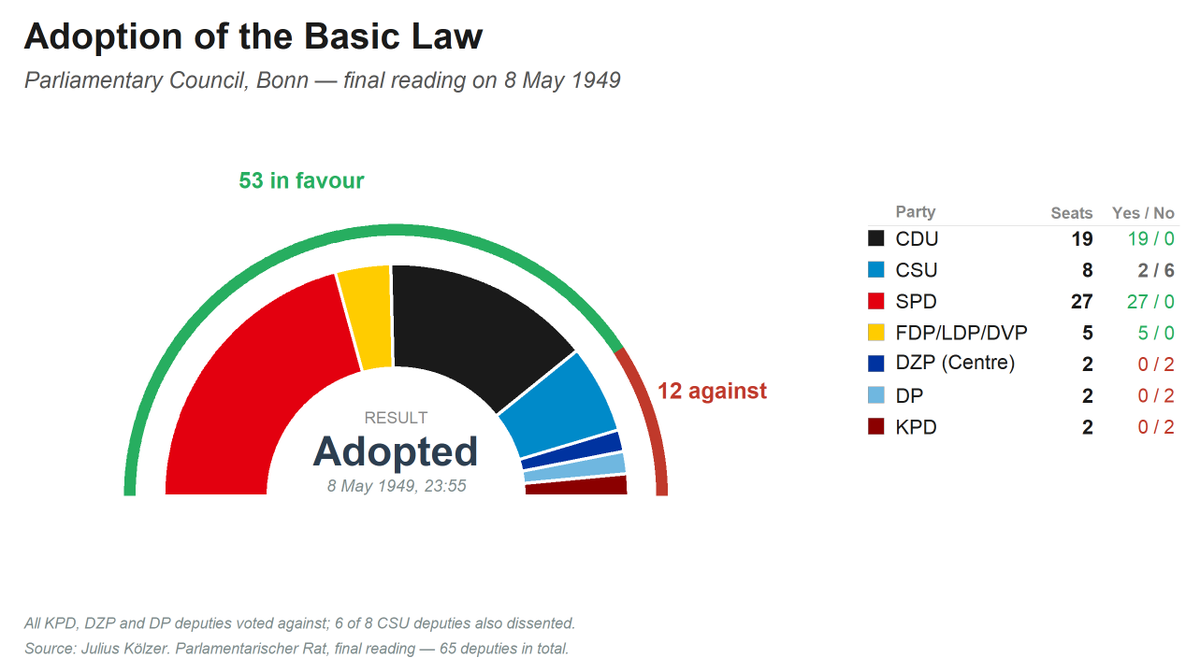
77 years ago today, on 23 May 1949, the German Grundgesetz entered into force. Before becoming the constitutional foundation of modern Germany, it had to cross two crucial hurdles. 🧵
It takes an average of 595 days and 3.1 rejections to get a paper accepted in political science.
This is the face of rejection and a very sluggish publication system. This makes it very hard for graduate students who only get 5 years of funding and makes a lot of academic work irrelevant to the world (technology like AI develops far faster than our publication system).
I'd love to see a larger dataset. But this is not too far away from my own experience.
La decadencia ética que atravesamos es tal que muchos, antes de opinar sobre algo, “el qué”, prefieren saber “quién” lo hizo, para decantarse solo entonces entre la condena indignada, cuando son los contrarios, o la indiferencia y hasta la justificación, si son de los nuestros.
A la luz de la información del auto, me temo que los políticos o comunicadores que abonen la tesis del ‘lawfare’ están dilapidando su credibilidad. Es legítimo preguntarnos por qué están dispuestos a hacerlo.
Smartphones are not the explanation for the recent decline in fertility. Instead, they are an accelerator of deeper forces already at work.
Let’s start with the facts. Fertility is falling almost everywhere: in rich, middle-income, and poor countries; in secular and religious countries; and in countries with high and low levels of gender equality.
The decline accelerated around 2014. So, no country-specific explanation will work unless you are willing to believe that 200 distinct country-specific explanations arrived at roughly the same time.
Smartphones look like the obvious candidate: the first iPhone was released in 2007, and global adoption has been astonishingly fast.
Economists understand the first major decline in fertility in advanced economies, from 6 or 7 children per woman throughout most of human history to about 1.8, that occurred between the early 1800s and roughly 1970, well before smartphones. The main drivers were a sharp fall in child mortality (effective fertility was rarely above 3 and often close to 2) and the shift from a low-skill, rural agrarian economy to a high-skill, urban industrial one. We have quantitative models that fit these facts well.
Country-specific factors mattered too, of course. Proximity to low-fertility neighbors accelerated Hungary’s decline, while fragmented landowning structures accelerated France’s. But these were second-order mechanisms.
This is also why most economists long considered Paul Ehrlich’s doom scenarios implausible. We forecast that fertility in middle- and low-income economies would follow the same path as in the rich, probably faster, because reductions in child mortality reached India or Africa at lower income levels (medical technology is nearly universal, and most gains come from handwashing and cheap antibiotics, not Mayo Clinic-level care). Much of what we see in Africa or parts of Latin America today is still that old story.
But in the 1980s, a new pattern appeared. Japan and Italy fell below 1.8, the level we had thought was the new floor. By 1990, Japan was at 1.54 and Italy at 1.36.
This second fertility decline began in Japan and Italy earlier than elsewhere, driven by country-specific factors, but the underlying dynamics were widespread: secularization, an education arms race, expensive housing, the dissolution of old social networks, and the shift to a service economy in which women’s bargaining power within the household is higher. The U.S. lagged because secularization came later, suburban housing remained relatively cheap, and African American fertility was still high. U.S. demographic patterns are exceptional and skew how academics (most of whom are in the U.S.) and the New York Times see the world.
My best guess is that, without smartphones, Italy’s 2025 fertility rate would be about 1.24 rather than 1.14. I doubt anyone will document an effect larger than 0.1-0.2. Italy was at 1.19 in 1995, not far from today’s 1.14. The TFR is cyclical due to tempo effects, so I do not read too much into the rise between 1995 and 2007 or the decline from 1.27 in 2019 to 1.14 today. The direct effect of smartphones is not zero, but it is not, by itself, that large.
Where social media, in general, and smartphones, in particular, matter is in the diffusion of social norms. What would have taken 25 years now happens in 10. Social media are not the cause of fertility decline; modernity is. But they are a very fast accelerator.
That is why social media are a major part of the story behind Guatemala (yes, Guatemala) going from 3.8 children per woman in 2005 to 1.9 in 2025. Without them, Guatemala would also have reached 1.9, just 20 years later.
Modernity, in its current form, is incompatible with replacement-level fertility. By modernity, I do not mean capitalism: fertility fell earlier and faster in socialist economies than in market economies. Socialist Hungary fell below replacement in 1960, and socialist Czechoslovakia in 1966 (both experienced small, short-lived baby booms in the mid-1970s). By modernity, I mean a society organized around rational, large-scale systems and formalized knowledge.
Countries will not converge to the same fertility rate. East Asia is likely stuck near 1, possibly below, given its unbalanced gender norms and toxic education systems. Latin America faces the same gender problem plus weak growth prospects, so I expect something around 1.2. Northern Europe has more egalitarian family structures and might hold near 1.5. The very religious societies are probably the only ones that will sustain 1.8.
All of this could change with AI or changes in population composition. We will see. But on the current evidence, deep sub-replacement fertility is the “new new normal.” Unless we reorganize our societies, better learn to handle it as best we can.
Políticos convencidos de que "puede haber sorpresas" porque han tomado el pulso de la ciudadanía pasando dos semanas rodeados sólo de aquellos tan politizados que acuden a los actos que organizan los partidos.