To read more, check out our new paper, out now:
Bayesian Influence Functions for Hessian-Free Data Attribution
https://t.co/GUIYFiL9Bc
Philipp A Kreer, Wilson Wu, @bfpill, @FurmanZach, @jesse_hoogland
10/10
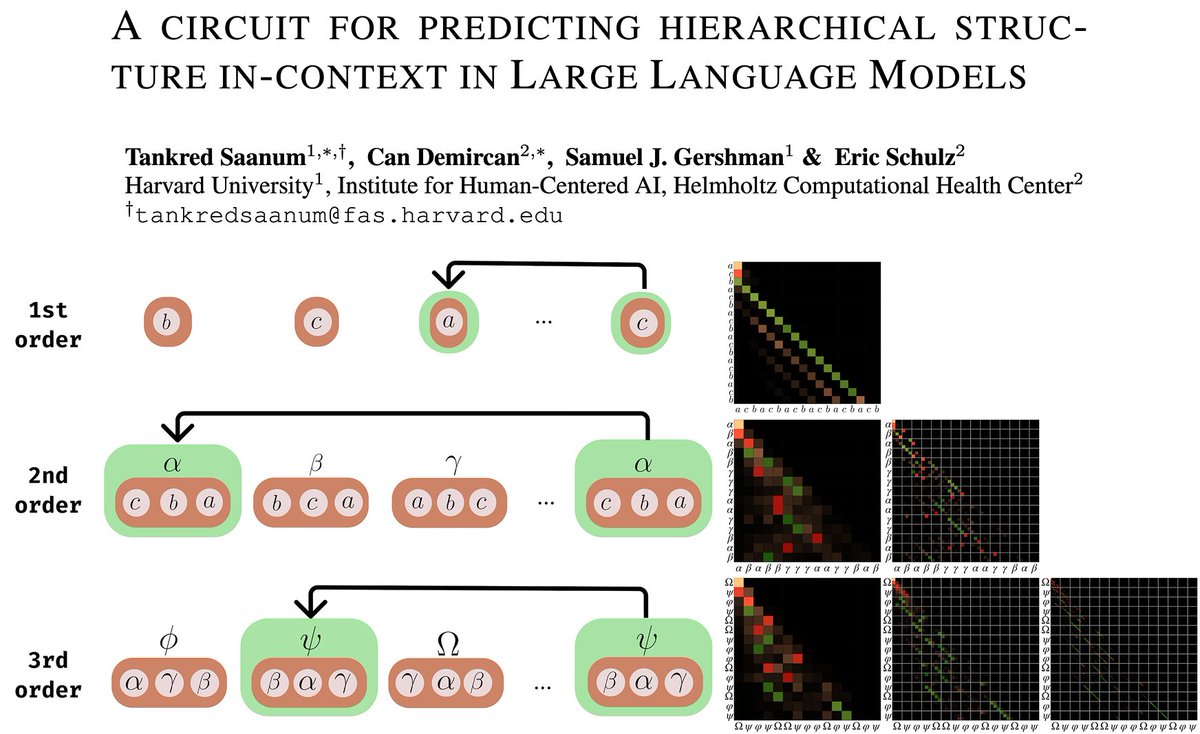
Induction heads are surprisingly powerful. In a new preprint, we find that they can learn what to attend to in-context! We study this in a hierarchical prediction task and uncover a possible mechanism giving rise to in-context learning in induction heads. See thread for details!
I've written the full story of Attention Sinks — a technical deep-dive into how the mechanism was developed and how our research ended up being used in OpenAI's new OSS models.
For those interested in the details:
https://t.co/0EAi2KQMMx
¿A qué edad te enteraste que Google tiene una herramienta GRATUITA para presentar datos de forma más dinámica, fácil y llamativa?📊🤯
Se llama Data Gif Maker y está disponible aquí→ https://t.co/TyR3LKlbrb
Excited to spend the week at #CVPR2025 in Nashville! 🇺🇸 If you’re interested in learning more about MixerMDM, come check out our poster at the following sessions: 📍
💃 [@humogen11384] Wednesday 11, 16:00-18:00, ExHall D #430
📹 [AI4CC] Thursday 12, 17:00, ExHall D #412
👑 Saturday 14, 10:30-12:30, ExHall D #165
Feel free to reach out if you want to chat, connect, or just say hi! ☺️
Prev. work by @GoodfireAI, @neuronpedia & al. showed that SAEs can be helpful beyond interpretability, to surgically condition model behaviors.
In this work, we take a small step towards making steering useful for MT personalization on literary works! Check out our 🧵⬇️
1/ How can a monolingual English speaker 🇺🇸 decide if a French translation 🇫🇷 is good enough to be shared?
Introducing ❓AskQE❓, an #LLM-based Question Generation + Answering framework that detects critical MT errors and provides actionable feedback 🗣️
#ACL2025
🎉 Exciting first session with paper presentations and a keynote talk at the AmericasNLP 2025 workshop!
We have much more lined up for the rest of the day -- join us in-person or on Zoom! ✨
#NLProc#NAACL2025
🚨New Paper🚨
1/ We often assume that well-written text is easier to translate ✏️
But can #LLMs automatically rewrite inputs to improve machine translation? 🌎
Here's what we found 🧵
📢 Introducing MixerMDM [#CVPR2025] — the first learnable model composition technique for combining pre-trained human motion diffusion models while preserving their core characteristics. 🟡➕🔵🟰🟢
MixerMDM enables consistent, fine-grained individual controllability in generating human-human interactions by:
🎛️ Mixer – A lightweight module that learns how to dynamically mix motions based on their specific characteristics and input conditions.
👩🏻🔬 Mixing – A model composition formula that combines motions dynamically through the denoising process, guided by Mixer predictions.
👮🏻♂️ Adversarial Training – A training strategy using adversarial losses, where predictions from the pre-trained models act as pseudo-ground truths.
🏅 Evaluation – A novel metric for measuring mixing quality, evaluating both individual and interaction alignment.
❤️ Huge shoutout to my amazing supervisors and co-authors: @Germs96@cpalmeroc@SergioEscalera_ and José García-Rodríguez
🌍 Project: https://t.co/X3o25KZFw7
📚 Paper: https://t.co/wtniqZlp9D
🧬 Code: https://t.co/3W9zDG1siv
[1/7] Introducing "Investigating the translation capabilities of Large Language Models trained on parallel data only" To our knowledge, the first work studying translation on #LLM trained exclusively on parallel data.
Arxiv paper: https://t.co/RvIcjQgzKA