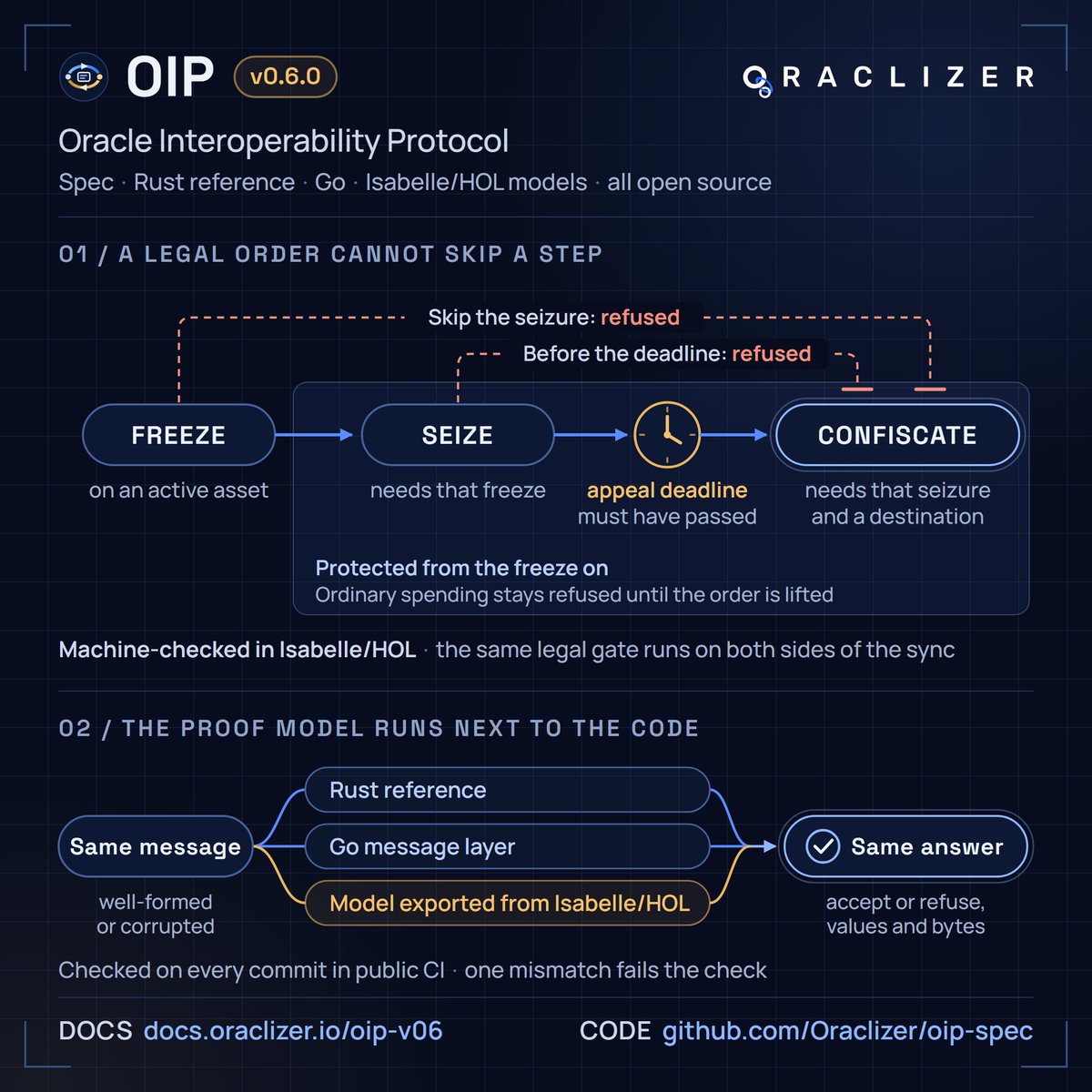
In OIP v0.6.0, a legal order cannot skip a step. Seizure needs the completed freeze, confiscation needs that seizure and an elapsed appeal deadline, and ordinary spending stays refused until the order is lifted. All machine-checked in Isabelle/HOL.
https://t.co/Rd1KfGfyfg
The spec, the code and the proofs are open source. On every commit, Rust, Go and a model exported from Isabelle get the same messages and must give the same answer. For a state-synchronization oracle, that means both sides read a legal order the same way and hold it to the same proven rule.
Tokenizing an asset doesn't make its rules go away.
So which rules?
ERC-8319 gathers 31 of them from published guidance and organizes them around five principles.
@Oraclizer proposed it and is built to comply with all of it.
StateSync-GKR v1.2.0 is out.
Measured next to v1.1.0 on the same 192-core server, same day: 3,300 requests a second, each proved and verified within 1 s, up from 1,150. At 1,000 a second, 99% of requests now finish within 34 ms, down from 440.
https://t.co/XIPBWkvlPr
StateSync-GKR is the prover inside @Oraclizer's state sync: every change that crosses between a chain and the off-chain world gets its first proof here. At this speed that proof lands in milliseconds, the clock trading runs on, instead of waiting for an end-of-day reconciliation. That brings Oraclizer a real step closer to its purpose.
The SEC says tokenized stocks on public chains must halt “concurrently” with the exchange.
In @Oraclizer’s terms, that’s S₃, and as far as we know, it’s only us.
We size this sync market at up to $690B a year per venue.
https://t.co/75hay2THPx
ERC-TRUST from @Oraclizer runs regulatory actions on security tokens: six typed actions, fail-closed, one receipt each. It builds on ERC-8319, which I co-authored with @robviglione and @DanSpuller, and our proofs ran on tools from @certora and @rv_inc.
https://t.co/aRGU579L5f
ERC-7943 built in, ERC-3643 plugs in.
Dan wrote ERC-8319's policy principles, and ERC-TRUST lives by them: a technical capability is not a legal obligation, the chain carries out decisions made through due process and never makes them, and compliance stays modular, so no market is forced into another's rules.
Certora's Prover checked our rules that the ERC-3643 adapter can never claim Full and that its receipts carry the token's real restriction state. With Runtime Verification's KEVM and Kontrol, we proved on the compiled bytecode that raw freeze and forced-transfer calls stay closed, that failures and non-raising freezes leave state untouched, and that LIQUIDATE moves exactly its amount and ends with its receipt.
Thank you, Rob and Dan, and the Certora and Runtime Verification teams.
While building StateSync-GKR at @Oraclizer, three questions kept coming back.
How far can we take it?
Is there a better way?
Why not prove the prover itself?
So we built our own engine and took it all the way.
Less memory, more speed, machine-checked.
What happens when a state changes? 👇
We prove just that change, layer by layer, all the way to the new state root, on a path machine-checked in Isabelle/HOL.
Thanks to @muellerberndt for reviewing our challenge generation and sharpening our claims.
Tests cover the cases someone wrote down. A proof leaves no case where it fails 👇
Every registered execution is checked on the exact compiled bytecode, and the freeze is proven for every possible input.
Thanks to @Certora, whose prover ran part of our verification.
A state oracle asks another ledger the same questions: is this record there, is it gone, did it change correctly. Last December we showed why GKR fits this work. Over ten months at @Oraclizer we built the StateSync-GKR prover around those questions.
https://t.co/m2iysHIxJW
We've put the StateSync-GKR design, measured results and developer docs together here:
https://t.co/3jr1N3RtO0
The Rust engine, Isabelle models and reproduction tools are on GitHub:
https://t.co/DTgpGStLnM
StateSync-GKR is a reusable, high-performance Rust proof engine for computations and ledger updates. Both papers are on arXiv.
Machine-checked models and conditional Rust verifier refinement under explicit assumptions. Thanks @muellerberndt for the challenge-generation review and claim corrections.
Proud to share these controlled results: 89.46x lower peak RAM vs our dense reference and up to 23.68x faster prepared same-proof verification vs table wiring.
The engine paper includes 300+ benchmark graphs. Targeting Springer for the formal paper and Wiley's Software: Practice and Experience for the engine paper.
Engine: https://t.co/sr2mEE7emR
Formal: https://t.co/vYDZbQHSsd
New Cadence demo shipped today: A brain with eyes that tracks multiple objects in real-time at 40 fps. Biological visual processing is pretty well-researched, we can just copy/paste from nature 😁
An audit, a fuzzing run, and a formal proof do different things.
Our new guide compares what each one catches, what a clean result actually tells you, and where its guarantees stop.
Second in our formal verification series for the people who approve the budget and carry the risk.
https://t.co/NrRyezFN6g