Today was my first day at a school where I'll be completing a life skills boot camp for the first 8 weeks.
Only 3 hours of academics a day. The rest is real-world lessons I'll actually use, that wasn't taught at my last school-teamwork, grit, how to handle things once you're on your own.
We have 18 challenges to complete, starting now. The first is audience building-gain at least 100 followers in under 2 months. It doesn't take a million, just a solid fanbase.
I'll be sharing what I learn along the way.
Today I helped make my school's student handbook.
It wasn't just me helping create it though; it was the whole school. We collectively discussed certain rules and principles for everyone to follow that should or shouldn't be adopted.
At Alpha High, the students are a true part of setting the school standard.
I used to think that flexibility was a natural thing. That if you were in flexible you stayed that way, nothing about that could change.
I was wrong, after stretching every day for two week I finally got my splits.
Who said the same thing couldn't be said for ideas?
NO ONE!
Stretch your mind, if you work every day towards something you are bound to achieve it.
Lock in.
Everyone assumes that we can't live on Mars because of hostile conditions.
While that is a very real issue there is a bigger one,
getting there.
The real reason we can't do that is radiation. Specifically space radiation.
Space radiation is made of tiny, high-energy particles and waves that travel through space.
It can come from the Sun, faraway stars, and particles trapped around planets by their magnetic fields.
And if you're exposed to it for too long, you'll end up up with radiation sickness.
...Or worse.
Did you know you can actually see the past?
Every time you look into space, you’re seeing light that took time to reach you.
The Sun? You see it as it was about 8 minutes ago.
Andromeda? About 2.5 MILLION years ago.
So the farther into space we look, the farther back in time we see.
In a sense, telescopes are time machines.
And here’s an even crazier thought:
If you could put a giant mirror far enough away from Earth and somehow look into it, the reflected light could theoretically show you an older Earth.
The universe doesn’t just show us where things are.
it shows us where,and when,they were.
I just got 98th Percentile Nationally on my SAT... As A Freshman
Today, @Alphaschool took the SAT without studying at home.
All with:
-No teachers
-No classes
-No homework
It's been proven that most parents lock their kids in rooms to improve their SAT scores; that doesn't work.
Find the right motivation/drive and work consistently.
RESULTS WILL COME
I got a 1320 on a practice SAT with only 1 week of studying.
While the national average in the U.S. is a 1029, a 1320 is my baseline. Future scores must not be any lower than this, only higher.
I'm aiming to raise this by at least 100 points when I retake it in 3 weeks. AI is devising a study plan based on my score report, so I know exactly what to spend my time reviewing.
Follow along to see how effective AI-guided studying really is.
@prepgenix Thanks for the tip! I will be going through my weak spots in each category and working on what I don't know before I take my next practice test.
I got a 1320 on a practice SAT with only 1 week of studying.
While the national average in the U.S. is a 1029, a 1320 is my baseline. Future scores must not be any lower than this, only higher.
I'm aiming to raise this by at least 100 points when I retake it in 3 weeks. AI is devising a study plan based on my score report, so I know exactly what to spend my time reviewing.
Follow along to see how effective AI-guided studying really is.
A book is about to decide how my school writes its student handbook.
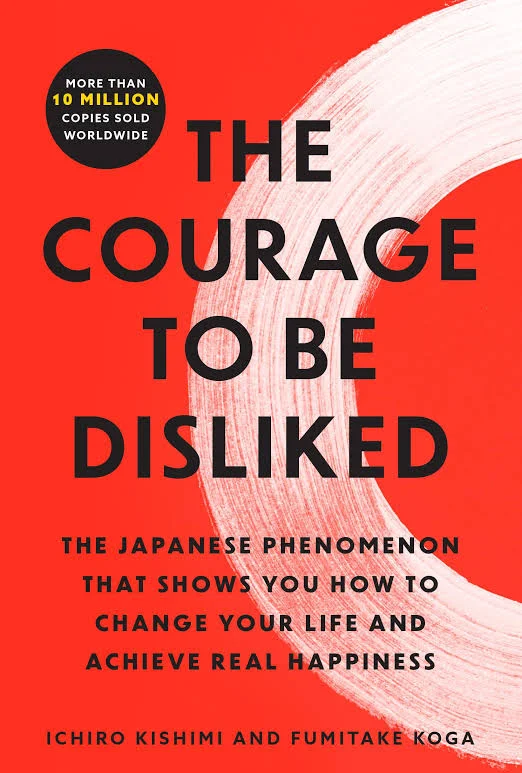
I have 5 days to read "The Courage to Be Disliked" by Ichiro Kishimi and Fumitake Koga, then write actual rules for the handbook with a group.
Today was day one. I'm hoping some ideas start forming as I get further into the book, especially as I learn more about Adlerian psychology from it.
After the book is finished, the real work starts: turning whatever we take from it into rules that actually work on paper.
A book is about to decide how my school writes its student handbook.
I have 5 days to read "The Courage to Be Disliked" by Ichiro Kishimi and Fumitake Koga, then write actual rules for the handbook with a group.
Today was day one. I'm hoping some ideas start forming as I get further into the book, especially as I learn more about Adlerian psychology from it.
After the book is finished, the real work starts: turning whatever we take from it into rules that actually work on paper.
I gave my AI one job: call out every goal I set that wasn't ambitious enough.
The aim was to make 3 goals, with only a week to complete each one. This may seem easy, but my AI repeatedly rejected my goals for being "basic and vague".
Connecting personality tests that I took to my goals helped me finally create ones that push myself.
If your goals don't test your limits, maybe it's time to rewrite them.
I gave my AI one job: call out every goal I set that wasn't ambitious enough.
The aim was to make 3 goals, with only a week to complete each one. This may seem easy, but my AI repeatedly rejected my goals for being "basic and vague".
Connecting personality tests that I took to my goals helped me finally create ones that push myself.
If your goals don't test your limits, maybe it's time to rewrite them.
Most of us know our biggest flaws. We just avoid saying them out loud.
I didn't get that choice this week; personality tests I took for school revealed both my main weaknesses and strengths.
What was this for?
Setting goals that actually fit me, instead of ones that just sound good. Knowing yourself well is what makes that possible in the first place.
It's hard to build the right goals on top of unspoken truths.
Would you take advice from someone you've never met?
That's exactly what my latest bootcamp challenge is-track down strangers on social media and give them feedback on their posts helpful enough to prompt a response.
To pass, I need at least 3 of them to reply.
Finding people to help is easy. The feedback part is not. Getting a stranger to care means giving feedback that is worth their time.
One reply down. Two to go. Not sure who's being tested here-them or me.
I climbed Mount Everest last Friday. As a high schooler.
Not in real life, but according to the Harvard Mount Everest Simulation I reached the summit and passed at an 87%! For reference, the average pass rate for Harvard MBAs is around 60%.
I was in a group with 5 other people, with each member having a role that ranged from team leader to environmentalist. To succeed, we had to collectively gather the different information that came with each role and make the best possible decisions.
It actually took us 3 tries, but we finally figured out that the key to surviving the mountain was coming together as a group and all being heard.
Do you think you could reach Mount Everest's summit?