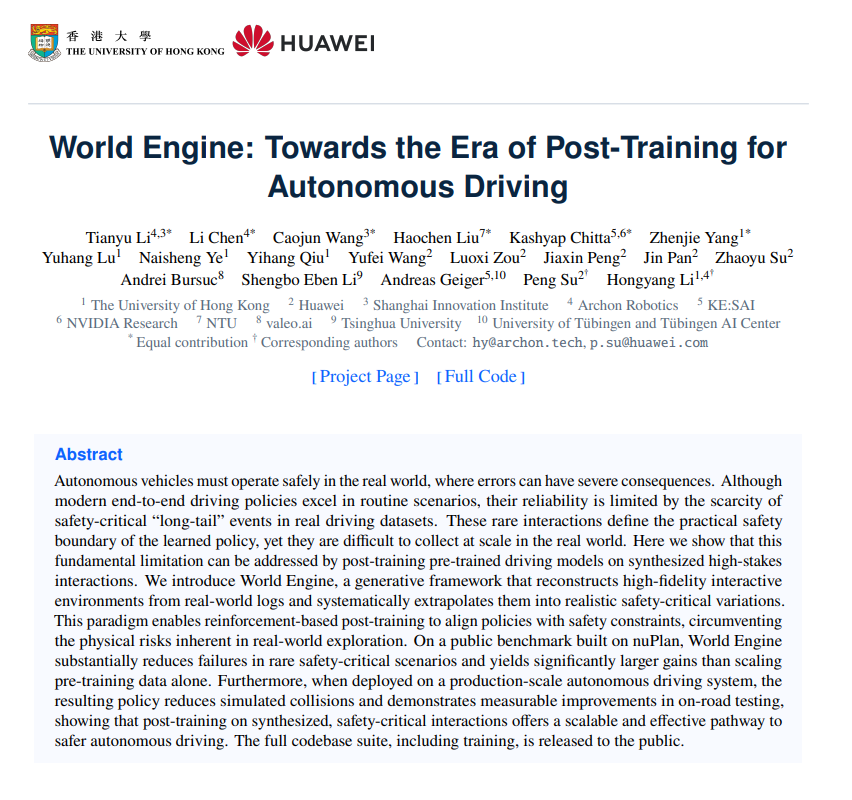
The #WorldEngine tech report is now up!
It's our post-training framework to deal w/ scarcity of long-tail safety-critical scenarios.
Post-training strategies for AD are rarely tackled and discussed in the open. We hope that this will open more this area.
https://t.co/5E8Ta131xa
Introducing #WorldEngine, https://t.co/UK3vsulS2u, a two-year long project. The missing infrastructure for Physical AI post-training in Autonomous driving. Open-source. Production-validated.
Introducing EmerNeRF, our answer to the challenging dynamic NeRF in-the-wild problem. EmerNeRF is the best-ever project I've got involved in, led by our only @JiaweiYang118 (stay tuned for his even more impressive works), in collaboration with @NVIDIAAI colleagues @iamborisi@orlitany@xinshuoweng@seungkim0123@Boyiliee Tong Che @danfei_xu@FidlerSanja@drmapavone. EmerNeRF is a spatial-temporal scene representation for autonomous driving and robotics. It learns static-dynamic decomposition and flow estimation, all from self-supervision. No magic, all you need is a good combination of static, dynamic, and flow fields parameterized by instant NGPs.
Paper: https://t.co/aA5GXvbAsX
Website: https://t.co/4LjZSQBgNb
Code: https://t.co/K36ePoNx85
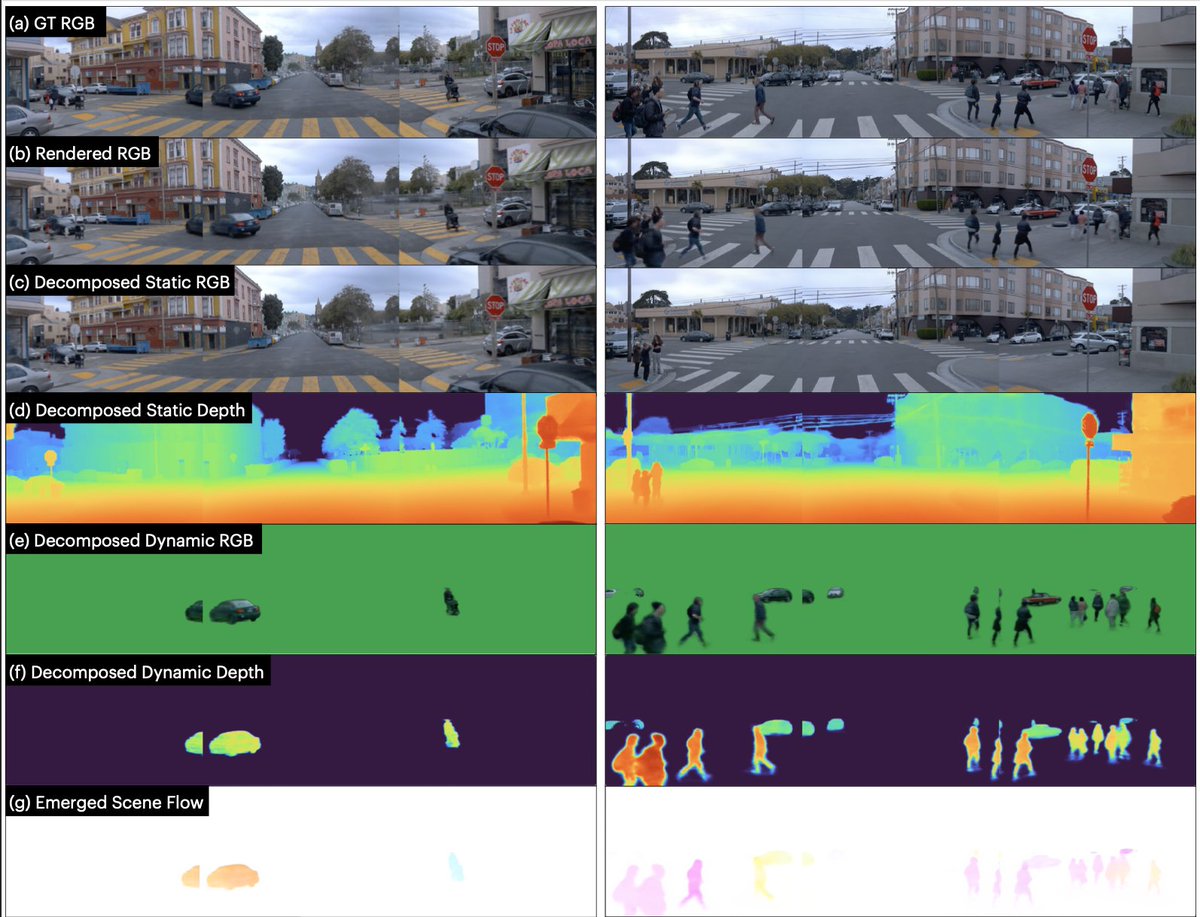
EmerNeRF can perform high-quality scene reconstruction and scene decomposition.
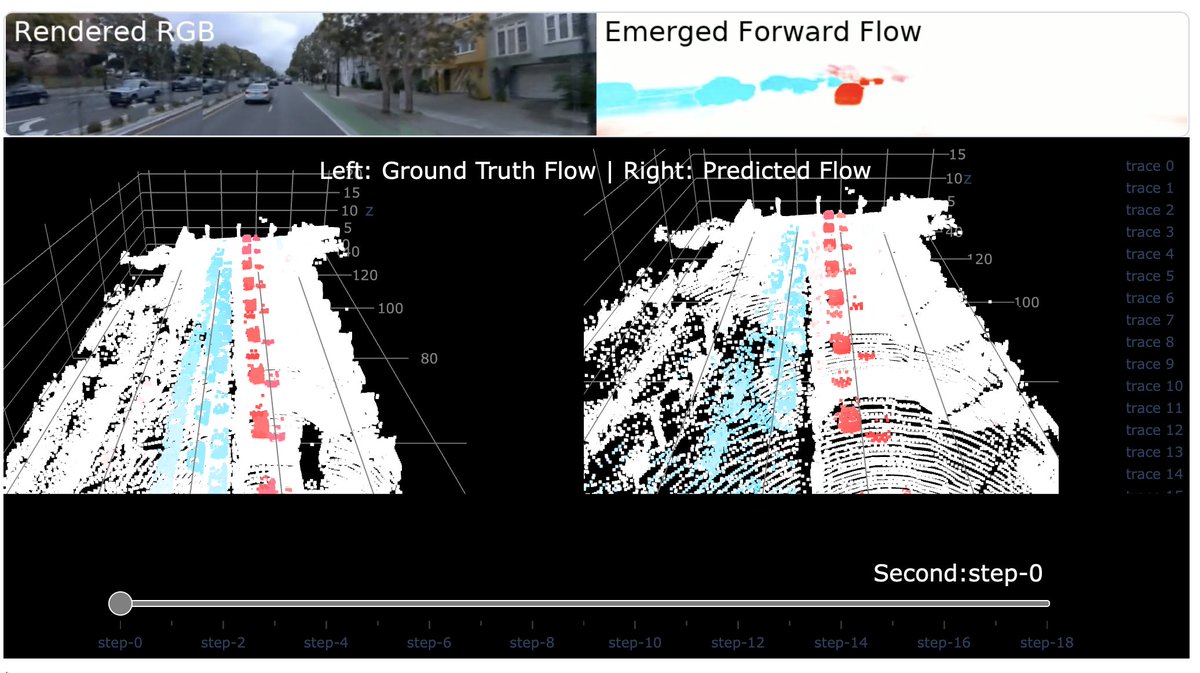
We also visualize the learned 3D voxels with flow (check out our website for more visualizations).
In addition, EmerNeRF lifts foundation model features to 4D space-time, to enable a range of semantic tasks. In doing so, we discover that self-supervised trained VITs exhibit unpleasant positional embedding noises (in line with the Register paper from Meta FAIR). We design a feature fitting module to denoise the 2D foundation model feature maps for better feature lifting.
We also introduce a NeRF On-The-Road (NOTR) dataset (a derived subset of the Waymo Open Dataset) to facilitate future research in this domain.
We've witnessed the amazing power of LLMs to accelerate everyday tasks. But, how does that translate to autonomous vehicles?
As an AI-first autonomous technology company, Nuro has invested in state-of-the-art research to apply LLMs across our AV stack.
"Avatr announces a phased roll-out of its Autonomous Driving (NCA) nationwide, progressing from 6 to 16 cities across China, including Beijing, Shanghai, Guangzhou, Chongqing, Shenzhen, and Hangzhou, by the end of the year."
Code Llama is free for both research and commercial use and we've made three different models available:
- Code Llama
- Code Llama - Python
- Code Llama - Instruct
More details on each of these models and how you can download them ➡️ https://t.co/yLBEKVJhU5
Today in The Download, our daily newsletter:
🚗 Using chatbots to make driverless cars smarter
💉 Updated covid vaccines
🩻 How AI can help screen for cancer https://t.co/gRssYCmxeR
The #AITO New M7 incorporates Huawei's developed GOD (General Obstacle Detection) and RCR (Road Cognition Reasoning) technologies, making it the first model in the AITO brand that does not rely on high-definition maps.