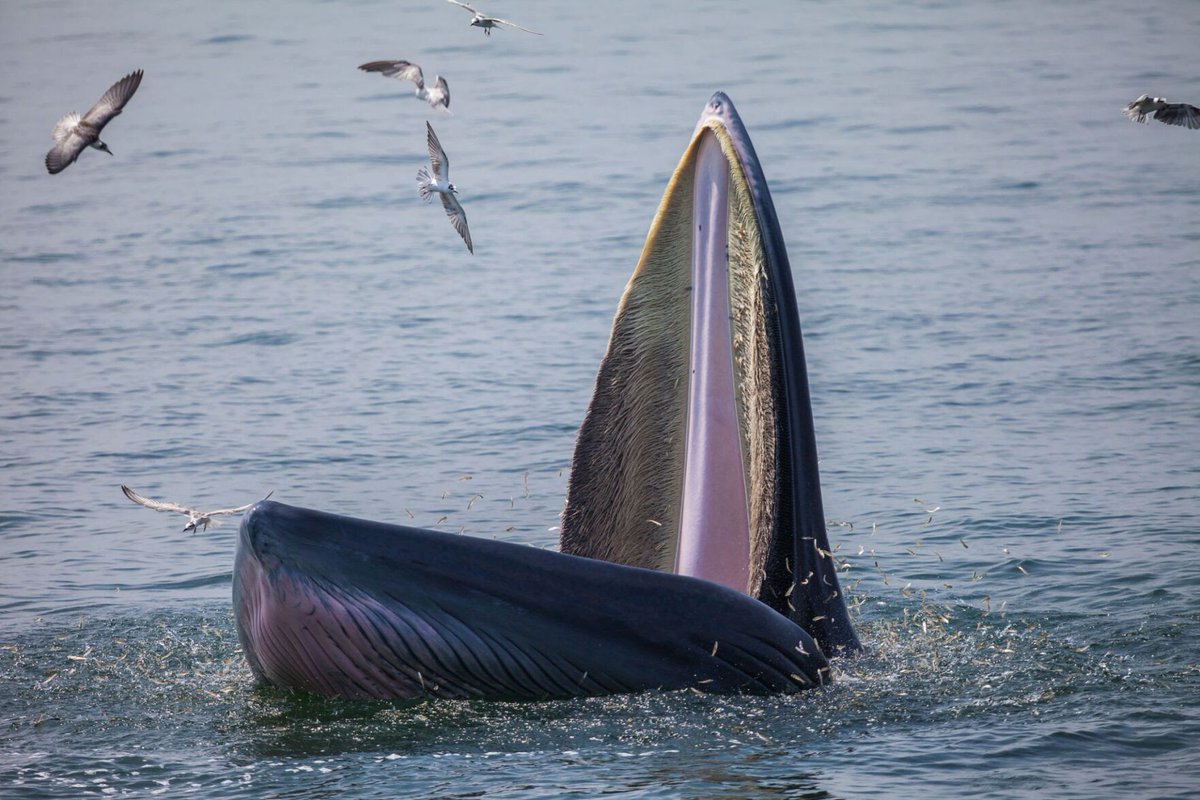
There are 50 Rice's whales left alive on Earth. They live nowhere else but the Gulf of Mexico. The admin’s own scientists said *last year* oil & gas drilling would drive the species to extinction.
Today, Trump's cabinet removed every protection standing between the oil industry and these animals’ deaths.
Indonesia is on track to become the world champion of tropical deforestation. Under the Prabowo administration, over 433,000 hectares were cleared in 2025, nearly double the previous year. Driven by mining and palm oil, the loss equals six times the size of Singapore.
Australia now has some of the democratic world's most draconian anti-protest laws. Today a man was arrested as an "agitator" simply for peacefully yelling "shame" in the direction of the visiting Israeli President, on the basis it may have "incited fear" https://t.co/jZJ59cRU02
The scale of the unfolding ecocide of West Papua is so vast, it’s hard to believe.
This looks at first glance like an AI-generated image, but it is an actual photo of one of many barges loaded with over 100 excavators sent to deforest millions of hectares of Papuan rainforest.
A proposed zoning overhaul in Indonesia’s North Sumatra province could strip legal protections from nearly a third of the Batang Toru ecosystem, threatening the last remaining habitat of the critically endangered Tapanuli orangutan.
@StandMighty
https://t.co/tcYngzJwcl
The CSIRO, the agency that gave the world Wi-Fi, among other world-leading research, has never been more important to Australia’s future.
Successive governments have failed to invest.
We need to turn that around and value the science and scientists that are key to our future.
https://t.co/XGRVwc6hXt
Firestone was never just a bad company acting immorally. It has always been an extension of U.S. empire. This is how neo-colonialism and imperialism work.
When Firestone entered Liberia in 1926, it did so with U.S. government backing. Washington guaranteed loans to Liberia through Firestone’s banking arm, and in return the company gained control of 1 million acres, about 10% of the country, for only six cents an acre. The purpose was clear: to secure a steady rubber supply for American industry and the U.S. military at a time when Britain and the Netherlands controlled global rubber through their colonies in Southeast Asia
A young activist opposing a geothermal project in East Nusa Tenggara, Indonesia, was found dead in a gruesome manner.
Southeast Asia has long been a dangerous place for environmental activism.
https://t.co/XUyQn0LLq9
We have this new paper, led by Meghna Goyal, which provides the first global view of inequality in the agri-food system. We find that agricultural production has increasingly shifted to the South, but income is increasingly captured in the North.
https://t.co/t8MJsy1yvD
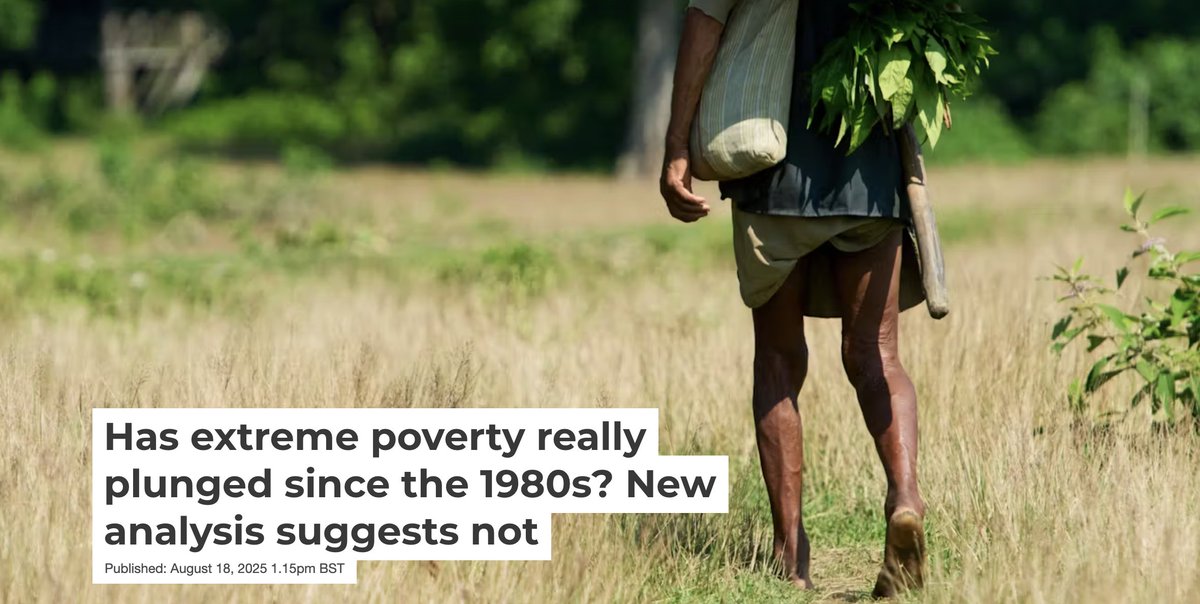
We have this new piece in The Conversation describing recent scholarship on the question of extreme poverty, with Dylan Sullivan and Michalis Moatsos.
A growing body of literature argues that the World Bank’s PPP-based method has a major empirical limitation: it does not account for the cost of meeting basic needs in any given context.
Scholars have recently developed a more accurate method for measuring extreme poverty. This is done by comparing people’s incomes to the prices of essential goods (specifically food, shelter, clothing and fuel) in each country.
This approach is known as the “basic needs poverty line” (BNPL), and it more closely reflects what the original concept of extreme poverty was intended to measure.
The BNPL data indicates that the story of global poverty over the past few decades is more complex – and more troubling – than we previously understood. There are three major findings.
First, progress is slower than we thought. Between 1980 and 2011, global extreme poverty declined by only six percentage points, from 23% to 17%. During the same period, the number of people in extreme poverty actually increased, from 1.01 billion to 1.20 billion.
Second, poverty alleviation has not been steady. In the 1990s the poverty rate increased dramatically, during the period when neoliberal structural adjustment programmes were imposed on many developing countries.
Third, while we don't yet have robust BNPL data after 2011, we know that food insecurity has increased steadily in more recent years, going from 21% in 2014 to 30% in 2022. Given that secure access to food is central to the BNPL method, this suggests that post-2011 poverty trends have probably not improved much.
This bears repeating: despite the massive productivity of the world economy, nearly one-third of the human population does not have secure access to food.
Extreme poverty is a condition of severe humanitarian crisis. It is not a natural condition, and should not exist. It occurs because, in our current economic system, most of our production is organized around what is most profitable to capital, rather than what is most necessary for people.
This suffering can be eliminated very simply by organizing production - our labour and our resources - first and foremost around human needs and well-being, using basic policies like public provisioning and price controls to ensure universal access to essential goods.
Link in reply.
"...a single lawsuit raised by three authors over Anthropic's AI training now threatens to 'financially ruin' the entire AI industry if up to 7 million claimants end up joining the litigation and forcing a settlement."
AI has been stealing from us. They owe us $
Perampasan dan penghancuran ekologis berkedok ecotourism (capitalist green grabbing)
Habitat komodo dihancurkan demi bisnis pariwisata mewah, PT. KWE dikasih izin pengelolaan 55 tahun
2.000 warga desa Komodo cuma kebagian 27 ha, perusahaan dapat 10 kali lebih luas
5 years ago, American and European authors published a paper about the 'gaps' in Neotropical ornithology yet I still hear about cool manuscripts by Latin American authors on Neotropical species being rejected by American and European journals for their 'limited scope'
I wonder, @PennySharpemlc… does this deeply upset you? Land clearing in NSW surged by 40% in 2023 - putting it on par with palm oil deforestation in Indonesia. Koalas can’t survive this. Words do nothing, time for a #KoalaProtectionAct
https://t.co/pqwcBSpDfU