Last week, I celebrated one year as Head of Community for Writers @OpenAI. I lead our efforts to teach writers, professors, and students to use ChatGPT as a writing tool — not to generate prose, but to talk out ideas, break writer’s block, do research, and get feedback on drafts.
@krishnanrohit it’s really true. the question is: to qualify as AGI, does it have to be able to write in a way no one considers slop? on that front we’re still a long way away
If you’re having AI do your brainstorming, “your brainstorming muscles are going to get weaker,” the MS NOW host Chris Hayes tells @cwarzel. They discuss the possible effects of letting AI take over creative and generative thinking:
Watch Galaxy Brain: https://t.co/377oJ9Nw9u
I'm going live on Substack with @jeremycaplan today at 2:30pm Eastern.
How I use AI in my writing process — never as a content generator, always as a thinking partner.
Would love to see you there!
https://t.co/IdsGSCHrFo
@DeryaTR_ remarkable. between this slick interactive site and the video @danshipper generated via Notebook LM of a book he’s reading, we’ve entered the era of one-shotting
My one-sentence trick to transform ChatGPT from a desperate yes-man that drools over your every word into a thinking partner that actually challenges your ideas.
Free workshop this Wednesday 1:00pm Eastern with @Narratively:
https://t.co/ykn2llIMHF
When I was at @OpenAI, I didn't worry much about AI safety. I understood the risks, but since I knew our best people were already on it, I assumed the problem was handled.
@theaidocfilm showed me what I was missing: that the problem isn't bad intentions, it's bad incentives.
https://t.co/BlfXnvDoJR
Credit to @tristanharris and @aza of @HumaneTech_ for laying out the solution so clearly.
Files are all you need!
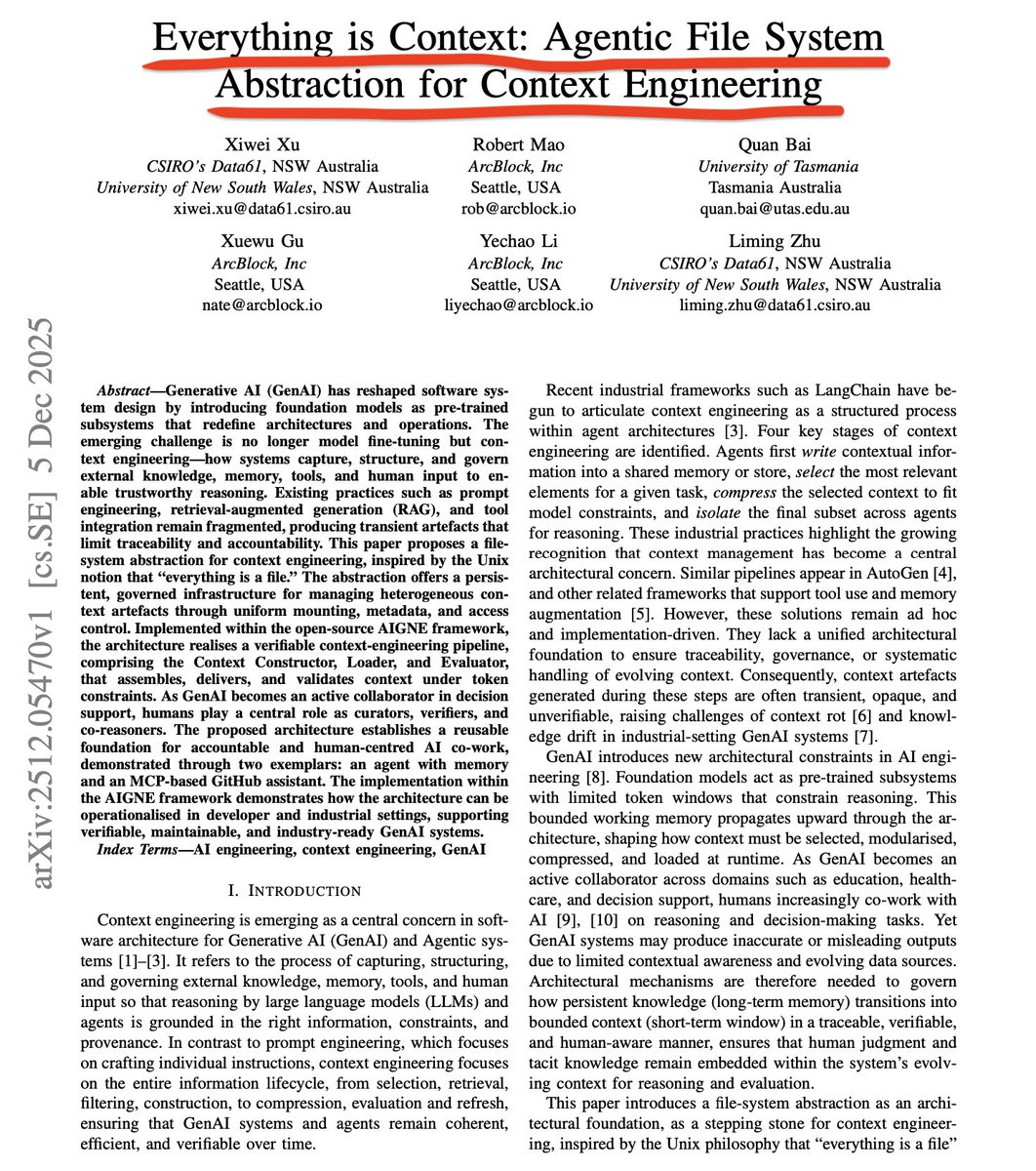
This research paper says the best way to manage AI context is to treat everything like a file system and OpenClaw has already proven it.
But most agent frameworks still haven't figured this out.
Memory is bolted on as an afterthought. Tools live in a separate layer. Everything is fragmented, short-lived, and impossible to audit when things go wrong.
The paper "Everything is Context" borrows a 50-year-old Unix idea to fix this.
Instead of treating memory, tools, and knowledge as separate systems, store all of it as files. Every piece of knowledge gets a path, metadata, and a version history. Every reasoning step is a logged, traceable transaction.
Now if you open your OpenClaw directory.
You'll find SOUL. md, MEMORY. md, AGENTS. md, and HEARTBEAT. md sitting right there as plain Markdown files.
The paper formalizes what OpenClaw is doing into three stages:
↳ The Context Constructor selects what's relevant and compresses it to fit the token window
↳ The Context Updater refreshes context as the conversation evolves
↳ The Context Evaluator writes verified knowledge back to disk
Under the hood, the file system separates raw history, long-term memory, and short-lived scratchpads. The model's prompt only ever loads the slice it actually needs right now.
And every access and transformation is logged with timestamps, so you always have a trail showing how information, tools, and human feedback shaped a given answer.
That's the payoff.
When your agent forgets something or gets something wrong, you can open a file and see exactly what it knew. Nothing disappears silently between sessions. Files fix this by design.
If you are building with agents, this paper is worth reading.
Link to the paper in the next tweet.
This afternoon, in just two short hours, I'll be leading a special session for @OpenAI Academy about teaching writing in the age of AI.
Writing in the Age of AI: A Guide for Faculty
May 22, 4:00pm Eastern
I'd love to see you there! Register here: https://t.co/8acIEqZ1v5
@gregisenberg But do we have reason to think a dying person’s perspective looking back on life is more accurate? Rather than, say, distorted by fear, grief and (often) illness and cognitive decline?
If you want to hear the origin story — how I went from teaching writing at @Yale to leading writing community at @OpenAI — I told the whole story on @cbcradio on @OttawaMorning. 😊
🎙 https://t.co/mitEc6XyBg.
I joined @OpenAI because I wanted to help other writers experience what I already knew firsthand:
That when used thoughtfully, AI can support writers — not by doing the writing for us, but by serving as a practical creative tool.
The best part has been connecting with so many brilliant writers, educators, and @OpenAI colleagues to explore how AI can extend and amplify human creativity, not replace it.